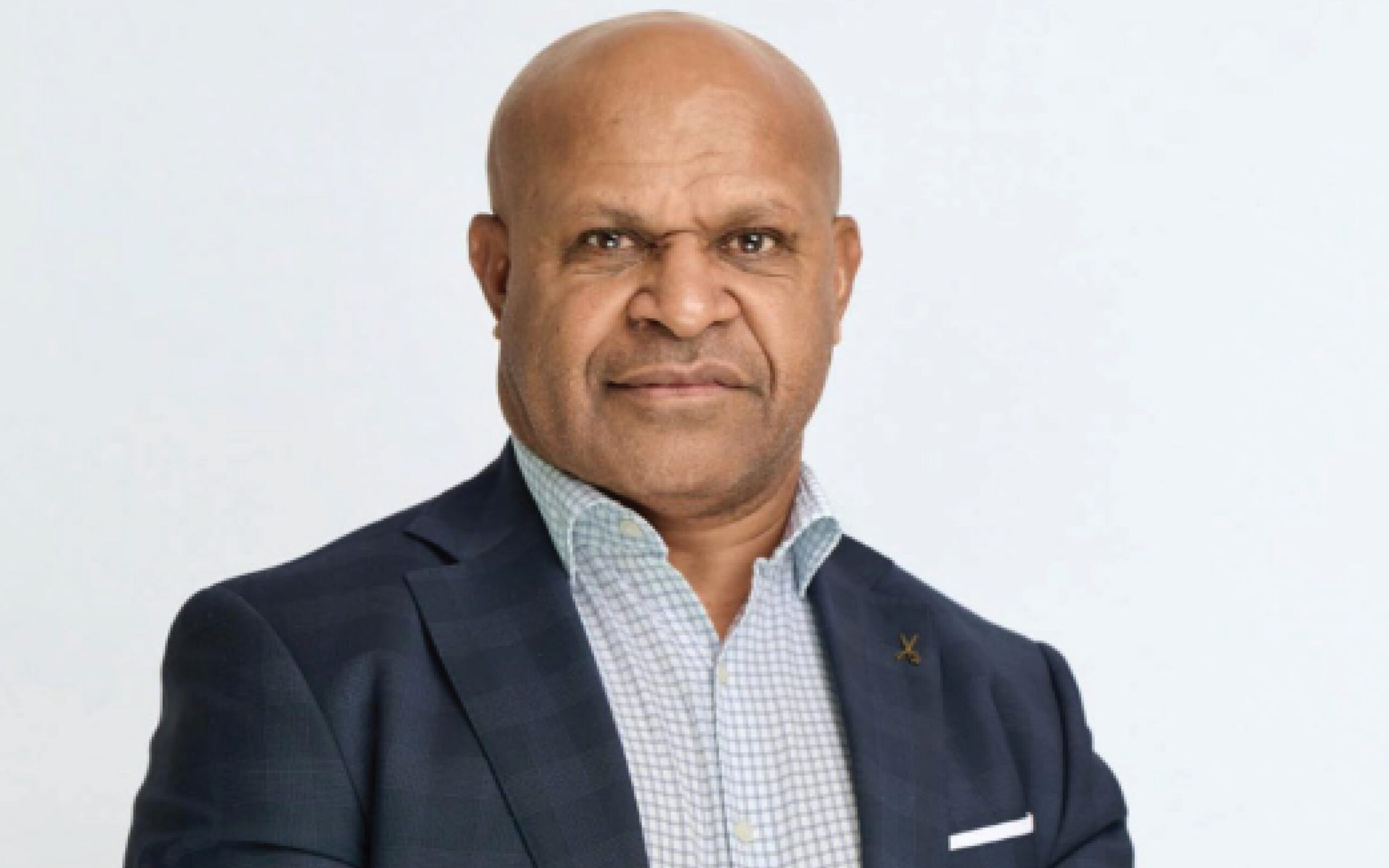
Kedi Ilimbit joined Ok Tedi in 1995 as a graduate mechanical engineer, when BHP held the majority stake and the ultimate decisions were made in Melbourne. He runs the company now. Ok Tedi Mining Limited is 67% owned by the Independent State of Papua New Guinea and 33% by the people of Western Province, an arrangement in place since 2012, a decade after BHP exited in 2002, according to the company, and it reported unaudited revenue of K9.3 billion for 2025
A Papua New Guinean engineer trained at Unitech, running a nine-billion-kina company with no head office offshore, is a rare arrangement in Pacific resources, where operating control and national ownership seldom sit with the same people.
Eleven years away
Ilimbit entered Ok Tedi through the Graduate Development Scheme in 1995, spending his first year in Purchasing and Warehouse before moving to Mine Maintenance in his second, according to his professional listing. He spent nine years there in total. Ok Tedi’s own appointment release records that he worked for the company from 1995 to 2004, left for Australian operations including Blackwater, Peak Downs, Saraji, Prominent Hill, Cannington and Koolyanobbing in senior and managerial roles, and returned in 2015.
The Australian decade is the part most accounts of his career omit, and it covers the Bowen Basin coal mines and the Western Australian iron ore fields, operations with no particular reason to be patient with a young manager. He came back to Ok Tedi in 2015 with maintenance and processing experience earned somewhere that did not owe him anything.
After rejoining he moved through Manager Mine Maintenance, General Manager Processing, General Manager Asset Management, General Manager Community and Operations Support, and Deputy CEO, per Ok Tedi’s leadership page, which also records a mechanical engineering degree from the PNG University of Technology, a Diploma in Management and a Graduate Diploma in Maintenance Management from Central Queensland University. The company credits him with over 25 years across coal, iron ore, zinc, lead, silver and copper
The international search
The board appointed him Managing Director and Chief Executive Officer effective 17 April 2023, following an international search campaign and an assessment of candidates, according to then-chairman Jeffrey Innes.
Ok Tedi went to the global market for a chief executive and returned with the Papua New Guinean who had been running its plant. For a state-owned company, the process matters as much as the outcome. A national employer appointing a national leader without an open search invites the suggestion that the job was reserved; an open search that lands in the same place removes the argument.
Where the money lands
Every kina Ok Tedi distributes reaches a PNG government entity or a Western Province trust, with no offshore parent taking a margin on the way. The 2025 distribution, according to figures published by the International Copper Association Australia, ran to K1.09 billion in taxes, K178 million in royalties, K99 million in compensation, K37 million invested in training and K766 million delivered through the Tax Credit Scheme for roads, schools and health facilities, alongside dividends of about K1 billion.
Against 2024 the movement is steep. That year brought K346 million in taxes, K106 million in royalties, K285 million through the Tax Credit Scheme and K450 million in dividends. Taxes tripled, dividends more than doubled, and the Tax Credit Scheme, which funds infrastructure directly rather than routing money through Waigani, rose 169%.
The production behind those payments moved far less. Ok Tedi produced 106,018 tonnes of copper, 298,350 ounces of gold and 1,008,346 ounces of silver in 2025, PNG Mining reported, against 103,246 tonnes of copper, 265,830 ounces of gold and 993,274 ounces of silver in 2024. Volumes rose about 3% while revenue rose 63%, which puts the copper price rather than the pit at the centre of the result.
Ilimbit used the year to clean the balance sheet. Ok Tedi cut debt from K709 million at the end of 2023 to K370 million, including early repayments, the company reported, and held US$221 million in cash at bank at the half-year mark. The result, he told PNG Mining, “reinforces the value of operating a 100 per cent PNG-owned mining company for the benefit of our people.”
The Misima purchase
In May 2025 Ok Tedi agreed to acquire the Misima Gold and Silver Project from ASX-listed Kingston Resources for A$60 million, with contingent payments of up to A$35 million, covering a resource of 3.8 million ounces of gold and 22.1 million ounces of silver, located 625km east of Port Moresby in Milne Bay. The National reported that the purchase was funded from existing cash flows.
Capital in Pacific mining usually travels the other way. Here a Papua New Guinean state-owned company paid an Australian listed company for a Papua New Guinean orebody, one that produced 3.7 million ounces of gold under Placer Dome between 1989 and 2004 before closing. Chairman Mark Stone described the transaction as “a significant step for Ok Tedi” as the company moves toward operating more than one mine.
The deal completed on 11 July 2025. The first machinery and equipment landed on Misima Island on 23 February 2026, according to Ok Tedi. At A$60 million against K9.3 billion of revenue, the company was never exposed to the outcome, which is its own signal about where Ok Tedi now sits financially.
Ok Tedi Power
Ok Tedi signed a memorandum of agreement with the National Energy Authority in October 2025 covering rural electrification through decentralised renewable energy in the short to medium term and hydropower in the long term, aligned with PNG’s national targets of 70% electricity access by 2030 and 100% by 2050. Work already running in Western Province includes grid extensions at Kiunga and along the highway corridor, plus stand-alone solar systems for priority Community Mine Continuation Agreement villages, The PNG Sun reported.
“Lighting Up the West starts at home. Western Province is our host,” Ilimbit told EMTV, after feasibility work extended into West Sepik and East Sepik.
There is engineering logic beneath the community framing. Hydro plants at Ok Menga and Yuk Creek already supply an average 75% of the mine’s power, so the company generating capability, the transmission experience and the decades of demand ahead of it. Mining companies elsewhere fund schools and clinics. Ok Tedi is building a power utility.
From 2028 to 2084
The mine’s horizon has moved twice under Ilimbit. The board approved an extension from 2033 to 2050 in September 2023, with expected dividend payments above K30 billion over 27 years, The National reported at the time. In January 2026 Prime Minister James Marape confirmed a further 50 years, taking the mine to 2084, and credited Ilimbit for the technical and operational work behind it, according to Papua New Guinea Today.
Marape described where the process started in his own words: “I was advised that Ok Tedi was expected to close in 2028.”
A company six years from closure became a company with a 58-year plan, which changes the nature of the job rather than the seniority of it. Infrastructure decisions, workforce pipelines and community agreements all now have to hold for longer than most of the people making them will work.
Two conditions arrived with the announcement. Marape said landowners of Western Province would hold a 40% equity stake, with talks continuing on long-term social licensing, and that 7% of revenue from Ok Tedi and all major resource projects would be channelled into a sovereign wealth fund structure initially domiciled at the Bank of PNG. Western Province currently holds 33%, so moving to 40% rewrites the ownership table Ilimbit reports into, and neither the mechanism nor the timing has been made public.
The Fly
Concentrate travels by pipeline to Kiunga, then by barge to Port Moresby, then by ocean vessel to smelters in Germany, India, Japan, Korea and the Philippines. Fuel, consumables and equipment travel the same route in reverse. One river carries the entire operation in both directions.
Ok Tedi said on 7 August 2026 that it is monitoring El Niño impacts on the Fly, that river levels are low, that parts of the river are not being used for normal freight movements, and that it is sourcing alternative logistics to keep supplies reaching site. The statement acknowledged increased costs in logistics and supply chain management. Two months earlier the company had reported no disruption at all, with Ilimbit saying that “alternate routes are currently being reviewed for exporting of copper concentrate,” according to NBC PNG.
The mine and mill run 24 hours a day, 365 days a year, processing over 60,000 tonnes of ore daily. An operation with no scheduled stop and a single transport artery carries a concentrated risk, and El Niño recurs in this geography rather than arriving once.
No parent company
Ilimbit has no group head office to escalate to, which is both the argument for him and his exposure. A foreign operator facing a bad year in PNG can write down the asset and move capital to another jurisdiction. Ok Tedi has no other jurisdiction. One hundred per cent of the benefits from its operations go to the people of Western Province and the State, and the same proportion of any shortfall goes there too.
He joined the company under BHP, watched it pass into national hands, and now runs it with 58 years on the plan, a second mine under development, a power business forming inside it, an equity renegotiation that has not been costed publicly, and a river running low in August. Jeffrey Innes said in 2023 that the company had tripled its value over the preceding six years. Holding that through a copper price that stops cooperating is the test Ilimbit has not yet faced.