
Port Moresby’s newest tech showroom does not look like a company that started by selling typewriters. Remington Hi-Tek, the Remington Group’s flagship retail store, opened its doors in the capital in November 2025, stocked with smartphones, laptops, televisions and smart gadgets from global brands, according to the company’s own launch announcement.
A Lae showroom and an online store are next on the roadmap. It is, in the words of the man who runs the company behind it, “not just a shop, it’s a long-term commitment to PNG’s digital future.”
That man is Justin Kieseker, and the company is 78 years old.
Remington Group has been part of Papua New Guinea’s commercial life since 1948, when it opened its doors in Port Moresby as a supplier of typewriters and office equipment, according to the company’s own history published through Exepreneur. It has outlasted colonial administration, independence, multiple currency and banking reforms, and three generations of office technology.
Now, under a CEO who has been with the company for six years and in the corner office for barely more than a year, Remington is trying to prove that a business built on hardware nobody uses anymore can still set the pace for how Papua New Guinea buys and services technology.

From Colonial Storefront to National Institution
Remington’s founding predates Papua New Guinea’s own nationhood by nearly three decades.
“Back then, Remington was introducing modern office technology to a young nation finding its feet,”
Kieseker has said of the company’s earliest years, describing typewriters and office equipment as vital tools for government agencies, schools and local businesses at a time when the country’s formal business infrastructure was still being built.
The company tracked every major shift in office technology that followed. It moved from typewriters to photocopiers, to fax machines, to the first computer systems, according to Kieseker’s own account of the transition. Each shift required the company to rebuild not just its product catalogue but its service model, since selling a photocopier in Port Moresby in the 1970s meant nothing if there was no one who could repair it in Goroka or Wewak.
Ownership changed too. Remington grew beyond its foreign ownership to become a fully Papua New Guinean-owned enterprise, a shift Kieseker has called a turning point.
“Becoming PNG-owned was about commitment to our people and country,” he said.
That transition also reframed what the company sold. It stopped being a products business and became a services business, offering installation, servicing and support alongside every machine, anticipating a demand for end-to-end technology support that would only grow more important as PNG’s economy modernized.
Five Brands, One Group
Today Remington Group operates as a holding structure over five distinct business lines, each built around a specific technology niche.
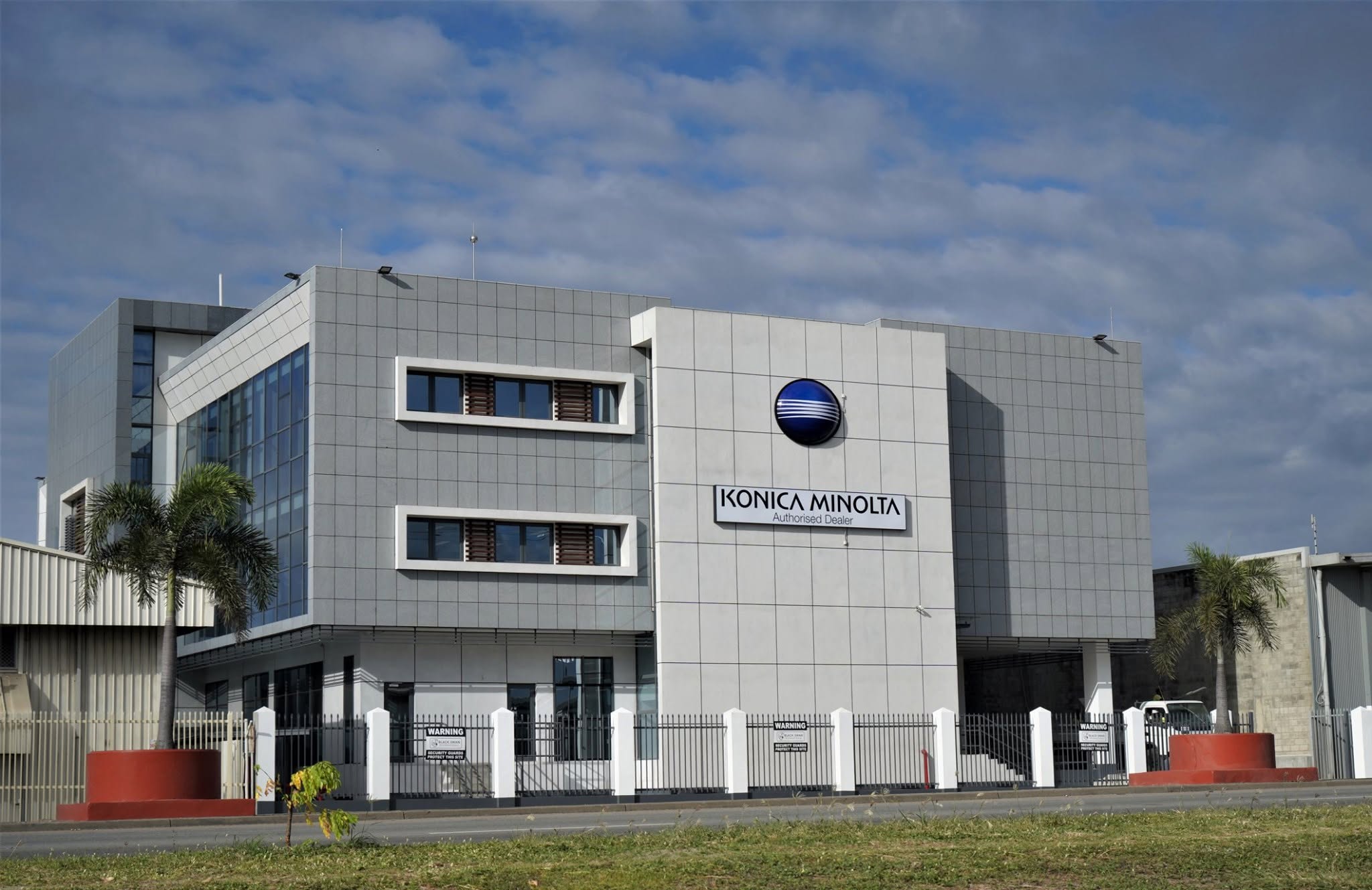
Remington Technology is the country’s only authorised Konica Minolta dealer, a partnership the company describes as spanning 30 years. BizPrint handles commercial and corporate printing, merchandising and branding work. FX Business Centre is PNG’s sole authorised Fujifilm dealer, a relationship that industry contacts at Fujifilm Australia have described as running more than a decade. OF Communications provides unified communications and internet services under the MaxiNet brand. Remington Hi-Tek, the newest of the five, is the consumer retail and online technology arm launched in November 2025.
That structure lets the Group chase a wider range of customers than any single brand could.
“Our diversity allows us to meet a range of customer needs, from printing and communications to cutting-edge ICT solutions, under one roof,” Kieseker has said.
It also means the Group’s fortunes are not tied to any single technology cycle. If office printing volumes decline as PNG businesses digitize, Remington still has a foothold in consumer retail, industrial printing and telecommunications infrastructure.
OF Communications occupies a different position in the portfolio from the other four brands. Where Remington Technology, BizPrint and FX Business Centre sell and service physical equipment, OFC sells connectivity itself, positioning the Group as a provider of unified communications and internet services under its MaxiNet brand rather than purely a hardware and print vendor. That distinction matters strategically. It means Remington is not solely dependent on partnerships with equipment manufacturers such as Konica Minolta, Fujifilm and Mimaki, each of which the Group could in theory lose to a rival dealer, and has a recurring-revenue services line running alongside its equipment sales business.
The Group has continued adding to that portfolio through 2026. In April, Remington Technology was appointed the first locally based dealer for Mimaki, a global leader in wide-format printing, ending a reliance on Mimaki’s Australian dealer network that had previously meant longer wait times for service and repairs in PNG.
“We’ve seen what this technology can do overseas, there’s no reason PNG businesses should be left behind,” Kieseker said of the deal.
“This partnership is about closing that gap and backing our customers properly.” Kohei Kobayashi, Mimaki Australia’s managing director, said the partnership would let PNG businesses “access global-standard technology and unlock new growth opportunities.”
The first units were expected to arrive in May 2026, with Remington’s technical teams undergoing specialised training ahead of the rollout.
Two months earlier, in January 2026, Remington Technology confirmed a platinum sponsorship of the 2026 AI Summit, a sign the Group is positioning itself not just as a hardware and service vendor but as a visible presence in PNG’s emerging conversation about artificial intelligence and digital infrastructure. That sponsorship sits at the intersection of the Group’s two identities. It is, on one level, standard brand-building of the kind any established PNG company might do to associate itself with a forward-looking policy conversation.
On another, it puts Remington’s name in front of the government officials, telecom executives and investors who will shape whatever regulatory framework eventually governs AI adoption in a country that, as of early 2026, had no specific AI legislation on its books, according to Digital Watch Observatory’s country assessment. A company that sells the hardware layer underneath any future AI rollout in PNG, from servers to end-user devices, has an obvious commercial interest in being at that table early.
A Leadership Transition, Told Plainly
Kieseker’s path to the CEO’s office was not sudden. He joined Remington Technology as general manager, a role in which he managed operations across eight branches in Papua New Guinea and, over six years, built market presence that earned the Group a Dealer of the Year award in Australia, according to the company’s own announcement of his subsequent promotion.

In November 2024, he was named Chief Operating Officer, taking charge of the Group’s entire Printer Division, spanning both Remington Technology and FX Business Centre. At the time, Navin Raju held the Group’s chief executive role and praised Kieseker’s promotion as “a testament to our commitment to enhancing our sales and after-sales service for our customers.”
By June 2025, Kieseker had been named Group CEO, a step the company’s board chairman, John Beattie, framed as a natural progression rather than a gamble.
“Justin has earned this,” Beattie said. “He’s proven himself repeatedly, he listens, he leads, and he follows through. That’s what we need.”
Kieseker brought more than three decades of business development experience across Australia and Papua New Guinea into the role, according to the company’s own biography of him. His own framing of the appointment leaned on continuity rather than reinvention.
“This business is built on good people doing good work,” he said when the appointment was announced. “What’s kept Remington strong all these years isn’t just our products, it’s our people, our customers, and our drive to keep showing up and delivering.”
The Kieseker Playbook
Kieseker has been explicit about where he intends to spend his first year in the role. He named three priorities on taking the CEO seat: aligning operations across the Group’s various business lines, building a stronger internal team culture, and investing in smart, sustainable growth, with a particular focus on ICT and digital infrastructure. Central to that third priority is scaling up Remington Digital Solutions, alongside targeted investment in systems and services built for PNG’s digital future.
The Hi-Tek launch, four months into his tenure, was the clearest early evidence of that strategy in motion.
“Technology shouldn’t be something Papua New Guineans need to chase overseas,” Kieseker said at the launch. “With Remington Hi-Tek, we’re bringing global-standard tech retail to PNG, right here, backed by local support, service, and stock.”
The showroom’s positioning target is broad: offices, schools, small and medium enterprises, and households nationwide, all markets Kieseker has described as under-served by reliable local access to genuine, warrantied technology products.
He has also been candid that the retail push is a response to a specific customer complaint rather than a purely opportunistic expansion.
“We’ve listened to our customers,” he said. “People want real tech, fair prices, and someone they can call when things go wrong. Remington Hi-Tek delivers exactly that.”
That framing, service and after-sales support as the actual product, threads through nearly every public statement Kieseker has made since taking the role, whether discussing printers, wide-format signage equipment, or smartphones.
A National Footprint Built for a Fragmented Country
Papua New Guinea’s geography is the operating constraint that shapes almost every decision Remington makes. Kieseker has pointed to that directly.
“What works in Port Moresby might not fit Lae, Mount Hagen, or remote regions,” he has said, describing the logic behind the Group’s regional service centre network.
The company has previously described operating service and support teams across Lae, Goroka, Mount Hagen, Madang, Wewak, Kokopo, Kimbe and Kavieng, a footprint intended to ensure installation, maintenance and technical support are available outside the capital, not just within it.
Remington Technology’s own current branch listing names seven of those locations, Goroka, Hagen, Kimbe, Kokopo, Lae, Madang and Wewak, without Kavieng; Exepreneur has not been able to confirm whether that reflects a change in the network or simply an updated summary.
That regional density is a genuine structural advantage in a market where global brands typically operate through a single Australian-based distributor with limited local presence, the exact gap Remington’s own executives pointed to when explaining why the Mimaki partnership mattered.
A wide-format printer with a six-week wait for a spare part from Brisbane is a liability for a PNG business in a way it would not be for a comparable business in Sydney or Auckland. Remington’s pitch, repeated across its Konica Minolta, Fujifilm and now Mimaki partnerships, is that it can close that gap because it already has technicians, spare parts logistics and service contracts running in eight PNG towns.
The Market Remington Is Betting On
Remington’s pivot toward consumer retail and digital infrastructure is a bet on a market that is still, by regional standards, in its early stages. Papua New Guinea had 2.60 million internet users at the end of 2025, an online penetration rate of 24.1 percent of the total population, according to DataReportal’s Digital 2026 report on the country, produced with Kepios.
Mobile connections were considerably more widespread, with 5.21 million active cellular connections in late 2025, equivalent to 48.2 percent of the population, though DataReportal notes that a portion of those connections cover voice and SMS only, without data access. Social media use sat lower still, at 1.50 million active user identities, or 13.9 percent of the population, as of October 2025.
Those numbers describe a market with more headroom than saturation, which is the opening Remington Hi-Tek is built to exploit. A country where three in four people are not yet online is also a country where the retail channel for getting people online, and keeping their devices running once they are, has not been claimed by any single incumbent.
Digicel PNG, Bmobile and Telikom PNG dominate the connectivity layer itself, and the Papua New Guinea telecom market was valued at 1.35 billion US dollars in 2026, forecast to grow to 1.66 billion US dollars by 2031, according to Mordor Intelligence. Government infrastructure spending is reinforcing that growth from below: P
NG DataCo has budgeted 592 million kina over three years for digital infrastructure, including 500 new mobile towers by 2026 and a second phase of the Kumul Submarine Cable Network, according to reporting in Business Advantage PNG.
None of that infrastructure spend or connectivity growth directly benefits Remington’s printing and document divisions, which serve a different, more mature customer base of government agencies, schools and established businesses. But it benefits Remington Hi-Tek and Remington Digital Solutions directly, since every new mobile tower and every kilometre of subsea cable expands the pool of PNG consumers who will eventually need a laptop, a smartphone, or IT support bought from somewhere.
Kieseker’s bet is that when those customers are ready to buy, they buy from a company that already has a service technician in their province, rather than from an overseas retailer with no local presence at all.
Sizing the Company
Precise financial figures for Remington Group are not publicly disclosed, and Exepreneur has not verified any revenue or profit figures for the company through this reporting. What can be said with more confidence is its scale of operation.
Third-party employment data aggregator SignalHire estimates the Group’s workforce at between 200 and 500 people, a range wide enough that it should be treated as indicative rather than precise; the same source lists 71 employees with detailed profiles in its own database, a smaller and more specific figure that appears to reflect only a partial count.
Readers should treat both numbers as estimates from a data aggregator, not confirmed company disclosures. Remington’s own public materials describe the business as one of Papua New Guinea’s longest-standing and most respected companies, a claim echoed independently by Business Advantage PNG and by PNG Expo, both of which covered Kieseker’s appointment without disputing the description.
The 50th Jubilee Framing
Kieseker has repeatedly tied Remington’s own history to Papua New Guinea’s broader national story, a framing that gained particular resonance in 2025, the country’s 50th year of independence.
“Our story mirrors that of PNG,” he has said.
“Both have endured economic shifts, political changes, and natural challenges. Resilience is part of our DNA.”
The company has pointed to its investment in local talent, training Papua New Guineans and promoting them into leadership roles, as evidence of that resilience translating into substance rather than sentiment.
That framing extends to how Remington describes its role beyond commerce. The Group partners with government agencies, schools, nonprofits and private enterprises to deliver technology solutions supporting education, public services and enterprise growth, according to Kieseker’s own description of the company’s community work.
“We’re more than a supplier, we’re a partner in PNG’s progress,” he has said.
Whether that positioning translates into measurable social outcomes is not something this article can independently verify. It is, at minimum, a consistent public message the company has maintained across multiple separate announcements over more than a year, from the CEO appointment coverage through the Hi-Tek launch to the Mimaki partnership.
What’s Next?
The near-term calendar is concrete. The first Mimaki wide-format printing units were due to arrive in PNG in May 2026, backed by a Remington technical team completing specialised training ahead of the rollout. Remington Hi-Tek’s Lae showroom remains on the expansion roadmap, alongside an online ecommerce platform that the company has said will follow the Port Moresby flagship store, though no confirmed launch date for either has been published. Remington Technology’s platinum sponsorship of the 2026 AI Summit puts the Group’s name directly in front of PNG’s technology policy and innovation community at a moment when artificial intelligence adoption is becoming a live topic in the country’s business press.
Longer term, Kieseker’s stated ambition is less about any single product line than about what the Group represents in PNG’s economy.
“Remington has been part of PNG’s story for over 75 years,” he has said. “Now, my goal is to honour that legacy and drive the Group into a new era of digital leadership, inclusive growth, and sustainability.”
He has framed the company’s role as extending beyond its own balance sheet, describing Remington as a business that can help drive digital transformation across sectors, empowering local businesses, government and communities toward what he has called prosperous futures.
Whether Remington converts that ambition into measurable market share gains against global competitors now eyeing the PNG market directly, rather than through third-country distributors, is the open question hanging over Kieseker’s early tenure. The Hi-Tek showroom, the Mimaki dealership and the AI Summit sponsorship are each individually modest moves. Together, they describe a company trying to reposition itself from a legacy office equipment supplier into PNG’s default local layer for global technology brands entering the market.
“Our history is a foundation,” Kieseker has said.
“The future will be about embracing innovation while staying true to the people and places that have made us who we are.”
For a company that has now outlasted three generations of the technology it sells, that is less a slogan than a operating requirement.