

Westpac’s Impairment Charge Doubles to A$864 Million, Wiping Out Its Profit Growth
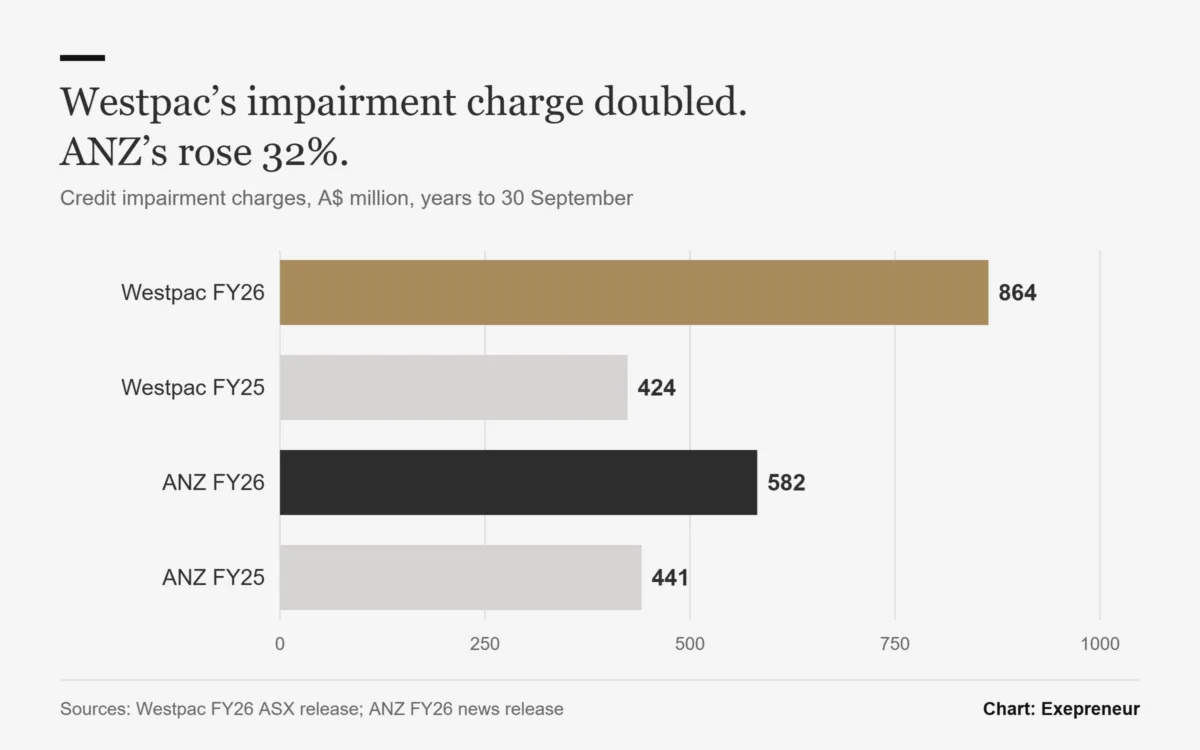
Westpac's impairment charges rose 104% to A$864 million in FY26, outweighing a 4% rise in pre-provision profit and leaving net profit at A$6.8 billion.
Key points
- Westpac’s credit impairment charges rose 104% to A$864 million in the year to September 2026.
- Statutory net profit fell 1% to A$6.8 billion, below the A$6.9 billion analyst average Bloomberg reported.
- Westpac’s CET1 ratio of 12.46% was above ANZ’s 11.99% and NAB’s 11.87%.
Westpac Banking Corp.’s credit impairment charges rose 104% to A$864 million in the year to 30 September 2026, from A$424 million. The figures are from the bank’s full-year results release on 2 November. The A$440 million increase was larger than the A$379 million rise in pre-provision profit.
Statutory net profit fell 1% to A$6.8 billion. Net profit excluding notable items was A$6.99 billion, compared with A$6.97 billion a year earlier, a result Westpac described as flat.
The statutory figure fell short of the A$6.9 billion average analyst estimate, Bloomberg reported on 1 November.
Where the profit went at Westpac
Pre-provision profit excluding notable items rose 4% to A$10.93 billion from A$10.55 billion, according to the release. Net operating income rose 1% to A$22.71 billion, and operating expenses fell 1% to A$11.78 billion.
The A$440 million rise in impairment charges was larger than that gain. Profit before income tax excluding notable items, as Westpac reported it, fell to A$10.06 billion from A$10.12 billion, a decline of A$61 million.
By Exepreneur’s calculation, impairment charges consumed 7.9% of pre-provision profit in 2026, compared with 4.0% in 2025.
Westpac said it applied management judgement through new overlays for energy-intensive sectors and discretionary spending, citing economic and geopolitical uncertainty. Credit impairment provisions rose to A$5.2 billion over the year. Collectively assessed provisions rose to 127 basis points of credit risk-weighted assets, from 125.
Reported stress fell over the same period. Stressed exposures as a share of total committed exposures dropped to 1.17% from 1.28%, according to the release.
The release did not state the dollar amount of the new overlays.
Lending outpaced income
Loans grew 5% to A$901.3 billion and customer deposits rose 6% to A$766.2 billion, according to the release. Net interest income rose 1% to A$19.69 billion.
Westpac reported that its net interest margin excluding notable items fell 7 basis points to 1.87%. The second-half margin was 1.86%, down 3 basis points from 1.89% in the first half. The core margin fell to 1.76% from 1.81%.
Analysts on the results call focused on a sharp fourth-quarter fall in the core margin, according to a summary of the call published by Investing.com. Management attributed it to deposit mix, liquidity effects and higher qualifying rates on savings products, the summary said.
Westpac said lending growth tilted toward business and institutional customers. Business lending rose 12% and institutional lending rose 18%, which Westpac tied to credit demand in energy, infrastructure and resources.
Australian housing loans, excluding the RAMS portfolio Westpac sold on 1 August, rose 7%, the bank said, or 1.1 times system growth as measured by APRA. The deposit-to-loan ratio rose 59 basis points to 85.5%.
New Zealand the only segment to shrink
Pre-provision profit in Business and Wealth rose 11% to A$3.76 billion, according to the release, the fastest growth of any segment. Westpac’s 2026 annual report says that segment includes its Pacific operations in Fiji and Papua New Guinea; the results release does not break those out.
Institutional rose 8% to A$2.34 billion and Consumer rose 5% to A$3.62 billion.
Westpac reported that pre-provision profit at Westpac New Zealand fell 12% to A$1.30 billion from A$1.47 billion, the only operating segment to decline. Group Businesses swung to a A$84 million loss from a A$95 million profit.
Margin falls as NAB’s rises
National Australia Bank reported on 5 November cash earnings excluding large notable items of A$7.09 billion, flat on 2025. Its statutory net profit fell 9.1% to A$6.14 billion. NAB’s net interest income rose 6.4% and its group net interest margin rose 6 basis points to 1.80%, according to its results summary.
ANZ Group reported on 6 November a cash profit of A$7.59 billion, up 10% excluding 2025 significant items, and statutory profit of A$7.27 billion. Its provision charge rose 32% to A$582 million, according to its news release.
The three banks use different underlying measures. NAB and ANZ report cash earnings; Westpac reports net profit excluding notable items.
Set side by side, the filings show Westpac’s margin fell 7 basis points while NAB’s rose 6. By Exepreneur’s calculation, Westpac’s impairment charge grew at more than three times ANZ’s rate.
ANZ reported a cost-to-income ratio of 49.26%. Westpac’s expense-to-income ratio excluding notable items was 51.88%, an improvement of 116 basis points.
Westpac holds the most capital of the three
Westpac’s Level 2 CET1 ratio was 12.46%, compared with 11.99% at ANZ and 11.87% at NAB, according to each bank’s results. Westpac said that leaves A$2.9 billion above its 11.25% target after paying the final dividend.
The ratio fell 7 basis points over the year. Westpac said profit and the RAMS sale were more than offset by dividends and higher risk-weighted assets.
According to the release, Westpac’s liquidity coverage ratio averaged 137% in the September quarter and the net stable funding ratio was 113%. Westpac raised A$40 billion of new long-term wholesale funding during the year.
Dividend and returns
Westpac declared a fully franked final dividend of 77 cents a share, taking the 2026 total to 154 cents from 153 cents. The payout ratio was 77% of statutory profit and 75% excluding notable items.
NAB paid 170 cents a share for the year, according to its results. ANZ paid 166 cents, with the final dividend franked at 80%.
Westpac reported that its statutory return on equity fell 6 basis points to 9.6%. Return on tangible equity excluding notable items rose 14 basis points to 11.1%.
Chief executive Anthony Miller’s total pay for 2026 rose about 21% to A$7.5 million, Bloomberg reported, citing Westpac’s annual report.
Westpac shares were little changed in early trade on results day at A$36.78, down 0.11%, according to Investing.com.
Guidance for 2027
Miller said in the release that inflation remains above the Reserve Bank’s target range and interest rates are likely to stay elevated into 2027.
For 2027, Westpac guided to cost growth similar to 2026 and more than A$600 million of structural savings, according to the Investing.com call summary. It expects to spend A$850 million to A$950 million on its UNITE technology program and to book no restructuring charge, the summary said. UNITE is expected to cost no more than A$3.5 billion in total and finish by the end of the 2028 financial year, the summary said.
Westpac expects system mortgage growth to slow to 3.8% in 2027, the summary said. Miller described the period ahead as “the tough 18 months for us as a company,” according to the summary.
Westpac’s next result covers the six months to 31 March 2027.