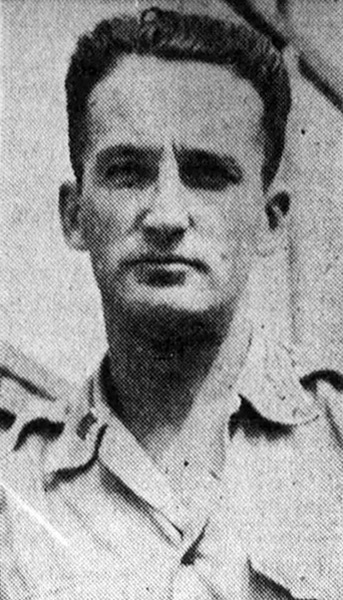
US President Joe Biden claims that his uncle, 2nd Lieutenant Ambrose J Finnegan was eaten by ‘cannibals’ in Papua New Guinea (PNG) during World War 2.
MSNBC reported that Mr. Biden made the statement during a campaign stop in Pittsburgh, making a clear distinction between his family’s military service and Donald Trump’s reported criticisms of military members, as detailed in The Atlantic in 2020.
The statement has sparked debate about the appropriateness of using the word “cannibal” and its potential impact on U.S. reputation in the Pacific region, especially amid efforts to strengthen relationships with Pacific island economies amidst rising Chinese influence in geopolitics.
According to The Telegraph, Mr. Biden stated;“He flew single-engine planes, reconnaissance flights over New Guinea,” Mr. Biden said of his maternal uncle, 2nd Lieutenant Ambrose J Finnegan.
“He had volunteered because someone couldn’t make it. He got shot down in an area where there were a lot of cannibals in New Guinea at the time.
“They never recovered his body. But the government went back, when I went down there, and they checked and found some parts of the plane and the like.
But The Telegraph again revealed that official war records dispute all of Mr.
Biden’s assertions about his uncle’s fate during the flight on May 14, 1944. Lt Finnegan was not flying the plane, nor was it shot down.
Firstly, it’s crucial to note that Mr. Biden’s comment was made in the context of a personal story about his family history. But Mr. Biden is well known for telling exaggerated stories.
He once said his house got burnt down and that he got arrested trying to see Nelson Mandela in jail.
However, the use of the term “cannibal” carries historical and cultural weight, particularly in PNG and other Pacific islands.
Historically, Western explorers and colonizers often depicted indigenous peoples as “savages” or “cannibals,” perpetuating harmful stereotypes and contributing to the marginalization of these communities.
The Pacific island economies have diverse cultural backgrounds and histories, and they value respect and sensitivity in diplomatic interactions.
The use of a term like “cannibal” by a U.S. President, even in a personal anecdote, can be perceived as culturally insensitive and may undermine efforts to build trust and positive relations.
Moreover, the timing of such statements is critical. As the US seeks to strengthen its engagement with Pacific island nations in the face of increasing Chinese influence, every word and action is scrutinized.
China has been actively expanding its presence in the region through infrastructure projects, economic partnerships, and diplomatic initiatives. In contrast, the U.S. has been working to reassert its commitment to the Indo-Pacific region, including the Pacific islands, as part of its strategic efforts to maintain a balance of power.
White House press secretary Karine Jean-Pierre danced around questions on about President Joe Biden apparently “embellishing” the story of his uncle’s death and going so far as suggesting that he was eaten by cannibals after being shot down in World War II.
“You saw the president. He was incredibly proud of his uncle’s service in uniform. You saw him at the war memorial. It was incredibly emotional and important to him,”she responded.
“The president highlighted his uncle’s story as he made the case for honoring our sacred commitment to equip those we send to war and to take care of them and their families when they come home, and, as he reiterated, that the last thing American veterans are suckers or losers, and he wanted to make that clear.”
But the damage is been done. And its upsetting a lot of people.
“The Melanesian group of people, who Papua New Guinea is part of, are a very proud people,” said Michael Kabuni, a lecturer in political science at the University of Papua New Guinea as reported by The Guardian and Irish Times.
“And they would find this kind of categorization very offensive. Not because someone says ‘oh there used to be cannibalism in PNG’ – yes, we know that, that’s a fact.
“But taking it out of context, and implying that your [uncle] jumps out of the plane and somehow we think it’s a good meal is unacceptable.”
Jonathan Ritchie, a historian at Australia’s Deakin University, told The Daily Beast.
“You hear it in a number of different ways,” Ritchie said.
“You could go out to a pub in Melbourne and talk about Papua New Guinean people, and people would go: ‘Oh, they’re all cannibals up there.’ That’s bad enough. But when the American president suggests something like that, it’s really upsetting.”
In a statement released, White House spokesman Andrew Bates in an attempt to do damage control said Biden was “proud of his uncle’s service in uniform,” adding that Finnegan “lost his life when the military aircraft he was on crashed in the Pacific after taking off near New Guinea.
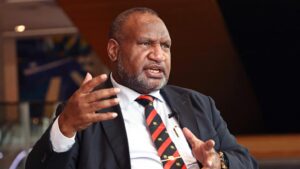
PNG Prime Minister James Marape’s response is blunt and carries a lot of weight in the context of the geopolitical tussle between the US and China in the Pacific.
Prime Minister Marape said in a statement, “President Biden’s remarks may have been a slip of the tongue. However, my country doesn’t deserve to be labeled as such.”
“World War II was not the doing of my people. However, they were needlessly dragged into a conflict that was not of their making,” he continued.
“The remains of World War II lie scattered all over PNG, including the plane that carried President Biden’s uncle, Ambrose Finnegan,” Marape noted.
“Perhaps, given President Biden’s comment and the strong reaction from PNG and other parts of the world, it is time for the USA to find as many remains of World War II in PNG as possible, including those of servicemen who lost their lives like Ambrose Finnegan.”
“The theaters of war in PNG and the Solomon Islands are many and littered with remains of World War II, including human remains, plane wrecks, shipwrecks, tunnels, and bombs. Our people live daily with the fear of being killed by detonated bombs from World War II.”
Several media sources have criticized the US for being all talk and no action in the Pacific, while China steadily expands its influence in the social, economic, and political fabric of Pacific island nations.
This isn’t the first such situation involving a US sitting President, a situation which China takes advantage of with open arms.
In 2018, US President Donald Trump skipped the APEC summit in PNG, sending Vice President Mike Pence in his place.
In 2023, PNG declared a national holiday in honor of Biden’s visit, which would have been the first-ever visit from a sitting US president. However, Biden canceled the trip to deal with domestic issues.
“We are disappointed that this historic visit has been canceled as we have prepared well, spent a lot of time, effort, and energy towards the visit, and we were all looking forward to the visit,” Powes Parkop, the governor of the National Capital District stated.
The US has hosted and participated in high-level meetings with Pacific leaders, signaling a renewed focus on the region. However, commentators view this as merely a power play, with concerns about ulterior motives underlying these engagements.