Under O’Neill the Kina Fell 30%. Under Marape, Debt Doubled to K68.5bn
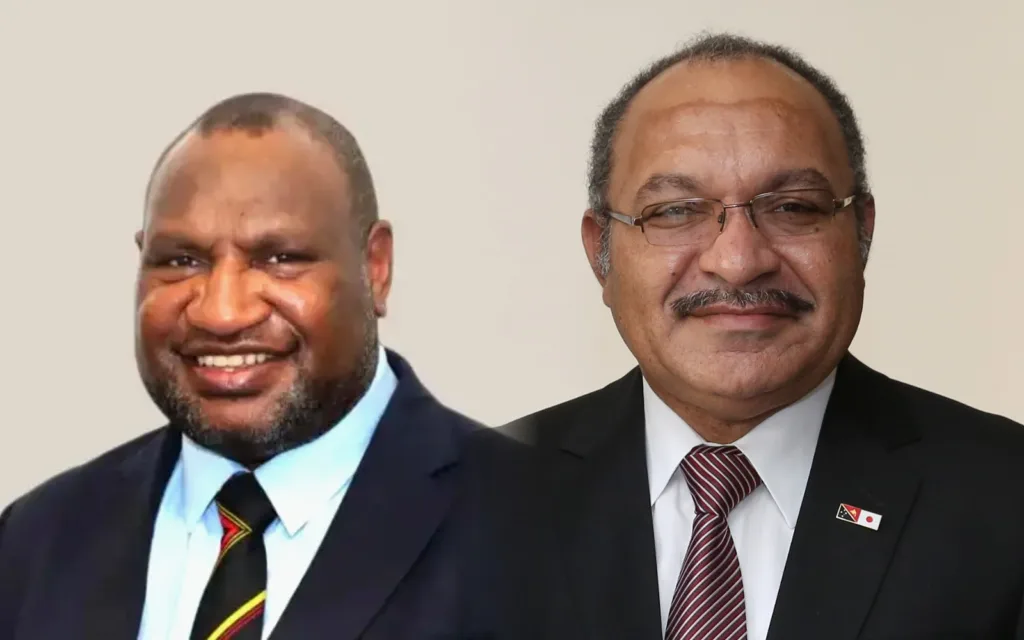
Marape cut PNG's deficit to 2.1% of GDP while debt doubled to K68.5 billion. Under Peter O'Neill the kina fell 30% and formal jobs shrank.
Key points
- Under Marape, Treasury figures show public debt rose from K33.7 billion in 2019 to K68.5 billion in 2025, while the deficit fell from 8.9% of GDP in 2020 to 2.1%.
- On World Bank data the kina lost more value under O’Neill than under Marape, but the foreign-exchange backlog only cleared after 2023.
- The World Bank says about half of Papua New Guineans live on less than US$3.65 a day, roughly where it found them in 2009-10.
Papua New Guinea’s public debt reached K68.5 billion at the end of 2025, according to the Treasury’s Final Budget Outcome released in August. The same series put it at K33.7 billion in 2019, the year James Marape became prime minister.
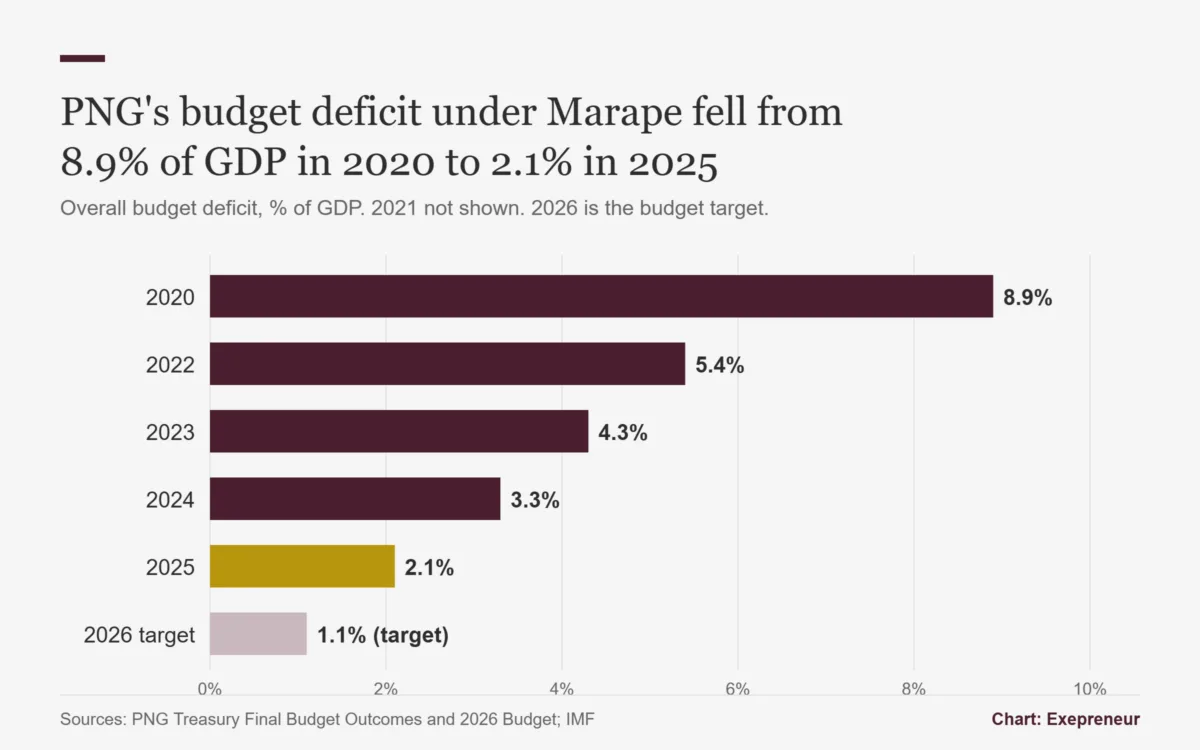
Over those six years the Treasury also recorded the budget deficit falling from 8.9% of GDP in 2020 to 2.1% in 2025. PNG holds its next national election in June 2027.
The record of his predecessor, Peter O’Neill, who governed from August 2011 to May 2019, gives a mixed comparison. World Bank annual averages show the kina lost 30% against the US dollar during O’Neill’s tenure and 18% during Marape’s to 2025. Yet businesses queued for foreign currency for most of the O’Neill years, and the queue largely disappeared only after 2023.
Gas lifted growth but not jobs
O’Neill took office while ExxonMobil was building PNG LNG, a US$19 billion project that shipped its first cargo in May 2014. World Bank data put real growth that year at 13.5%. Growth averaged 5.3% a year between 2012 and 2018, against 2.6% a year from 2020 to 2025 under Marape.
The ANU-UPNG 2019 PNG Economic Survey, led by Stephen Howes, found that Treasury data showed growth outside the resource sector near zero from 2015 to 2017, and the National Statistical Office recorded a non-resource contraction in 2015. In a 2022 Devpolicy analysis, Howes and Dek Joe Sum Mambon wrote that non-resource GDP per capita and formal employment “declined in most years” of O’Neill’s premiership.
The state’s tax take from the project was small. The ANU survey cites the IMF on the project’s generous fiscal terms. Jubilee Australia’s 2018 report Double or Nothing, co-written by former Treasury adviser Paul Flanagan, argued PNG would have been better off without the project on most 2016 welfare measures, a conclusion O’Neill, ExxonMobil and Oil Search rejected.
Budget targets missed under O’Neill
Oil and LNG prices fell sharply from late 2014, and the gap between O’Neill’s budgets and their outcomes widened.
The 2016 supplementary budget promised K928 million in spending cuts. The outturn, as analysed by Flanagan’s PNG Economics blog, showed K262 million delivered. Revenue that had been forecast to rise fell K1.24 billion instead, and the deficit came in at K3.09 billion. Flanagan described the government’s handling as “inexcusably poor”.
The IMF put the 2017 deficit at about 2.5% of GDP, an improvement that did not hold. The ANU survey found spending in 2018 ran K1.4 billion over budget, with wages accounting for three-quarters of the overrun.
On Devpolicy’s series, public debt rose from 19% of GDP in 2012 to 40% in 2019, while interest costs went from 1% to 2.6% of GDP. A Center for Global Development paper published in 2020 records that the Fiscal Responsibility Act’s debt ceiling was breached in 2014 and redrawn in 2017 as a 30% to 35% range.
In September 2018 the government issued its first international bond, US$500 million at 8.375%, maturing in 2028. Moody’s had cut PNG from B1 to B2 in April 2016, and S&P’s rating history shows a cut from B+ to B in April 2018.
The kina slid but stayed overvalued
The Bank of PNG introduced a trading band on 3 June 2014 that raised the kina about 17% overnight, according to a Devpolicy review of the policy. From there it allowed a gradual decline. On World Bank figures the kina moved from 2.37 per US dollar in 2011 to 3.39 in 2019, most of the fall coming between 2014 and 2016.
The IMF’s 2018 Article IV report said foreign-exchange shortages persisted because the exchange rate was overvalued, and estimated that a further real depreciation of 10% to 11% was needed. The ANU survey put the backlog of unfilled currency orders at about K1.7 billion at the end of 2017. A 2019 business survey it cites found 5% of firms could get foreign exchange when they needed it.
Howes, writing in June 2019 as O’Neill stepped down, said he had “missed his 2014/15 window of opportunity”.
O’Neill kept his main social programmes funded through the downturn. Devpolicy reported that the 2015 budget allocated K605 million to Tuition Fee Free schooling, and free primary health care continued. His government also completed PNG LNG and hosted the APEC summit in 2018, for which it bought 40 Maserati sedans. Exepreneur found no official figure for the summit’s total cost. Finance Minister Sir John Pundari told the Post-Courier in October 2021: “We made a terrible mistake.”
The UBS loan
In March 2014 O’Neill’s cabinet borrowed A$1.239 billion from UBS to buy about 10% of Oil Search. Treasurer Don Polye refused to sign the arrangement and was sacked.
Oil Search shares fell, the lenders forced sales, and the state’s last shares were sold by September 2017. O’Neill said at the time that the deal had made around K100 million, according to Loop PNG. Kumul Petroleum recorded a paper loss of A$322 million, and its managing director, Wapu Sonk, told a Commission of Inquiry in 2021 that the loss was about US$432 million.
The Ombudsman Commission’s report, tabled in June 2019, found O’Neill’s conduct “wrong and improper” for committing the state without proper cabinet approval and without going to parliament. The same report found Marape’s conduct as finance minister “wrong and improper” over a separate National Petroleum Company payment deed.
The Commission of Inquiry, chaired by former Chief Justice Sir Salamo Injia, reported in April 2022. Islands Business and PACNEWS quoted its finding that “Mr O’Neill is centrally responsible for the UBS Loan”. It also recommended a 10-year ban on UBS. A commission of inquiry makes findings and recommendations; it is not a court.
Police charged O’Neill on 12 June 2023 with giving false evidence to the inquiry. In April 2024 the Public Prosecutor told the National Court the state would not proceed because the evidence was insufficient, and the case was closed. O’Neill told Islands Business the prosecution had been “a political witch-hunt to discredit and distract me.” When the report came out in 2022 he had said: “I am responsible and have never shied away from my responsibility in this regard.”
Marape restates the debt
Marape resigned as O’Neill’s finance minister in April 2019 over the Papua LNG gas agreement and became prime minister on 30 May. In parliament he has since also cited O’Neill’s borrowing as a reason.
His Treasurer, Ian Ling-Stuckey, presented a supplementary budget that October. It put the 2019 deficit above K3.5 billion, against a forecast of about K2.4 billion, after adding unbudgeted wages and arrears. The Lowy Institute reported that it set debt at K31.9 billion, or 39.8% of GDP, and lifted the legal ceiling to 45%. The Treasury later restated the 2019 figure at K33.7 billion by including three guaranteed domestic loans.
O’Neill rejected the Treasurer’s figures. “This Treasurer is using made-up figures for no other reason than to play politics,” he told The National on 1 October 2019, adding that Marape had been finance minister when the 2019 budget was drawn up. The IMF, the ADB and the ANU had all raised concerns about unrecorded liabilities before O’Neill left office.
Australia lent PNG US$300 million in budget support within months, in place of a proposed China Development Bank loan, the ABC reported. BenarNews puts Australian lending since 2020 at about A$2.6 billion.
Deficit cut from 8.9% to 2.1%
The pandemic and the April 2020 closure of the Porgera gold mine pushed the 2020 deficit to 8.9% of GDP on the Treasury’s latest figures. Devpolicy’s Rohan Fox and Howes called it PNG’s “highest budget deficit ever, but that’s a good thing”, given the circumstances.
Treasury and IMF figures show the ratio at 5.4% in 2022, 4.3% in 2023 and 3.3% in 2024. The 2025 Final Budget Outcome records a deficit of K2.88 billion, which the Treasury puts at 2.1% of GDP and the IMF at 2.4%. On either measure it is the lowest since 2012. The Treasury also reported a primary surplus of K499 million, the first since 2011.
How the 2025 target was met
The same Treasury report shows revenue K2.17 billion below budget in 2025, which it called the largest shortfall in its history. The deficit target held because the Treasury withheld K2.24 billion in spending warrants, money parliament had appropriated but the government did not release.
The World Bank’s October 2026 Macro Poverty Outlook puts revenue at 17.9% of GDP in 2023, 17.5% in 2024 and 17.0% in 2025.
This year has followed a similar course. The Treasury’s mid-year outlook, signed by Ling-Stuckey on 31 August, showed a first-half deficit of K2.41 billion, 150% of the full-year target of K1.61 billion. It said a K2.98 billion adjustment would be needed in the second half and cut forecast 2026 revenue by K937 million.
The supplementary budget on 1 September raised 2026 spending to K32.2 billion, including about K1.1 billion for fuel subsidies, a drought response and K150 million for election preparations. The deficit target was kept on the strength of K1.33 billion in extra revenue forecast from oil and gold prices. Presenting it, Ling-Stuckey said the economy had “more than doubled in size” under Marape, from K79 billion in 2018 to K160 billion, and that “part of this record number, is due to high oil and gold prices.”
Price rises have lifted the denominator as well. Treasury figures show nominal GDP up 63% between 2019 and 2025, from K83.8 billion to K137.0 billion, which pulls every ratio down. By Exepreneur’s calculation from the same data, spending was 19.2% of GDP in O’Neill’s last budget and 19.1% in the 2025 outturn. Marape’s target of a K200 billion economy, now set for 2030 after an earlier 2029 date, is also measured in nominal kina.
Debt doubles to K68.5 billion under Marape
O’Neill and Marape clashed over the debt figure in parliament on 20 March 2023, The National reported. Marape replied that it was “a K39 billion debt you left behind,” some of it “hidden in State-owned enterprises,” and said he had quit as finance minister over O’Neill’s “appetite for unsustainable debt.”
On the Treasury’s revised series, debt rose from 40.2% of GDP in 2019 to a peak of 53.1% in 2021 and stood at 50.0% in 2025. In kina it grew 12.6% a year on average, from K33.7 billion to K68.5 billion, while nominal GDP grew 8.5% a year.
The Treasury estimates that the weaker kina added K4.5 billion to the value of foreign-currency debt between 2023 and 2025, about 13% of the increase under Marape. The legal ceiling was raised to 45% in 2019. A 2020 amendment allowed temporary breaches up to 60%, and the limit stood at 52.5% by 2025.
Most new external borrowing has been concessional. The Treasury’s 2025 accounts show K18.96 billion of external loans on concessional terms and K0.22 billion on commercial terms. The 2018 bond is counted separately and falls due in 2028, and a joint World Bank and IMF debt sustainability analysis lists that repayment as a liquidity risk.
Other Pacific governments borrowed heavily over the same period. In the IMF’s October 2026 World Economic Outlook, PNG’s government debt goes from 38.2% of GDP in 2019 to 51.6% in 2025. Fiji’s rises from 49.5% to 77.1% and Solomon Islands’ from 7.8% to 29.6%, while Vanuatu’s eases to 36.2%.
IMF programme nears its end
The IMF approved a US$918 million Extended Credit Facility and Extended Fund Facility for PNG on 22 March 2023 and added a climate facility on 11 December 2024, taking the package to about US$1.19 billion. All reviews up to June 2026 have been completed, with a waiver in December 2025 for a missed mid-2025 deficit target. IMF staff reached agreement on the final reviews on 6 October 2026, which would release up to US$189 million. Exepreneur had not found Executive Board approval by 9 November, and the programme expires in December.
The programme required Marape’s government to reverse one of its own laws. In December 2021 parliament passed in a single day an amendment that broadened the Bank of PNG’s mandate beyond price stability and shortened the governor’s term, and Governor Loi Bakani left. The IMF made reversal a condition of the 2023 loan, and parliament restored price stability as the bank’s primary objective in September 2024, months after the agreed deadline.
The Lowy Institute’s Alexandre Dayant and Maholopa Laveil called the programme “an unexpected success story” on fiscal and exchange-rate policy in December 2025. In the same analysis they said governance was its weakest area and was deteriorating.
S&P revised its outlook on PNG’s B- rating to positive on 19 June 2026, citing growth prospects, according to the title of its research update. Reuters reported in July that Moody’s had made the same change to its B2 outlook. Neither agency has upgraded PNG during Marape’s tenure.
Currency backlog cleared after 2023
The Bank of PNG accelerated the kina’s decline from 2023 and formalised a crawling arrangement in January 2024 under the IMF programme. World Bank data put the 2025 average at 4.12 per US dollar, and the central bank’s rate on 9 November 2026 was about 4.49.
Business Advantage PNG reported that the backlog of currency orders fell from about K2 billion to about K200 million. The IMF put reserves at about US$4 billion at the end of June, close to five months of imports. The reform came four years into Marape’s term and as a condition of IMF lending, after the IMF had set out the problem in 2018.
Inflation rose with the weaker currency. World Bank data show it at 0.6% in 2024 and 4.4% in 2025, and it reached 5.3% in the June quarter of 2026. The Bank of PNG held its policy rate at 5% in September and raised its 2026 inflation forecast to 5%. Over 2020 to 2025 inflation averaged 3.65%, compared with 5.1% over 2012 to 2019.
Papua LNG still has no investment decision
O’Neill signed the Papua LNG gas agreement with TotalEnergies on 9 April 2019, against bureaucratic advice according to Howes, with a 2% production levy that PNG LNG had not paid. Marape had left cabinet over the agreement, and his government later adopted “Take Back PNG” as shorthand for its resource policy. The Fiscal Stability Agreement it signed in February 2021 kept the 2019 terms.
ExxonMobil took over as operator on 16 October 2026 with a 34.1% stake, and the state and landowner company MRDC hold 22.5%. The US$14 billion project had no final investment decision as of 9 November, seven years and seven months after the agreement was signed. Westpac cites a 15 December target, and the decision has been delayed in 2020, 2024 and 2025.
Marape’s government pursued larger state stakes in mining. It declined to renew Barrick’s Porgera lease in 2020, and the gold mine stayed shut for about three and a half years before reopening on 22 December 2023 with 51% PNG ownership. Barrick reported 79,000 ounces in the first quarter of 2026 and 94,000 in the second on a 100% basis, roughly half the annual rate of the 700,000 ounces it had cited as the mine’s capacity.
Wafi-Golpu has no mining lease after delays under both prime ministers. Ok Tedi, wholly owned by the state, declared a K450 million interim dividend for the first half of 2026, the company said. UNCTAD recorded net foreign direct investment of about minus US$425 million in 2023, and World Bank data show about minus US$198 million in 2024.
Anti-corruption efforts stall
O’Neill created Task Force Sweep, an anti-corruption unit, in 2011. In June 2014, after it obtained a warrant for his arrest, his government moved to disband it, and a court reinstated it. The Supreme Court quashed the warrant as defective in December 2017 without ruling on the allegations behind it.
O’Neill was arrested in May 2020 over the K50 million purchase of two Israeli-made generators. On 14 October 2021 Justice David Cannings acquitted him of abuse of office, finding the state had failed to prove “any abuse of authority had occurred.” He has not been convicted in any of these matters.
Marape’s parliament passed a Whistleblower Act in February 2020 and legislation creating an Independent Commission Against Corruption that November. The commissioners were sworn in in July 2023, and all three were suspended in June 2025 after a dispute among them. RNZ reported the commission had no successful prosecution.
Transparency International scored PNG 28 out of 100 in 2018 and 2019. The score reached 31 in 2021 and 2024 before falling to 26 in the 2025 index, the lowest in the Pacific.
Both prime ministers increased the funds MPs control in their districts. O’Neill raised them to K10 million per district from 2013, and Devpolicy reports Marape doubled them to about K20 million from 2023, so that K2.2 billion to K2.4 billion a year now sits under MPs’ direct control. About 40% of MPs had not acquitted their 2020-22 allocations. Michael Kabuni, writing at Devpolicy after Marape survived a no-confidence vote 75 to 32 in September 2024, found “a clear correlation between the growth of CDFs and the increase in prime ministers’ tenure.”
On 10 January 2024 unexplained deductions from police and public servants’ pay led to strikes and then riots in Port Moresby and Lae, in which at least 22 people died. The Port Moresby Chamber of Commerce estimated business losses at K1.27 billion. Marape told NBC the next day that “someone in [Treasury, Finance and Planning] were not doing their jobs, simply put.”
Formal jobs lag population growth
Formal private-sector employment peaked in June 2013 as LNG construction wound down. Devpolicy’s reading of the Bank of PNG index shows it 12% lower by March 2020. Business Advantage PNG reports that formal employment grew 3.6% between 2015 and 2025, or 1.2% excluding mining, while census figures show the population rising 40% between 2011 and 2024 to 10.19 million.
The World Bank’s June 2026 economic update said formal employment per person had fallen despite growth of 5.6% in 2025, when formal jobs rose 2.4% and the working-age population 2.9%.
Real GDP per person rose 22% under O’Neill on World Bank data, about four-fifths of it during the 2014-16 LNG ramp-up. It has risen 3.6% under Marape, a period that included the pandemic and the Porgera closure.
In May 2025 the World Bank said about half of Papua New Guineans live on less than US$3.65 a day, little changed since the 2009-10 household survey. No household survey has been carried out since.
Scorecard
| Measure | O’Neill, 2011-2019 | Marape, 2019-2025 |
|---|---|---|
| Average real growth | 5.3% (2012-18) | 2.6% (2020-25) |
| Public debt | 19% to 40% of GDP | K33.7bn to K68.5bn; 40.2% to 50.0% of GDP |
| Deficit | 1.6% (2012) to about 6% (2016) | 8.9% (2020) to 2.1% (2025) |
| Kina against US$ | down 30% | down 18% |
| Currency backlog | K1.7bn (end-2017) | about K200m |
| Average inflation | 5.1% | 3.65% |
| Real GDP per person | up 22% | up 3.6% |
| Ratings | one-notch cut at Moody’s and S&P | no upgrade; positive outlooks in 2026 |
What comes next
Measured on the deficit, the currency backlog and the IMF reviews, Marape’s record is stronger than O’Neill’s. His Treasury added guarantees and arrears that earlier figures had not counted, though O’Neill disputes its numbers, and the deficit is down about three-quarters from its 2020 peak. The two hardest reforms, the exchange rate and the central bank law, came late and under IMF conditions, and debt doubled over the period. Revenue has fallen as a share of GDP, formal employment has not kept up with the population, and constituency funds grew under both prime ministers.
The IMF programme ends in December, and any successor will wait until after the election, for which writs are due on 29 April 2027 and polling begins on 26 June. The 2026 Final Budget Outcome, due around August 2027, will show whether the K1.61 billion deficit target was met. The US$500 million bond issued in 2018 at 8.375% matures the following year.