Fiji’s Interest Bill Climbs to F$572 Million as Capital Spending Shrinks
Fiji debt is limiting public works: the 2026-27 Budget sets F$572 million for interest against F$875.7 million for capital spending.
Key points
- Fiji debt is limiting capital spending, Finance Permanent Secretary Shiri Goundar said, with debt servicing above 10% of government expenditure.
- The 2026-27 Budget sets aside F$572 million for interest and F$875.7 million for capital works, as debt heads to 84.8% of GDP by July 2027.
- S&P revised Fiji’s outlook to negative in September, while the government aims to double capital spending.
Fiji’s Finance Ministry says rising debt is now limiting how much the government can spend on roads, bridges and other public works. Interest will cost the government F$572 million in the year to July 2027, according to the 2026-2027 Budget, against F$875.7 million set aside for capital works.
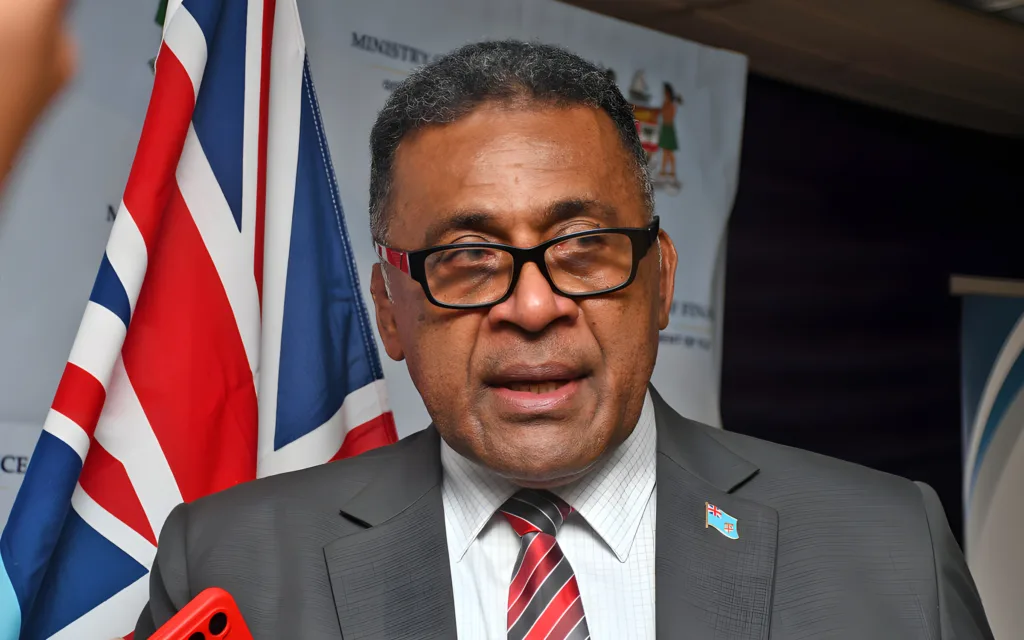
Permanent Secretary for Finance Shiri Goundar said on Wednesday that fiscal pressures are limiting the government’s ability to allocate adequate resources for capital spending, Fiji Village reported. Debt servicing now takes more than 10% of government expenditure, he said, and debt is growing much faster than the economy.
Goundar told the audience at the University of the South Pacific’s Laucala campus that Fiji had entered “uncharted territory,” according to Fiji Village. He was speaking at the launch of the World Bank’s first Fiji Economic Update, titled Creating Fiscal Space to Accelerate Growth.
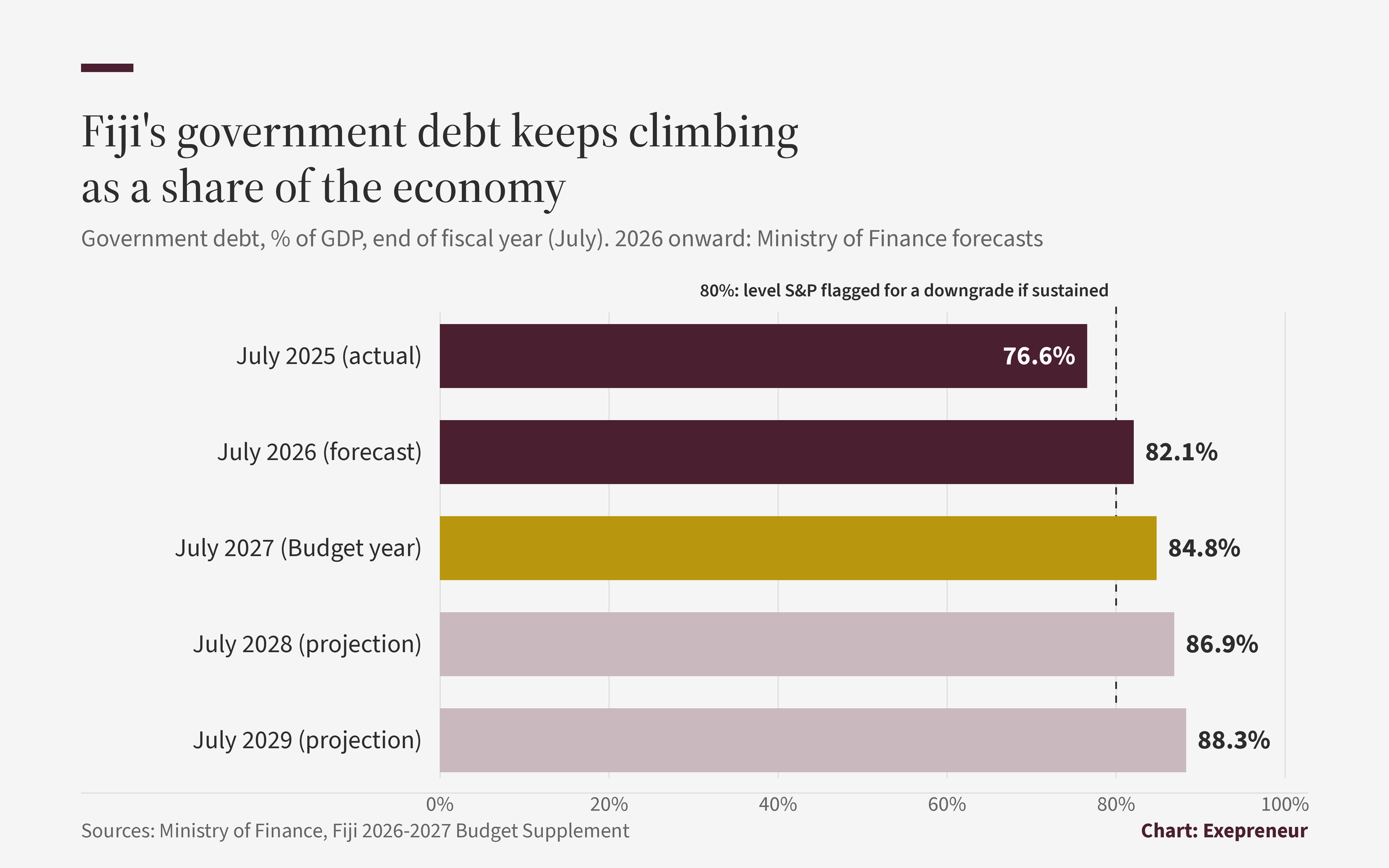
Government debt will reach F$11.54 billion by the end of July 2026, or 82.1% of GDP, the Ministry of Finance forecast in its Budget Supplement. That compares with F$10.76 billion, or 76.6% of GDP, a year earlier.
The ministry expects debt to keep rising, to 84.8% of GDP by July 2027, 86.9% in 2028 and 88.3% in 2029, according to the same document. About a third of the debt, F$4.01 billion, is owed to external creditors. Goundar said more external borrowing raises the country’s exposure to foreign exchange shocks, Fiji Village reported.
Debt fell from about 95% of GDP in 2021 to 76.9% in 2025 and is now projected to rise again, the World Bank said in a statement on Wednesday. In its downside scenario, debt could pass 90% of GDP by 2028. The bank also projected capital spending would fall to 5.6% of GDP in 2026.
The IMF put Fiji’s debt at 78.7% of GDP in 2025, according to the fund’s most recent country reports. That compares with 52.1% for Papua New Guinea in 2024, 29.5% for Solomon Islands and 18.1% for Samoa.
The IMF’s 2025 Article IV report projected debt easing to 76.8% of GDP by 2029. Its 2026 report has debt rising to 82.5% this year and staying above 80% until 2028-2029.
Interest up, investment down
Interest payments rose from F$274.9 million in the 2016-2017 fiscal year to F$521.2 million in 2024-2025, Ministry of Finance budget documents show. The 2026-2027 Budget allocates F$572 million. Finance Minister Esrom Immanuel told Parliament in June the annual interest bill was “almost $600 million.”
As a share of revenue, interest has climbed from about 9% to 10% before the pandemic to 15% in the current budget, based on ministry figures. Revenue for 2026-2027 is forecast at F$3.82 billion. The weighted average interest rate on government debt is 4.7%, according to the Budget Supplement.
Repayments of principal sit on top of interest. Total debt service for 2025-2026 was budgeted at F$1.14 billion, made up of F$534.5 million in interest and F$602 million in principal, according to the government’s answer to a written question in Parliament. That equals about 29% of revenue.
The Asian Development Bank’s April Asian Development Outlook put Fiji’s debt servicing at F$540 million, or 13.7% of revenue, with debt at 77.5% of GDP at the end of the 2024-2025 fiscal year.
Between 2016-2017 and 2018-2019, the government spent between F$1.03 billion and F$1.38 billion a year on investment, about a third of total spending, according to Ministry of Finance outturn figures. That fell to F$1.06 billion, or 24% of spending, in 2024-2025, and to a revised F$792.3 million, or 17%, in 2025-2026.
The current budget’s F$875.7 million equals 5.9% of GDP and 18% of total spending of F$4.87 billion. It is also 13% less than the F$1.01 billion the ministry pencilled in for capital spending in its March medium-term fiscal strategy.
For every dollar Fiji puts into capital works this year, it budgets 65 cents for interest. In 2016-2017, that figure was closer to 27 cents.
Part of the recent drop is accounting rather than a cut. The 2025-2026 Budget moved about F$290 million of spending from the capital to the operating side of the ledger, according to budget documents. Figures after 2025 therefore do not compare directly with earlier years.
The IMF, which counts capital spending differently, reached the same conclusion on direction. In its 2026 Article IV report, the fund said capital’s share of total spending fell from 25% to 18% in the 2025-2026 budget. The average between 2011 and 2019 was 35.6%.
The IMF also noted that April’s fuel relief package was partly paid for with unspent capital funds.
Growth in recurrent spending has “reduced the share of resources available for capital investment,” the ministry wrote in the Budget Supplement, while interest is taking a growing share of the budget.
Money allocated, money not spent
Actual capital spending has also fallen short of budget. It came in 14.7% below budget in 2023-2024, 11.8% below in 2024-2025 and 14.5% below in 2025-2026, Ministry of Finance figures show. The 2025-2026 revised figure of F$792.3 million compares with a budget of F$926.6 million.
Nine months into that year, capital spending was running 36.7% behind the year-to-date forecast, according to the ministry.
The Fiji Roads Authority receives F$369.8 million in 2026-2027, down from F$527.5 million in 2017-2018, according to budget documents. For four bridges whose total cost is about F$400 million, the government has set aside F$41.5 million this year, phasing the work over several budgets.
The Water Authority of Fiji gets F$290.6 million, budget papers show. Its Water Sector Strategy 2050 puts the long-run investment need at F$8.7 billion, and the utility loses about half the water it treats.
Off the books
More than F$5 billion of port, airport and renewable energy projects are planned through state-owned enterprises and government guarantees, according to budget documents. Energy Fiji’s programme of roughly F$2 billion is among them. Government-guaranteed debt stood at F$1.13 billion, or 8.1% of GDP, at the end of April 2026, the Ministry of Finance reported.
S&P Global Ratings affirmed Fiji at B+ on 14 September and revised its outlook to negative. The agency cited a more expansionary 2026-2027 budget than it expected and rising contingent liabilities, including Fiji Sugar Corp’s borrowing from India’s Export-Import Bank. S&P said it could lower the rating if debt stays above 80% of GDP for a prolonged period.
In May, the IMF rated Fiji’s risk of debt distress as moderate. It put total debt service at almost 10% of GDP and gross financing needs at 10.3% of GDP in 2026-2027. The fund put interest costs at about 4.2% of GDP a year.
It recommended a primary surplus of 2% of GDP, which it said would bring debt below 70% by 2032-2033 and create room for more public investment after that.
The government’s case
The government plans to reverse the trend. The 2026-2027 Budget Address set a goal of doubling capital spending and reaching a 70:30 split between operating and capital spending, against roughly 82:18 in the current budget.
Some economists read this year’s numbers as a turn. ANZ economist Kishti Sen told the Fiji Times in July that capital spending would rise 10.5% to F$876 million, alongside a F$2 billion infrastructure pipeline.
That increase is measured against the revised 2025-2026 outturn. Against the original 2025-2026 budget of F$926.6 million, this year’s allocation is 5.5% lower.
The 2026-2027 Budget forecasts a net deficit of F$1.05 billion, or 7% of GDP, and a gross financing need of F$1.48 billion, according to the Budget Supplement. Immanuel said in his Budget Address that Fiji must also refinance F$400 million to F$600 million of maturing debt each year.
Economist Satish Chand of the University of New South Wales assessed Fiji’s borrowing room on the Devpolicy blog in July.
Goundar pointed to the private sector on Wednesday. The government has no other options left but to help businesses take the lead in investment, he said, as reported by Fiji Village.
About 65% of Fiji’s debt is held domestically, according to the Budget Supplement. The Asian Development Bank’s April outlook flagged a related risk for business: publicly funded projects competing with private construction for resources.
Fiji’s next budget, for 2027-2028, is due in mid-2027. By then the ministry’s own forecast has debt at 84.8% of GDP, above the 80% level that S&P said could trigger a downgrade if it persists.