US$14 Billion Papua LNG: Santos and ExxonMobil Have 26 Days to Commit
Papua LNG's laws are certified and Santos says FID is planned this quarter. The 15 December sunset date leaves the partners 26 days to commit US$14 billion.
Key points
- Santos (ASX: STO) said on 22 October it was progressing Papua LNG towards a final investment decision in the fourth quarter; the Government's sunset date for that decision is 15 December.
- Parliament's Papua LNG laws were certified on 6 November, and the PNG Chamber of Resources and Energy says a decision is close to certain.
- The partners have not published a final cost; estimates run from about US$14 billion to US$14.5 billion, and Santos says it will update cost and schedule at FID.
Santos Ltd. (ASX: STO) is “progressing Papua LNG towards planned FID in the fourth quarter,” Managing Director Kevin Gallagher said in the company’s third-quarter report on 22 October. The Papua New Guinea Government’s deadline for that decision is 15 December, 26 days from today.
Prime Minister James Marape set out the date in September. “Fifteenth of December is the sunset clause to the announcement on FID,” he said at Government House on 18 September, according to his office. “Exciting times are coming in the next 10 years in the LNG space,” he added. His office valued Papua LNG at K60 billion and P’nyang LNG at K40 billion.
The project’s other partners are ExxonMobil (NYSE: XOM), now the operator, TotalEnergies (NYSE: TTE), ENEOS Xplora and the state’s Kumul Petroleum Holdings with landowner company MRDC. Together they must commit to a liquefied natural gas project that TotalEnergies costed at about US$14 billion in September.
What has been cleared
The laws Parliament passed for Papua LNG were certified on Friday 6 November. The PNG Chamber of Resources and Energy (PNGCORE) announced the step in a release on 9 November. The National reported on 10 November that PNGCORE president Anthony Smaré called a final investment decision now close to certain.
The partners and the State signed a revised gas agreement on 27 August, amending the 2019 agreement, according to PwC’s PNG Pulse for September. PwC reported that the State kept its share of project revenues. Conditional incentives worth US$1.95 billion (K8.1 billion) apply only if LNG prices fall below an agreed level after 2031/32. The Petroleum Minister described the incentives as temporary, reciprocal and capped, PwC said.
Marape’s office said in September that the revised arrangements offer the State an extra 2.5% of equity, taking potential PNG participation to 25%. It also said the domestic gas price formula had been cut from 9% of the Japan Crude Cocktail oil price to 5%. The Government expects that to lower the cost of gas used for electricity.
TotalEnergies agreed to hand operatorship to ExxonMobil and to sell a 9.1% interest to its partners, World Oil reported on 7 September. ExxonMobil has run the PNG LNG plant at Caution Bay since 2014. After the State exercises its back-in rights, ExxonMobil will hold 34.1%, Kumul Petroleum and MRDC 22.5%, Santos 21%, TotalEnergies 20% and ENEOS Xplora 2.4%.
TotalEnergies chairman and chief executive Patrick Pouyanné called the agreements a “decisive step towards the Final Investment Decision of Papua LNG,” World Oil reported. ExxonMobil took over the upstream operatorship after the end of the September quarter, according to World Oil’s report on Santos’s results.
Santos’s position
Santos agreed on 7 September to pay TotalEnergies about US$189 million for an extra 3.3% of PRL15 and Papua LNG, according to the company. The purchase lifts its interest to 21% after the State back-in. It is conditional on regulatory approvals and on the project reaching FID. Santos said its equity LNG production from the project would rise about 19% to roughly 1.2 million tonnes a year.
“Papua LNG is a world-class project and this is the right time to increase our position,” Gallagher said at the time. He added that ExxonMobil “brings a proven track record of project delivery and reliable operations in Papua New Guinea”.
Santos disclosed no capital cost for its share. The company said it would update the market on cost, schedule and project economics at FID.
Santos reported record third-quarter production of 26.3 million barrels of oil equivalent, up 23% on a year earlier, according to The Motley Fool’s summary of its report. Sales revenue rose 49% on the June quarter to US$2,006 million. It narrowed full-year production guidance to 99 to 102 million barrels of oil equivalent. “The inflection point is here,” Gallagher said. World Oil reported that construction had started in the quarter on the Agogo Production Facility tie-in in Papua New Guinea, a separate Santos project.
The cost and the gas
World Oil reported capital expenditure of about US$14 billion after design changes and the rebidding of construction packages saved nearly US$4 billion since 2024. PwC and PNGCORE use about US$14.5 billion, about K65 billion. The Government’s account, as reported by Streamline, says the first round of construction tenders was evaluated at US$18 billion and judged unfeasible before a second round.
World Oil reported that tendering for the engineering, procurement and construction contracts is complete and that award recommendations await approval by the co-venturers.
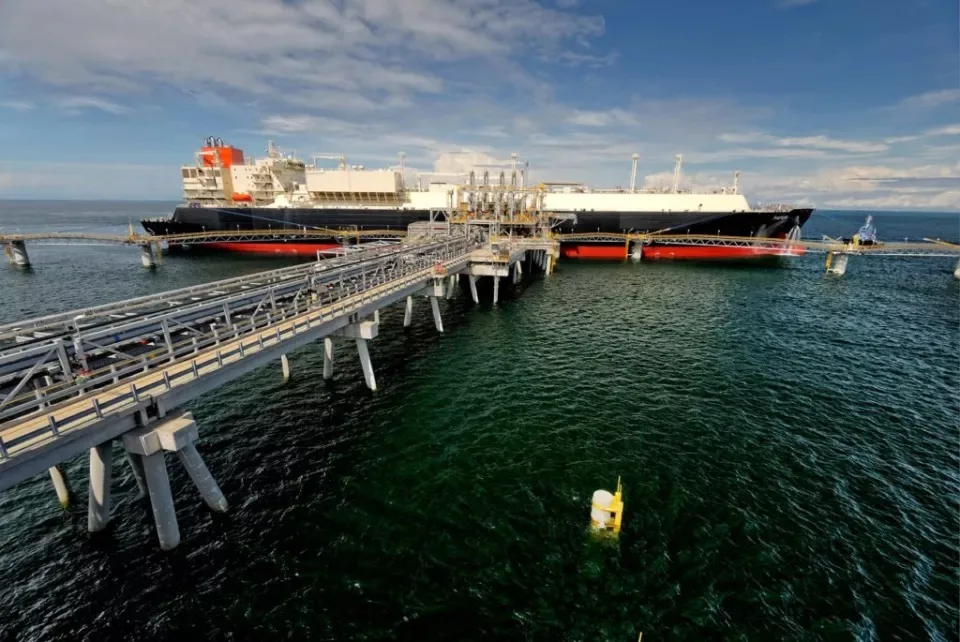
The project is designed to produce 5.6 million tonnes of LNG a year from the Elk and Antelope fields in Gulf Province. Gas will be piped to a liquefaction site near Port Moresby. A marketing joint venture between TotalEnergies and state entities will sell 2.4 million tonnes a year, according to World Oil. Streamline reported that TotalEnergies has signed heads of agreement for a further 1.5 million tonnes a year.
Marape put Papua LNG’s gas at about 6.6 trillion cubic feet, Streamline reported from the Government’s account. He compared that with about 80 trillion cubic feet for the Mozambique projects run by the same companies.
The remaining dates
Papua LNG’s investment decision was delayed in 2020, 2024 and 2025, as Exepreneur reported on 9 November. Argus Media reported that Pouyanné had flagged a November decision in July.
PwC reported that the PRL15 petroleum retention licence, which covers the Elk and Antelope fields, expires on 30 November. Exepreneur found no second public source for that date, and none of the partners has said how the licence will be renewed or converted.
In September Marape also asked landowners and leaders in Gulf and Central provinces to resolve outstanding issues and said the Government wanted landowner and provincial agreements substantially progressed before November, according to his office. No public report since has confirmed those agreements are complete. Marape has also urged the partners to resolve their internal differences and present one position, according to the Government account reported by Streamline.
PNG Investment Week runs at the International Convention Centre in Sydney from 29 November to 2 December, The National reported. A Papua LNG session on 1 December lists Gallagher, ExxonMobil PNG chairman Dinesh Sivasamboo and Kumul Petroleum chairman Isaac Lupari as speakers. Marape opens the Leaders Summit on 30 November.
Smaré told The National that PNG LNG, which cost about US$19 billion, employed more than 21,000 people at peak construction and about 2,000 once it was completed in 2014. He has argued that sequencing Papua LNG with other projects would avoid a repeat of that collapse in jobs. His estimates put P’nyang at about US$10 billion, Muruk at US$3 billion and Twinza’s offshore Pasca project at about US$2.5 billion. Wildebeest, not yet drilled, could add up to US$30 billion, he said.
Marape has said Kumul Petroleum has US$180 million ready for its Papua LNG stake, Exepreneur reported on 2 November.
The partners have until 15 December. A decision would satisfy one of the two conditions on Santos’s US$189 million purchase. Santos has said FID is when it will publish its cost and schedule figures for the project.