Paul Bayly Quits PNG Power After 18 Months, K1.3 Billion Debt Unresolved
PNG Power CEO Paul Bayly quit after 18 months without giving a reason, leaving debts above K1.2 billion, a K180 million court order and a 2027 sale deadline.
Key points
- Paul Bayly, PNG Power's sixth chief executive since 2018, left on 20 October 2026 without giving a reason, The National reported.
- He claimed a June profit, the company's first in over a decade, and lower losses. Neither figure has been audited, and the government's own loss figures are higher.
- PNG Power owes more than K1.2 billion to power producers and creditors and faces a K180.78 million court judgment, while the State plans to sell 49% before the 2027 election.
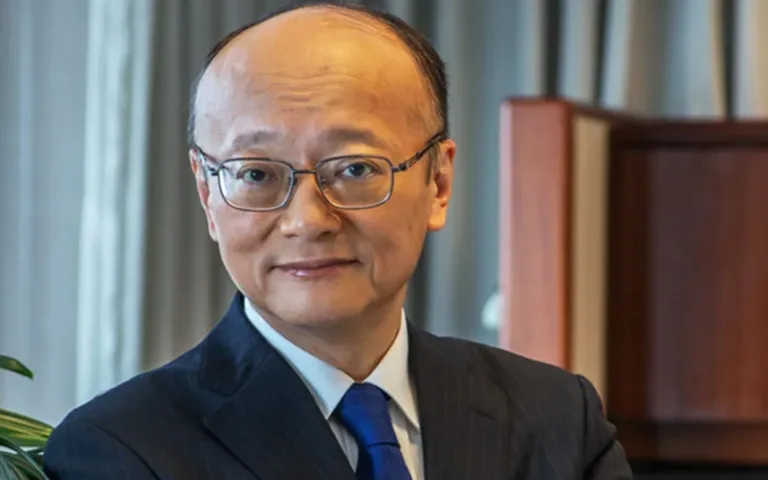
Paul Bayly told PNG Power staff it had been “a privilege and an honour” to lead the company over the past 18 months. According to The National, his farewell message set 20 October 2026 as his last day and gave no reason for leaving.
Richard Maru, the minister responsible for PNG Power, confirmed the resignation, the paper reported. Bayly, a New Zealand national, is the sixth person to run the state electricity utility since 2018, by The National’s count.
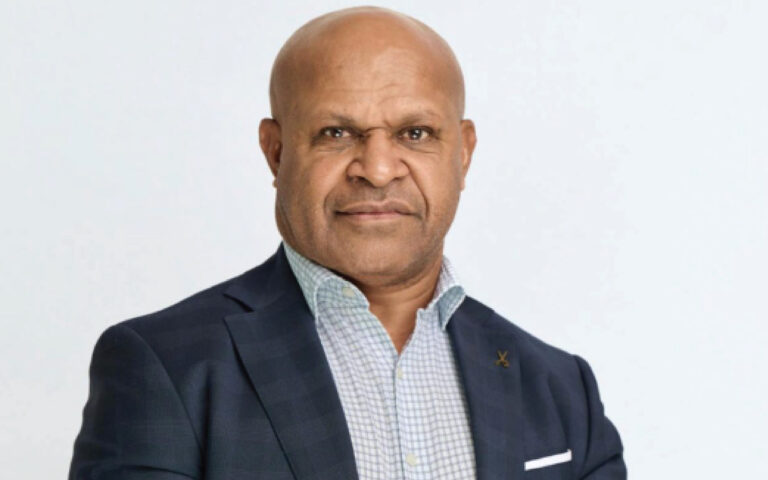
He leaves a company that its own chairman, Mal Lewis, told the shareholder was insolvent in June 2025, according to ABC News. He also leaves three months after Maru said he was “horrified with the total mess PPL is in” and promised “the biggest shake-up”, as The National reported on 28 July.
An investment banker hired to end the acting era
The National Executive Council announced Bayly’s appointment on 25 March 2025 after what NBC News described as a competitive selection process. The board said the appointment “fills a critical gap” and brings “much needed stability”, NBC reported, because the post had not had a permanent holder since 2023.
Obed Batia resigned as chief executive on 23 October 2023, EMTV reported, and his deputy, Nehemaiah Naris, ran the company as officer in charge. The National reported that Ivan Pekaea was acting chief executive in March 2025, the month PNG Power raised its tariff.
In a July 2025 interview with Business Advantage PNG, Bayly said he started at Citibank working with struggling businesses and spent about 30 years in investment banking.
He was Permanent Secretary for Infrastructure and Transport in Fiji, where, RNZ reported, he oversaw the state-owned power and water companies. He then led a redevelopment agency in the British Virgin Islands for the British Government after hurricanes Irma and Maria, he told Business Advantage PNG. NBC also described him as a former New Zealand Army colonel whose career took in Timor-Leste, Lebanon and Syria. No second source confirms the military record.
“The last time it made a profit was 12 years ago,” he told Business Advantage PNG four months into the job. He called the balance sheet “technically insolvent” and the grid a “broken-down network with many single points of failure”.
His plan, as he set it out in that interview, put people first. He wanted to grow revenue from a base of more than K1 billion, cut costs, reorganise the company around four grids and reduce system losses of about a quarter.
PNG Power buys electricity for more than it sells it
PNG Power’s revenue was K960 million in 2023, its last audited year, and K1.05 billion in 2025, Business Advantage PNG reported in September 2026. Revenue grew about 9% over the two years.
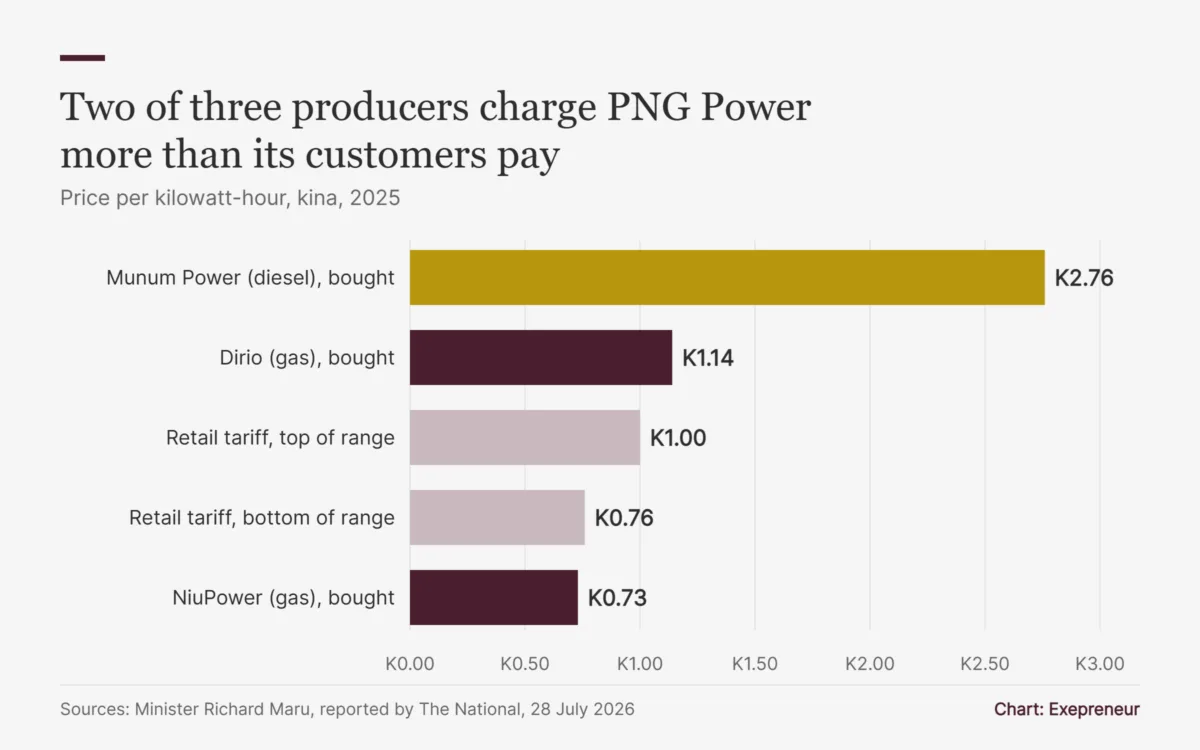
Maru told The National in July 2026 that PNG Power paid Munum Power K2.76 per kilowatt-hour for diesel electricity last year and Dirio K1.14 for gas, while retail tariffs ran from K0.76 to K1. Every unit bought from Munum cost the utility at least 2.76 times what any customer paid for it.
Of the three producers Maru named, only NiuPower made PNG Power money. It sold at K0.73 per kilowatt-hour, a positive margin of 20% by Maru’s figures, against negative margins of 200% on Munum and 25% on Dirio.
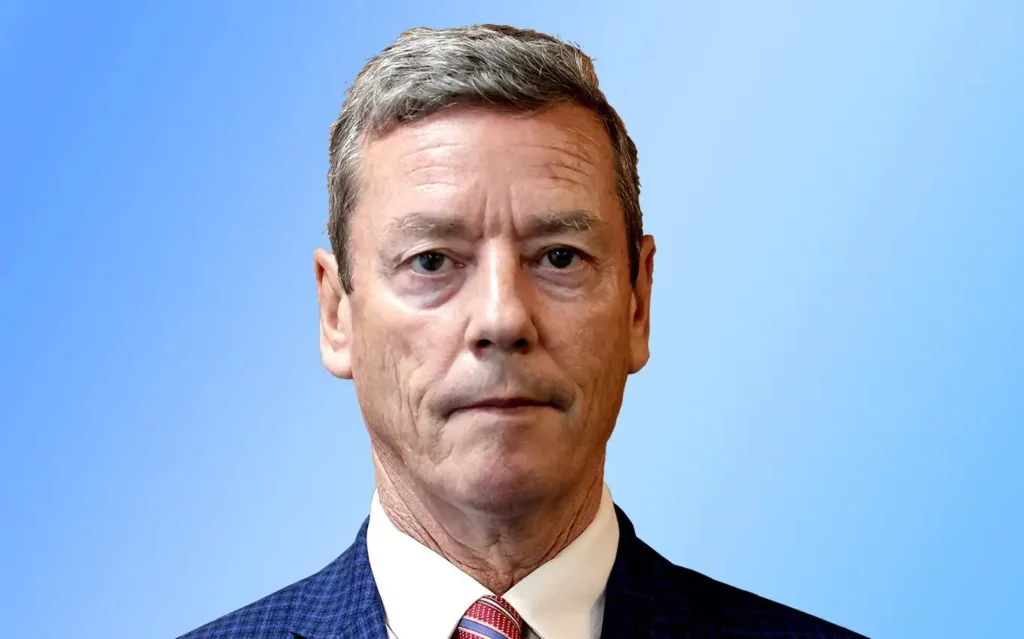
William Duma, the State Enterprises Minister who held responsibility for PNG Power until July, told The National that the 2019 power purchase agreements are priced in US dollars. “Every depreciation in the kina increases the amount that PPL has to pay,” he said.
Duma also said PNG Power had run at a loss since 2019 and collected about 80 toea for every kina it billed. The National reported in the same article that the company generated 1,585 gigawatt-hours in 2025 and sold 1,167. The missing 418 gigawatt-hours, 26.4% of generation, went to network losses, theft and metering failures.
A 5% increase took effect on 4 March 2025, The National reported, the first part of a 10% rise approved in 2022 and delayed by a government freeze. ABC News later reported that the government overturned a 2025 increase. Business Advantage PNG wrote in September 2026 that tariffs had not risen since 2013.
What Bayly says he fixed
Bayly’s farewell, as The National reported it, listed seven achievements:
- commissioning the 132kV Tari to Lae transmission line
- commissioning Rouna 1 and refurbishing Rouna 3
- cutting technical and non-technical losses from about 28% to about 20%
- re-establishing the PNG Power training facility
- completing an intake of 200 apprentices
- opening the staff social club building
- a profit in June, “the first in over 10 years”
Business Advantage PNG reported separately that the 220-kilometre Tari, Yonki and Lae line was completed in 2025, and that an extension from Tari to Hides would put 5 to 10 megawatts from Hides onto the Ramu grid.
Duma’s 26.4% covers calendar 2025, most of which Bayly ran. Maru put losses at “over 25% of sales” in July 2026, The National reported, and at about 26% when he swore in the new board on 18 September, according to The PNG Sun. None of the published reports says what period or measure Bayly’s 20% covers.
On the profit, The National did not say whether the June profit was for the month or a longer period, and gave no amount. The latest audited accounts cited in any public report are for 2023.
A minister arrives, a board changes, a chief executive leaves
Prime Minister James Marape reshuffled his Cabinet on 14 July and created a PNG Power portfolio for Maru, who also holds International Trade and Investment, Inside PNG reported.
Marape told Parliament the change followed a four-year performance review and cited serious problems at PNG Power, NBC News reported. Opposition Leader James Nomane warned that splitting the portfolios could create conflicts of interest and weaken oversight.
Maru set out his agenda at the handover. According to The PNG Sun, it included reviewing power purchase agreements he called financially unsustainable and cutting spending and debt. He also proposed to stop recruiting expatriate consultants, seek a court-approved debt settlement and prepare profitable units for partial privatisation. His stated goal was to “stop the blackouts and reduce the cost of power”.
On 28 July The National reported a Cabinet proposal to settle PNG Power loans of more than K2.3 billion and prepare the Port Moresby, Ramu and Gazelle grids for partial sale. Five “C” centres, which lose about K80 million a year, would be sold. The paper reported that the proposal would also stop expatriates from taking up key roles at the company. No public source has linked that proposal to Bayly’s departure.
“If we have to take these agreements to court and nullify them, we will,” Maru said in the same report.
Kerenga Kua, the member for Sinesine Yongomugl, told the House on 1 September that PNG Power “could be operating illegally” if it could not pay its debts, NBC News reported. Maru replied that the company met its daily operating costs. No insolvency proceeding has been reported.
A new PNG Power board
On 18 September a new board appointed under NEC Decision 217-2026 was sworn in, with Noel Mobiha as deputy chairman, The PNG Sun reported. David Kavanamur, managing director of Kumul Consolidated Holdings (KCH), said the company had operated for almost a year without full board oversight.
Maru gave the board its instructions in public. “Management who do not perform must go,” he said, according to The PNG Sun. “You are not here for a holiday.”
Five weeks later, the board named Mobiha acting chief executive, subject to NEC approval, and made chief technical officer Tony Koiri interim officer in charge, The National reported. Koiri has run the company before: Business Advantage PNG reported in May 2013 that John Tangit became acting chief executive “following the resignation of Tony Koiri”.
Business Advantage PNG reported on 26 October that Koiri was officer in charge and that PNG Power was still waiting for an NEC decision on an acting chief executive.
Six chief executives at PNG Power in eight years
According to The National, Carolyn Blacklock resigned in 2019. Douglas Mageo acted until late 2020. Flagon Bekker resigned in June 2021 after about nine months, following differences with the trade unions. Batia left in October 2023, and Naris acted until 2025.
Six chief executives since 2018 works out to an average of about 18 months each.
In February 2025 the NEC approved expatriate chief executives for PNG Power and Water PNG. Duma said then that “significant amounts of funding have been injected into PPL but execution rates have been below par”, The National reported.
The bill his successor inherits
Maru told The National on 17 August that PNG Power owed more than K1.2 billion to independent power producers and other creditors. He said the government owed PNG Power K200 million and would settle it by December through a supplementary budget.
At the board swearing-in, Maru put debts at about K1.3 billion, loans approaching K3 billion and government arrears at about K220 million, with monthly revenue of about K80 million, The PNG Sun reported.
Justice John Carey of the National Court entered judgment on 7 July 2026 for Dirio Gas and Power of K180,778,462.68 plus contractual interest, The National reported. The court found PNG Power in “substantial and ongoing breach” of a 2019 agreement for a Port Moresby gas plant and noted the utility had stopped paying in full from September 2022. PNG Power has said it will appeal.
At Maru’s figure of K80 million a month, the judgment equals more than two months of PNG Power’s revenue before interest.
KCH is preparing to sell up to 49% of the company under the Public-Private Partnership Act 2022, with the State keeping 51%, Business Advantage PNG reported. Kavanamur said the process had reached the scheme-of-arrangement stage, that “one or two court cases” had to be resolved first, and that tariff regulation had to be restructured before any sale. The National reported that the government’s target is February 2027.
John Byrne of the Lae Chamber of Commerce told Business Advantage PNG that drought had dried the Yonki catchment and caused outages on the Ramu grid. Mary Johns, chief executive of the Port Moresby Chamber of Commerce and Industry, said businesses now need “a backup of a backup generator”. She said the emergency fuel subsidy introduced in March 2026 ends in December.
Chairman Lewis told staff in an internal circular, quoted by The National, that “this is one time that we must all work together to make PNG Power responsive to our country’s issues.”
Bayly’s farewell claimed PNG Power’s first profit in more than a decade. His successor starts with a K180.78 million judgment under appeal, a fuel subsidy that expires in December and a sale the government wants done by February.
Who should be in the CEO Series next?
You tell us the next CEO or C-suite leader we should feature.
Recommend the C-suite leader