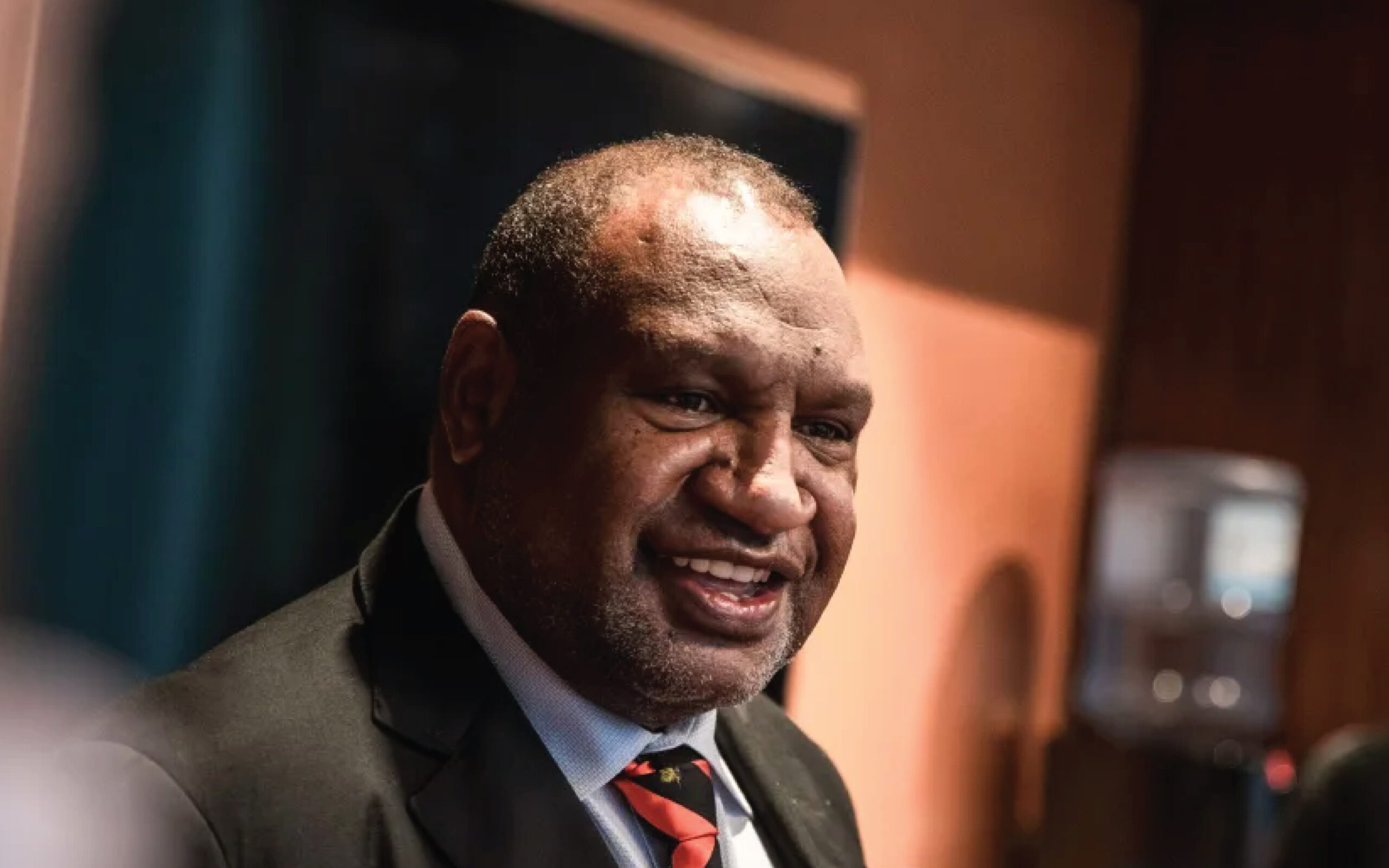
Prime Minister James Marape has a message for the nation, and he wants it heard clearly. “Papua New Guinea is not in crisis. The country is not dying. The country is growing.” as published in different channels including Prime Minister Marape himself and Department of Prime Minister and National Executive Council.
He has said some version of that line in at least four separate government statements since November last year. Each time, the numbers behind him get bigger. Revenue has nearly doubled since 2018. The non-resource economy has grown from K57 billion to more than K89 billion. The Prime Minister wants investors, citizens and his own coalition to believe the turnaround is real.
Three international bodies are telling a more complicated story at the exact same time. The Financial Action Task Force put PNG on its money laundering grey list in February. The International Monetary Fund says the country carries a high risk of debt distress. The kina has spent two years being quietly devalued by a government that once insisted it wasn’t. None of these facts cancel out Marape’s numbers. They sit next to them, unresolved, and that is precisely the problem for a government asking the country to trust the spreadsheet over the headlines.
A Government Fighting Its Own Narrative
Marape’s insistence that PNG “is not dying” is not a random talking point. It is a direct response to years of commentary, much of it from his own Parliament, describing debt levels, gun violence and fiscal slippage as evidence of a state losing control. The Prime Minister’s answer has been consistent: look at the data, not the noise.
Total government revenue climbed from around K14 billion in 2018 to roughly K25 billion in 2025. Internal tax revenue alone, excluding any contribution from Papua LNG or Wafi-Golpu, rose from K9.7 billion to more than K17 billion. The Prime Minister frames this as proof that his diversification strategy, away from a single dependence on mining and petroleum, is working.
The claim carries real weight. PNG’s economy has expanded through a stretch that included a global pandemic, a mine closure at Porgera, commodity price swings and a currency long propped up above its real value. Marape is not wrong that the country avoided the collapse some predicted in 2020. What he is not saying as loudly is that avoiding collapse and achieving stability are two different tests, and PNG has only passed the first one.
What the Numbers Actually Show
Start with debt. PNG’s public debt sat at an estimated 47 percent of GDP in 2025, and debt servicing as a share of government revenue has fallen from 20 percent in 2020 to around 15 percent in 2025, a genuine improvement Marape is right to claim credit for, according to analysis published by the East Asia Forum in December 2025. But the IMF’s own April 2026 Article IV country report (IMF Country Report No. 26/129) goes further than the government’s talking points. It describes PNG’s debt as sustainable, yet carrying a “high risk of debt distress,” driven by a large Eurobond bullet payment due in 2028 and mounting bilateral and multilateral service obligations. Under the baseline scenario, the report flags multiple breaches of the debt-service-to-revenue threshold in the years immediately ahead. That is not the language of a government that has solved its debt problem. It is the language of a government that has bought time.
Then there is the grey list. On February 13, the FATF placed Papua New Guinea under increased monitoring for weaknesses in its anti-money laundering and counter-terrorism financing systems. It is PNG’s second grey-listing in a decade, following an earlier stint from 2014 to 2016 (Asia Pacific Security Magazine). The Bank of PNG did not sugarcoat what this means. In its own words, reported by The National, grey-listing “could seriously affect our economy,” reducing investor confidence and making it harder for PNG businesses and citizens to move money internationally. Even Western Union transfers could be affected. By the June 19 plenary in Paris, PNG remained on the list. It was not removed. Twenty-two jurisdictions carry that status worldwide (ComplyAdvantage, June 2026), and PNG now sits alongside Haiti, Venezuela, Yemen and South Sudan, not the company a nation courting Indo-Pacific investment wants to keep.
Add the kina. For years, the Bank of PNG defended an exchange rate widely viewed by economists as artificially high, a policy that starved importers of foreign currency and created a black market for hard currency. The government has since allowed gradual depreciation, which the IMF Article IV report credits with narrowing the currency’s overvaluation and easing foreign exchange shortages, though not eliminating them. Net international reserves stood at around US$3.3 billion, per the same IMF report, a figure the government points to as proof of stability. Fair enough. But the same reform that eased FX shortages is also the reform Marape spent years resisting in public, because a weaker kina meant admitting the currency had been mispriced all along.
None of Marape’s economic statements mention Enga
Tribal warfare in the Highlands has killed well over 160 people in a single recent year of recorded conflict, with estimates running higher, according to the BTI 2026 Papua New Guinea Country Report. Porgera has seen repeated states of emergency, curfews and lethal-force orders from police according to Islands Business and RNZ Pacific and other local media. An estimated 50,000 illegal firearms circulate across the country, and PNG’s police-to-citizen ratio stands at roughly 1 to 1,845, four times worse than the United Nations’ recommended standard (Michael Kabuni, Devpolicy Blog, Australian National University). Riots in Port Moresby in January 2024 were triggered by nothing more than misinformation about tax policy, a sign of how thin the margin for public trust has become. A government that wants to be judged on GDP growth cannot ask investors to ignore the security conditions that GDP growth is supposed to fund.
This is where Marape’s “not in crisis” framing runs into trouble. He is technically correct that PNG has not defaulted, has not seen its currency collapse, and has not lost its institutions to a coup. Fifty years without a military takeover or a suspended constitution is a real achievement he is entitled to claim. But investors, ratings agencies and ordinary Papua New Guineans are not grading on a pass-fail scale. They are asking whether the trajectory of debt, security and financial compliance is improving fast enough to matter before the 2028 Eurobond payment comes due, before the next FATF review, before the next tribal clash shuts down a mine.
What the Government Is Actually Doing About It
Credit where it applies. The Government has passed new anti-money laundering laws and stood up institutional capacity that FATF itself acknowledges as progress, including strengthening the Independent Commission Against Corruption and building out a national risk assessment. Treasurer Ian Ling-Stuckey has said PNG intends to exit the grey list faster than it did the last time, a claim reported by The National that will be tested at the next plenary in October. On debt, Marape has set a public target: stop new borrowing by 2027, then spend the following years paying down existing loans, with full repayment targeted for 2033. The IMF’s own program with PNG, running since 2023, ends this year, which will test whether these reforms hold without an external anchor forcing the pace.
On the currency, letting the kina adjust to something closer to its real value was politically costly and economically necessary. Inflation has stabilised around 5 percent, below PNG’s historical average, according to IMF officials cited by PMNEC, and the government correctly notes that recent price pressure has come more from global food and fuel costs than from the exchange rate itself. That is a defensible position, not spin.
Where the Optimism Is Earned
The non-resource economy genuinely has diversified. Agriculture, fisheries, tourism, construction and small business now account for a larger share of output than at any point since independence, reducing PNG’s historic vulnerability to a single commodity cycle. Four consecutive years of non-resource growth above 4 percent is a real number, not a projection (PMNEC). Foreign direct investment interest in Papua LNG, Wafi-Golpu, Frieda River and Pasca remains active, and Marape’s insistence on securing PNG a larger share of project benefits, reportedly targeting around 55 percent over project lifetimes (PMNEC), reflects a government negotiating from a stronger position than it held a decade ago.
Why the Framing Itself Is the Risk
There is a deeper problem here, and it has nothing to do with whether any single statistic is accurate. It is about what happens when a government’s confidence outruns its own institutions’ caution. The IMF’s language is careful and technical: sustainable, but high risk of debt distress. FATF’s language is procedural: increased monitoring, agreed action plan, committed timeframes. Marape’s language is absolute: not in crisis, not dying, growing. Those are three different registers describing the same country, and only one of them is designed to close down debate rather than invite scrutiny. Executives making capital allocation decisions do not read press releases from Port Moresby in isolation. They read them against the IMF report, the FATF statement and the Bank of PNG’s own admission that grey-listing could hit remittances, correspondent banking and investor confidence all at once. When the political message contradicts the technical one, sophisticated capital defaults to the more cautious read, not the more confident one.
The Reckoning Ahead
Three deadlines now sit on Marape’s desk at once. The FATF’s October plenary will decide whether PNG’s reforms have moved fast enough to avoid a longer stay on the grey list. The 2028 Eurobond bullet payment is closing in, and the IMF has already flagged it as a liquidity pressure point. And the 2027 national election means every fiscal decision from here forward will be read as much through a political lens as an economic one. Cabinet reshuffles already underway, with new ministers sworn in under what Marape calls a “reset,” suggest the government itself knows the current coalition needs to look sharper before voters judge it.
The question worth asking is not whether Marape is lying about the data. He isn’t. The revenue numbers are verifiable, the debt ratio has genuinely improved, and the non-resource economy has real breadth it lacked a decade ago. The question is whether “not in crisis” is the right bar for a country carrying a FATF grey-listing, a high risk of debt distress and a security vacuum in its own resource heartland.
A patient who is not dying is not automatically healthy. PNG’s government has stabilised the bleeding. It has not yet closed the wound.
Why This Matters Beyond Port Moresby
Every credit rating agency, every LNG investor weighing Papua LNG, and every bank running enhanced due diligence on PNG transactions post grey-listing is reading the same government statements this masthead just fact-checked. Pacific-wide, the story is bigger than one country’s press releases. It is a test of whether resource-rich, reform-committed Pacific states can convince global capital that stability is durable, not just declared. Fiji, Solomon Islands and Vanuatu are watching how PNG’s grey-list exit unfolds, because the playbook PNG writes this year becomes the regional template for the next one caught in the same position.
The Line That Should Worry Everyone in the Room
Marape is asking the country to measure his government by what didn’t happen: no default, no coup, no collapse. History will measure him by what still could. Between now and the next FATF plenary, the next Eurobond stress test and the next tribal flashpoint in the Highlands, Papua New Guinea has a narrow window to turn “not in crisis” into “not at risk.” Whether that window closes on his terms or on the market’s is the only forecast that actually matters now.





