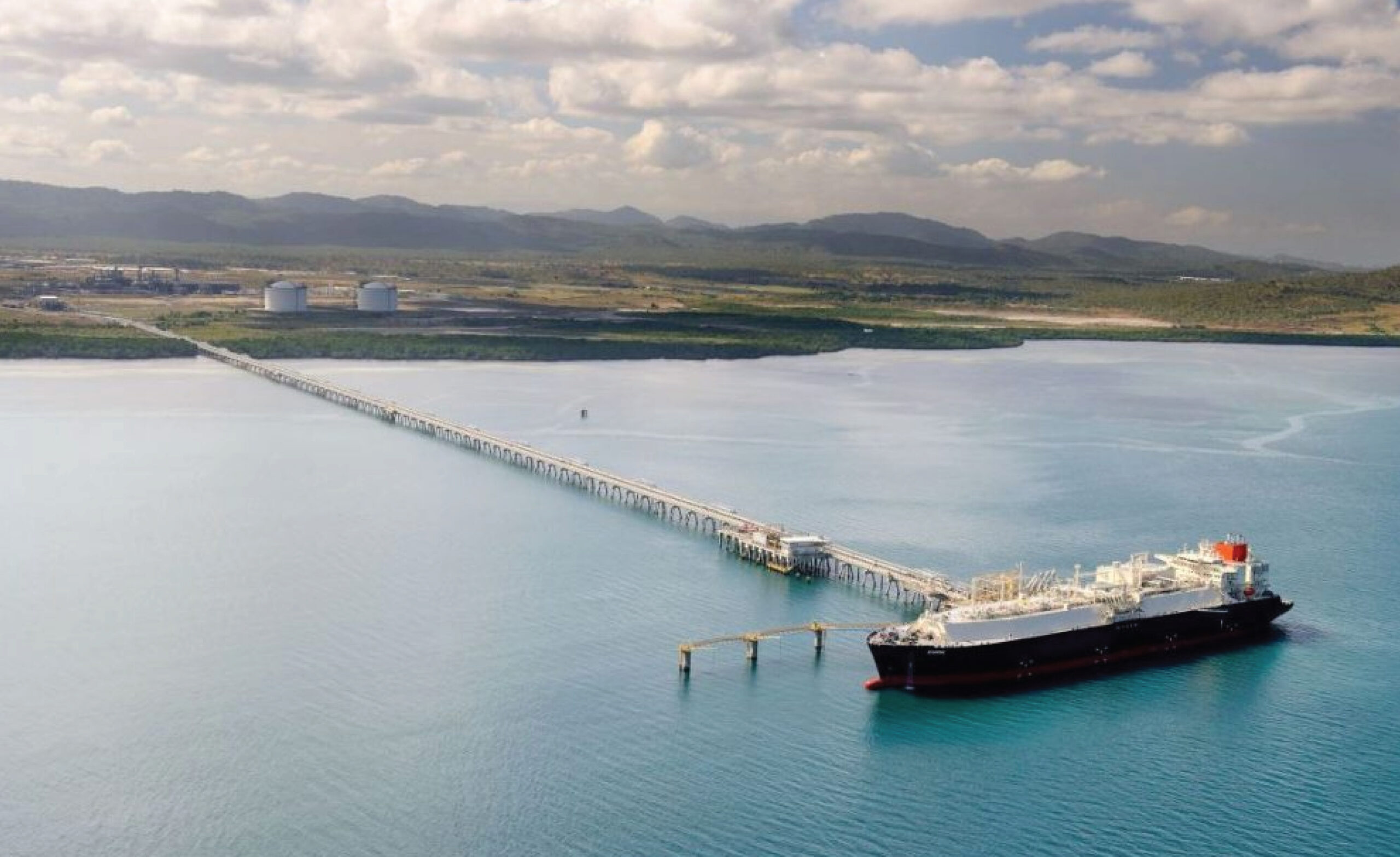
Papua New Guinea’s government has promised to balance its budget by 2027. The global LNG market it depends on to get there is heading into the biggest supply glut in a decade, on schedule to test that promise.
The target is the IMF’s own characterization of PNG’s official position. In the Fund’s March 31, 2026 statement announcing a staff-level agreement on PNG’s sixth program review, the mission chief cited the authorities’ “determination to balance the budget by 2027″ as a factor in further reducing public debt vulnerabilities.
The same commitment appears in PNG’s medium-term fiscal framework as documented in IMF Country Report No. 24/231, which describes a consolidation path “envision[ing] a balanced budget by 2027 and surpluses, thereafter,” projected to bring public debt to 40.4% of GDP by 2029.
Three years of narrowing deficits
PNG’s fiscal deficit has narrowed for three straight years. It fell from 4.3% of GDP in 2023 to 3.4% in 2024, according to Lowy Institute analysis published in December 2025. The IMF’s June 2026 country report separately puts the 2025 deficit at 2.1% of GDP.
PNG’s 2026 national budget, analyzed by KPMG in its November 2025 budget briefing, targets a deficit of K1.6 billion, or 1.1% of GDP. KPMG’s report describes that as the lowest level since 2012, with the budget projecting a positive primary balance for the first time in years.
That is the trajectory a balanced 2027 budget requires. The government is executing on it.
What the revenue growth is made of
PNG’s 2026 budget documentation, per KPMG’s analysis, projects total revenue and grants at K29.3 billion, a 15.3% increase over 2025, with tax revenue the dominant contributor at 76% of the total. The budget attributes that growth to higher commodity prices generally, the completion of debt amortization on Kumul Petroleum Holdings’ financing for the PNG LNG project, improved tax compliance, and ramped-up production at the Porgera gold mine.
PNG’s budget separates its resource revenue drivers. Mining and Petroleum Tax is projected to rise 17.2%, from K4.1 billion in 2025 to K4.8 billion in 2026. KPMG’s analysis attributes that increase to an “expected increase in mineral commodity prices, except for oil and LNG,” with gold and copper carrying the gains and oil and gas prices described in the same budget documentation as “stabilising.”
Non-tax revenue is projected to jump 93%, driven substantially by dividends flowing from a new state-owned enterprise dividend policy. KPMG’s report links that change to “the ending of the repayment of PNG LNG partners on the debt borrowed,” a structural, one-time unlocking of cash flow as Kumul Petroleum finishes paying down its original PNG LNG project financing.
A meaningful share of the 2026 revenue improvement therefore occurs independently of LNG prices, driven by gold and copper price strength and by a debt-amortization schedule reaching its natural end point. The LNG price exposure sits after 2026, and in whether a second wave of LNG investment materializes on anything like its original timeline.
The IMF’s two-sided risk
The Fund’s risk assessment, laid out consistently across successive country reports, names commodity price volatility as a two-sided variable inside PNG’s fiscal outlook. Its December 2025 review statement lists “commodity price volatility” among downside risks alongside weaker external demand and prolonged war in the Middle East. The corresponding upside case names higher commodity prices and “major resource projects for which final investment decisions have not yet been made.”
The IMF’s baseline forecast for PNG’s fiscal path does not assume a second LNG mega-project comes online. If one does, on favorable pricing, PNG beats its own consolidation targets. If gas prices soften further and a new project’s investment decision keeps slipping, the government finds its 2027 balance entirely from tax administration and spending discipline, without the cushion a new project’s construction-phase spending would provide.
Supply growth at the fastest pace since 2019
The International Energy Agency’s Q1 2026 Gas Market Report puts global LNG production growth at almost 7% in 2025, with roughly three-quarters of that concentrated in the second half of the year. The IEA projects supply growth accelerating further in 2026, to its fastest pace since 2019.
Prices have already moved. The same IEA report puts European TTF down 14% and Asian spot LNG down 17% in the second half of 2025 against the same period in 2024, as the wave of new supply, led overwhelmingly by North America, began easing a market that had been tight since 2021.
The Oxford Institute for Energy Studies’ February 2026 analysis of what it calls the LNG wave forecasts European gas at $10.55 per MMBtu for 2026 and $9.30 for 2027, down from an average of $12.31 in 2025. OIES describes that as consistent with “the slight oversupply in the LNG market” building through the current investment cycle.
The same report puts global LNG supply growth between 2025 and 2030 at roughly 50%, based on final investment decisions already taken plus a handful more expected within twelve months, with the buildup accelerating in 2028 and 2029. Pricing data tracked by Trading Economics shows the Asian JKM benchmark at $16.53 per MMBtu as of July 13, 2026, down nearly 12% over the preceding month while remaining 26% above year-ago levels.
Private-sector forecasting has modeled more severe downside. A 2026-2035 global LNG outlook report reviewed for this piece models a bear case in which JKM falls to a $5.00-$5.78 per MMBtu range, a level the report states would push most US Gulf Coast, Canadian and higher-cost global LNG projects into cash-negative territory, leaving only the lowest-cost producers such as Qatar structurally viable.
That report does not model Papua New Guinea, and its severe case is not a PNG-specific forecast. It indicates the tail risk the broader LNG market prices as plausible enough to model in detail, and PNG’s gas carries the same global oversupply exposure driving that scenario.
Papua LNG and P’nyang
Papua LNG is TotalEnergies-led and valued at roughly US$12 billion, a project size the Australian government’s export finance agency described in a 2023 risk note as equivalent to about 60% of PNG’s entire GDP. That assessment expected a Final Investment Decision “in early 2024.”
It did not happen. The Bertelsmann Transformation Index’s 2026 country report on PNG states the project was “deferred once again,” with construction costs running above quoted levels, undermining project viability and requiring contracts to be retendered. FID remains pending, with no confirmed date in any primary source reviewed for this investigation.
ExxonMobil’s roughly US$10 billion P’nyang gas development sits behind Papua LNG on the same runway, and would add a new production train to the existing PNG LNG facility. Export Finance Australia’s 2023 assessment describes P’nyang as “poised to commence construction in 2028 once the Papua LNG plant is operational.” Every delay to Papua LNG pushes P’nyang’s construction-phase spending, and the FX and employment inflows attached to it, further out.
Neither project sits in the IMF’s current baseline fiscal forecast, per the Fund’s repeated framing of both as upside risk rather than assumed revenue. A pricing environment where new LNG capacity is already oversupplying the market, per the IEA and OIES data, is the environment least likely to accelerate a positive FID on a project already delayed once over cost concerns. If Papua LNG’s economics look worse in a $9-10 per MMBtu forward-price world than they did when the project was first sanctioned for a decision in early 2024, the commercial response for TotalEnergies and its partners is to keep waiting, which is what has happened for over two years running.
The 2027 exposure
PNG’s government is not building its fiscal plan around either mega-project materializing. The 2026 budget’s revenue growth is anchored in gold, copper, tax administration gains and a one-off dividend unlock rather than new gas volumes.
That leaves the 2027 balanced-budget target with almost no cushion if existing LNG revenue softens. Tax and royalty flows from the operating PNG LNG project run against the same Asian benchmark prices the IEA and OIES both project declining through 2026 and 2027.
PNG’s Mining and Petroleum Tax line already flags oil and LNG prices separately from other minerals in the government’s own budget language, because they are not expected to be the source of upside. Should they become a source of downside, meaningfully below the “stabilising” assumption in the 2026 budget, PNG needs an equivalent offset from spending restraint or non-resource tax collection in the year it has promised a balanced budget, with no IMF program oversight cushion once the current arrangement concludes.
The number PNG does not control
Papua New Guinea has completed the disciplined part of fiscal consolidation. Deficits are down from 4.3% to a targeted 1.1% of GDP across three budget cycles, debt is trending toward 40% of GDP by 2029, and revenue growth is increasingly diversified away from any single commodity.
The price of gas on a Tokyo or Rotterdam trading screen sits outside PNG’s control. The IEA says the global LNG glut accelerates this year. OIES says prices keep falling into 2027. TotalEnergies has already demonstrated once that it will wait rather than sanction Papua LNG into a soft market.
PNG built its 2027 promise on discipline it controls. The promise will be kept or broken by a price it does not.





