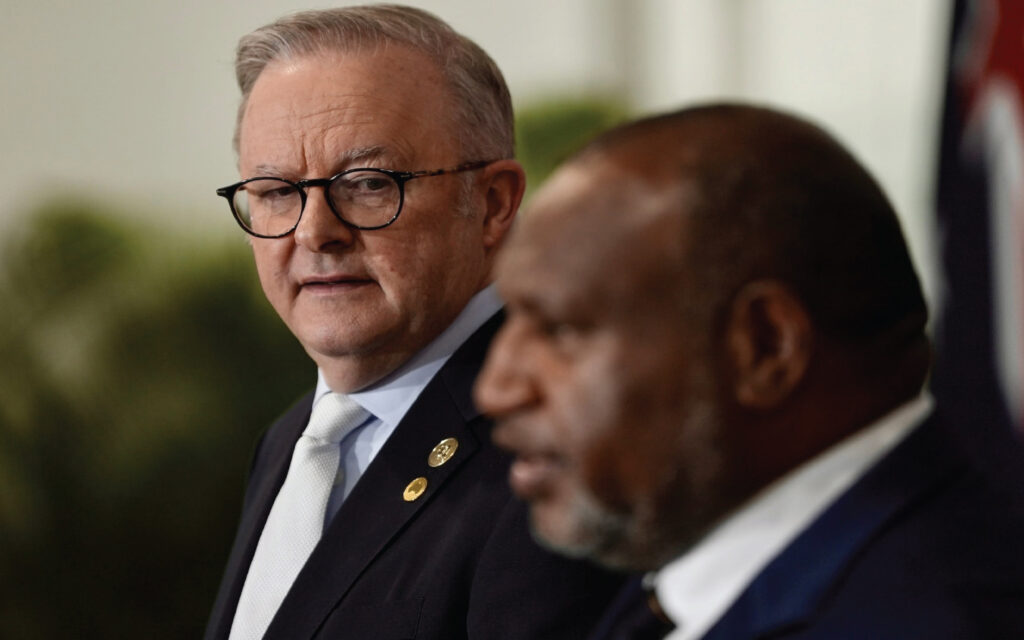
For the Albanese led government, this is a massive blow undermining Prime Minister Anthony Albanese’s efforts to strengthen Australia’s regional security partnerships in the Pacific in the face of increasing threat from China.
Efforts to finalize a Mutual Defence Treaty with PNG and a strategic security agreement with Vanuatu stalled despite months of talks and public declarations of intent by all parties. These setbacks come at a time when Australia is seeking to limit China’s growing security footprint in the region, making the lack of formalised security ties with key neighbours a crucial issue.
Papua New Guinea Treaty Talks Stall
Negotiations for a Papua New Guinea-Australia Bilateral Defence Treaty began earlier this year with promise. PNG Prime Minister James Marape initiated the treaty process, seeking a formal framework for defence cooperation.
Prime Minister James Marape stressed PNG’s sovereignty and initiative in the talks. “A security treaty for Papua New Guinea would represent the highest level of secure relations we have extended to any country. This treaty originated from PNG’s initiative, not Australia’s. It will not compromise PNG’s sovereignty,” Marape stated firmly.
Marape also emphasized the necessity of this treaty for PNG’s security. “I made a deliberate decision that Australia remains our preferred security ally. Papua New Guinea cannot independently safeguard its territory and maritime zones. This agreement is vital for our national security,” he said.
Despite the careful approach by PNG, the formal signing was delayed as Marape’s cabinet required more time to scrutinize the deal, a process that coincided with PNG’s Independence Day celebrations, contributing to the delay.
The Australian Prime Minister, Anthony Albanese, acknowledged the delay but remained optimistic: “We will navigate our respective cabinet processes and anticipate finalizing the signing of the treaty, the language of which has been settled, in the upcoming weeks. This is very positive. This is all upside for Australia and upside for Papua New Guinea,” Albanese remarked after the talks fell short of a signed agreement.
Australia and PNG instead signed a joint communique confirming the agreed draft text of the Mutual Defence Treaty (the Pukpuk Treaty) but postponed the formal treaty signing until further approvals complete. The communique details the treaty’s key elements but is distinct from the binding treaty itself.
Defence Minister of PNG Billy Joseph also reassured that the treaty would not undermine PNG’s sovereignty. “The deal won’t affect our independence. We’re still an independent nation. We’re taking it to cabinet first, then parliament, and I’m confident it’ll gain substantial support,” he said. He added flexibility for future changes, “The treaty could be modified in the future if necessary.”
Vanuatu’s Agreement Postponed Amid Concerns
Similarly, Vanuatu’s anticipated security agreement with Australia has been delayed indefinitely amid internal political concerns and sensitivities around foreign influence.
Vanuatu Prime Minister Jotham Napat cited concerns about potential limitations the agreement might impose on Vanuatu’s ability to secure infrastructure funding from other nations, particularly China, which is Vanuatu’s largest foreign creditor. “Further work is needed on issues related to funding for critical minerals and other cooperation aspects before we can finalize any agreement,” Napat said at a press conference in Port Vila.
Australia had pledged A$500 million to support Vanuatu’s infrastructure and economic development as part of the Nakamal Agreement, which also includes security cooperation. Albanese maintained optimism about the pact while highlighting sovereignty. “This is a pact that will importantly honor the sovereignty of Vanuatu, while also respecting Australia’s sovereignty,” he declared.
Vanuatu’s security environment remains complex, with multiple partners. Experts note that Vanuatu seeks to balance external support while maintaining sovereignty. As the analyst explain.
The previous 2022 security agreement between Vanuatu and Australia was never ratified by Vanuatu’s Council of Ministers or Parliament and was effectively discarded following a change in government. Prime Minister Ishmael Kalsakau, who led the previous administration, faced significant opposition and a vote of no confidence partly related to that pact.
Strategic and Regional Implications
The failure to finalize these security treaties marks a strategic challenge for the Albanese Government, which has prioritized deepening military and economic ties with the Pacific Islands amid concerns over China’s increasing presence.
Anthony Albanese framed the treaties as essential for establishing joint defence protocols and allowing mutual enrolment options in military forces, aiming to cement a rules-based security order in the region. “The anticipated agreement is designed to establish joint defence protocols in the event of military aggression and to permit citizens from both nations to enlist in each other’s armed forces,” Albanese explained.
However, critics and some opposition voices in Australia saw the failure as a diplomatic blow. Australian Senator Jane Hume described the early setbacks skeptically: “This is a real failure for the Prime Minister. It’s crucial that these agreements are approached correctly, with assurances that they will indeed materialize“.
Australia’s Recalibrated Approach
Despite these setbacks, Australian officials have signaled a commitment to ongoing security cooperation with PNG and Vanuatu. Non-treaty partnerships involving joint training, capacity-building, and intelligence sharing are likely to continue and possibly expand.
PNG’s Defence Minister Billy Joseph remains positive about future collaboration but signals a cautious approach. Vanuatu too appears likely to seek arrangements that balance sovereignty with security needs without binding treaties that may limit its strategic options.
The Albanese Government will need to recalibrate its Pacific outreach, focusing on flexibility, respect for sovereignty, and fostering trust with regional partners as it navigates a complex geopolitical environment shaped by competing influences from China and other powers.
Related posts:
- Golden Opportunity or Risky Gamble? PNG Weighs Foreign Control of Gold
- Papua New Guinea Faces Unprecedented Crises With No End In Sight
- Allan Birds New Deal. PNG Prime Minister Candidate Allan Bird Calls for New Deal
- Winnie Kiap Appointed Chair of Commonwealth Foundation: A Historic Milestone for Papua New Guinea and Women in Leadership