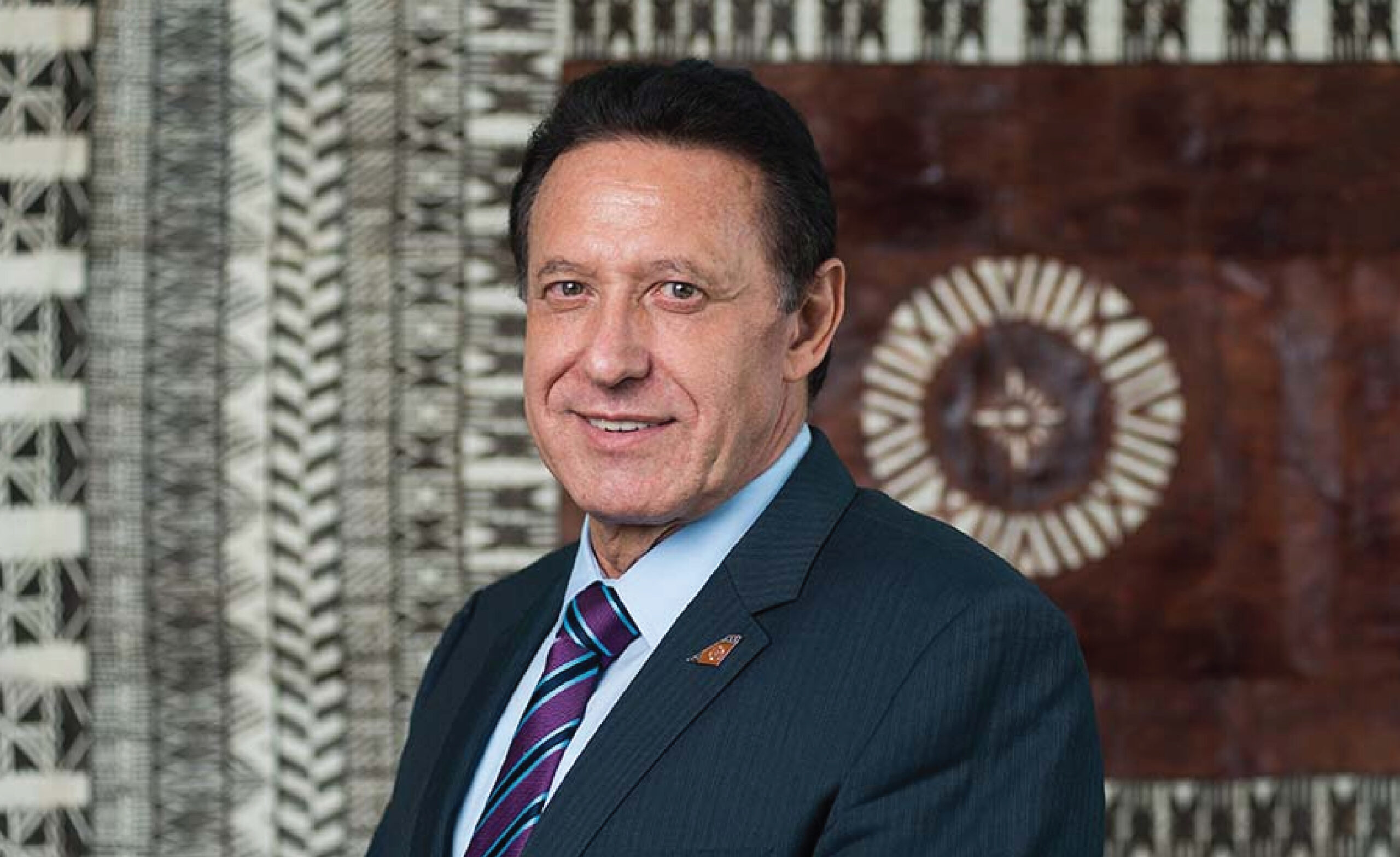
Andre Viljoen took over as Managing Director and Chief Executive Officer of Fiji Airways in October 2015, when the carrier ranked 102nd on Skytrax’s global airline list. Ten years later, when he stepped down effective October 2025, that ranking stood at 14th, according to Fiji Airways’ own account of his tenure and reporting by ch-aviation.
Viljoen isn’t a first-time turnaround specialist. He is one of a small number of executives who has now run three national flag carriers across two continents: South African Airways, Air Mauritius, and Fiji Airways. He returned to Air Mauritius as its Chief Executive Officer this October, closing a loop that started at the same airline fifteen years earlier, according to Fiji finance minister Biman Prasad’s comments reported by ch-aviation.
The accountant who chose airlines
Viljoen was born in South Africa and trained as a chartered accountant, not a pilot or an operations man. He earned a Bachelor of Commerce in accounting, economics, and management from Natal University in 1972, followed by a Bachelor of Accounting Honours from the University of South Africa in 1976, according to professional biography records maintained by The Official Board and corroborated independently by career-history aggregator Contact Out.
His airline career began at Comair, the British Airways franchise partner in South Africa, where he started as Financial Manager in the 1980s and rose to Group Financial and Commercial Director, a post he held for more than a decade, according to Airlink’s biography of Viljoen (Airlink and Comair share a common corporate lineage in South African regional aviation). In 1992 he moved to South African Express Airways as Chief Operating Officer, where he ran a turnaround program that returned the carrier to profitability and expanded its fleet to include regional jets, per the same Airlink account.
Perfecting the Basics at SAA
Viljoen joined South African Airways as Chief Financial Officer in 1995. He was named Chief Executive Officer in 2001, taking over from Coleman Andrews, according to FlightGlobal’s contemporaneous 2001 coverage of the appointment.
His signature program at SAA carried the name “Perfecting the Basics.” It targeted cost discipline and service consistency after a turbulent period under his predecessor, and it returned the airline to profitability by 2002, a milestone confirmed both by Airlink’s corporate biography and by Viljoen’s own contemporaneous comments to FlightGlobal, in which he said the airline would show a profit for the 2002 financial year while cautioning staff against a “false sense of prosperity.” Under his leadership, SAA also ordered a fleet overhaul from Airbus worth roughly $3.5 billion in 2002, timed to take advantage of a slump in aircraft order books after the September 11 attacks, according to SAA’s own historical archive.
The tenure ended abruptly. Viljoen resigned in July 2004, with his departure effective August 31 that year, roughly two years before his contract was due to expire. The Mail & Guardian and Aviation Week both reported at the time that the resignation followed a R6 billion currency-hedging loss at the airline, though SAA itself declined to state a reason publicly.
The tourism detour that shaped the turnaround
After leaving SAA, Viljoen became Group Managing Director of Cullinan Holdings, the South African travel and tourism group behind the Thomson Holidays, Thomson Tours, and Pentravel brands, a role he held from January 2007 to March 2009, according to corporate biography data compiled by TheOrg and consistent with career records on RocketReach.
He joined Air Mauritius in April 2009, initially as Chief Finance Officer and Chief Information Officer rather than as chief executive, per TheOrg’s org-chart history of the airline. He was confirmed as Air Mauritius’s Chief Executive Officer in 2012 after a period as acting CEO, following a board vote reported at the time by The African Aviation Tribune, which noted that Air Mauritius had cycled through seven CEOs in the years before Viljoen’s appointment, one of whom lasted 69 days. Fiji Airways’ own 2015 appointment announcement dated his CEO tenure at Air Mauritius from 2010, and Mai TV’s 2025 coverage of his departure from Fiji independently placed his Air Mauritius CEO tenure at “2010 to 2015,” so the confirmed range in the record is 2010 to 2015, with the acting-to-confirmed transition occurring partway through.
At Air Mauritius, he ran what the airline called a “7 Step Recovery Plan” that returned the carrier to profitability and re-fleeted it with new-generation aircraft, according to Mai Tv’s reporting on his career. That record is what Fiji Airways’ board was buying when it recruited him globally in 2015.
Bridging Fiji to the World
Fiji Airways announced Viljoen’s appointment as Managing Director and Chief Executive Officer in 2015, describing him at the time as having 33 years of experience in airlines and tourism, according to the airline’s own media release. He took the airline’s brand line, “Bridging Fiji to the World,” and built a decade around it.
The numbers over that decade are the clearest argument for what changed. Fiji Airways’ annual revenue rose from FJ$815.3 million in 2015 to FJ$1.9 billion in 2024, an increase of roughly 133 percent, according to figures released by Fiji Airways chairman Nalin Patel at the time of Viljoen’s departure announcement. The fleet doubled over the same period, from 12 aircraft in 2015 to 24 today, including the addition of four Airbus A350s, per Hideaway Holidays’ reporting on the airline’s fleet modernization. And the airline’s Skytrax global ranking improved by 88 places, from 102nd to 14th, while its Skytrax star rating rose to 4 Stars.
| Metric | 2015 | 2024 / 2025 | Change |
|---|---|---|---|
| Annual revenue | FJ$815.3 million | FJ$1.9 billion | Up approximately 133% |
| Fleet size | 12 aircraft | 24 aircraft | Doubled |
| Skytrax global rank | 102nd | 14th | Improved 88 places |
| Skytrax star rating | Not 4-Star | 4 Stars | Upgraded |
Figures per Fiji Airways’ own October 2025 departure statement, as reported by Fiji Village, FBC News, and Hideaway Holidays.
Viljoen also built the Fiji Airways Aviation Academy, a training facility equipped with four full-flight simulators. Two of those simulators were commissioned in January 2020, just months before the pandemic shut down global aviation, Viljoen told the Fiji Times at the academy’s later expansion. He said the facility became the reason the airline could still operate at all once COVID-19 hit.
What the simulators bought Fiji Airways during COVID-19
“We commissioned phase one, which were the full flight simulators in January 2020, and in April the same year, COVID-19 shut us down,” Viljoen told the Fiji Times. He called the academy a “lifesaver,” saying that without it the airline would not have been able to run its pandemic-era repatriation operation.
That operation was substantial for an airline Fiji Airways’ size. The carrier operated 523 repatriation flights and transported 17,825 tonnes of freight while larger competitors grounded their fleets entirely, according to figures Fiji Airways’ board chairman released in the same statement that announced Viljoen’s departure. Fiji Airways was also among the first airlines in the region to resume services once Australia and New Zealand reopened their borders, a positioning the board credited with fueling the airline’s record post-pandemic passenger numbers and financial results in 2023.
Viljoen has attributed the recovery to the workforce rather than to strategy documents. “The airline’s remarkable success” comes down to “the grit and dedication” of its people, he told FBC News, pointing to the training academy as the clearest proof.
Punching above its weight
At the APEX Global EXPO in September 2025, in one of his final public appearances as Fiji Airways CEO, Viljoen laid out the mechanics behind the airline’s run of awards rather than simply claiming credit for them. He described bringing cognitive psychology and leadership frameworks, including neuro-linguistic programming and the Enneagram, into senior leadership before rolling the training out across the entire company, according to APEX’s own coverage of the keynote.
“What it’s done is changed the mindset, which is now highly focused on being the best in the world and particularly on punching above our weight,” Viljoen said at the event. He also credited a service program run with consultant Ron Kauffman, in place since 2017, for the airline’s back-to-back Skytrax wins as Best Airline in Australia and the Pacific and its APEX Five Star Major Airline ratings in 2023 and 2024, an honor that placed Fiji Airways at the same table as Delta, American Airlines, Lufthansa, and Air France at the awards ceremony in Los Angeles, per FBC News’ account of the event.
“Essentially, we are custodians of the strategy of the country, which is tourism,” Viljoen told the APEX audience, a framing that positioned the airline’s commercial performance as a function of national economic strategy rather than airline management alone.
The board he leaves behind
Fiji’s government, which holds a 50 percent stake in Fiji Airways alongside the Fiji National Provident Fund, Qantas, and Air New Zealand, will run a global search for Viljoen’s successor. Finance minister Biman Prasad said the recruitment process sits with the Fiji Airways board under chairman Nalin Patel, and that Viljoen will remain on that board after his executive exit “for continuity and institutional history for new projects currently underway,” according to ch-aviation’s reporting on Prasad’s comments. Prasad also addressed the obvious question of conflict, stating that Fiji Airways and Air Mauritius serve different markets and that no conflict of interest exists.
The timing gives Viljoen an unusual vantage point. He is handing off an airline he took from a 102nd-place global ranking to 14th, and arriving at a national carrier he already turned around once, between 2010 and 2015, using a recovery plan built on the same instincts: fleet discipline, service investment, and a workforce narrative he repeats at every airline he has run.
Viljoen described himself on his own professional profile as “a 40-year airline industry veteran,” a characterization that, unlike some of the softer claims often layered onto executive profiles, understates rather than inflates a career now spanning three national carriers, one currency crisis, one global pandemic, and two separate stints at the same Indian Ocean airline. Fiji’s next Managing Director and CEO inherits a five-star, 14th-ranked carrier. What they do with the accountant’s playbook is now their decision to make.





