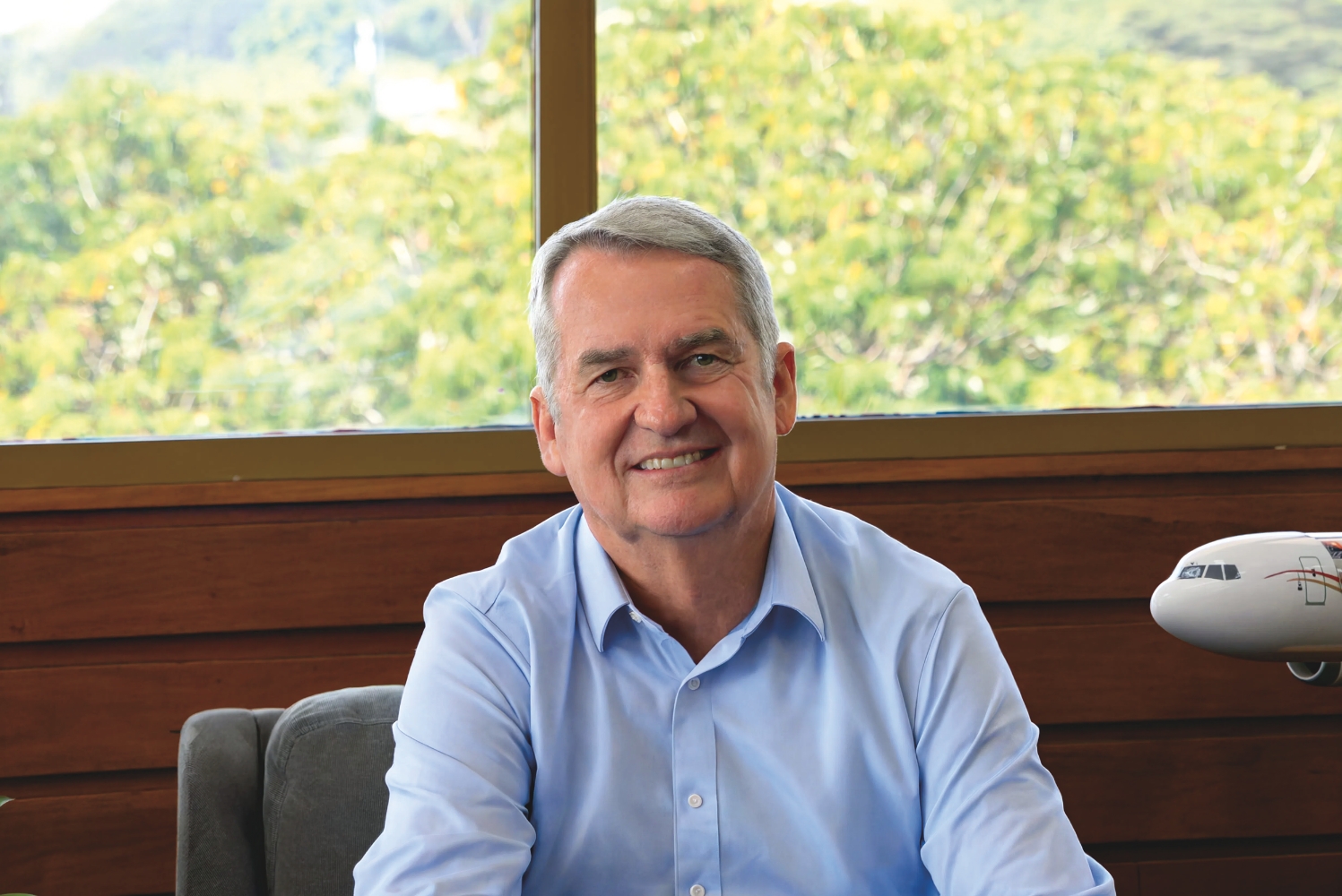
Air Niugini currently operates seven different aircraft types. Allan Milne wants to simplify that to just three.
“Our plan is to bring that down to probably only three,” the chief executive told Exepreneur. “It will set the airline up for the next 20 to 25 years. So we need to make sure we get it right.”
Milne returned as CEO to lead Papua New Guinea’s national carrier in early 2026, stepping back into a role he previously held from 2018 to 2020 as the Managing Director.
His reappointment came as the airline embarked on the largest fleet renewal program in the country’s aviation history, amid some of the highest fuel costs the industry has faced in decades.
Building a Regional Gateway
Under Milne’s leadership, Air Niugini is repositioning Port Moresby as a key transit hub connecting the Pacific, Australia, and Asia. The airline has revived long-dormant international routes and is expanding frequencies to major destinations across the region.
“All the Pacific Islands, Australia, East Coast Australia, can now come via Port Moresby, out to our Asian destinations, now Tokyo, Manila, Hong Kong, Singapore and onwards,” Milne told Exepreneur. “So we’re starting to see a lot of that traffic coming through Port Moresby.”
He sees untapped potential in turning layovers into opportunities for visitors to explore Papua New Guinea.
“Rather than spending two or three hours at the terminal, potentially two or three days to have a look around Papua New Guinea, be it Port Moresby or one of the other cities. So there’s opportunity there. You know, yes, it’s challenging, but we’ve got to take the opportunity as well.”
Despite the ambitious expansion, profitability remains non-negotiable.
“They have to be profitable,” he said of the new routes. “We’re not going to operate these routes at a loss.”
A Modern, Efficient Fleet
Central to Milne’s strategy is fleet simplification and modernization. Air Niugini has begun taking delivery of new Airbus A220 aircraft, fuel-efficient jets that will gradually replace older models like the Fokker series.
“We are exiting the Fokkers that have served the airline well for many, many years,” he told Exepreneur.
“Whilst the A220 will replace the Fokker fleet, we need to have plans for our turboprop operation and also our larger 737 and 767 replacements. So that’s a big task.”
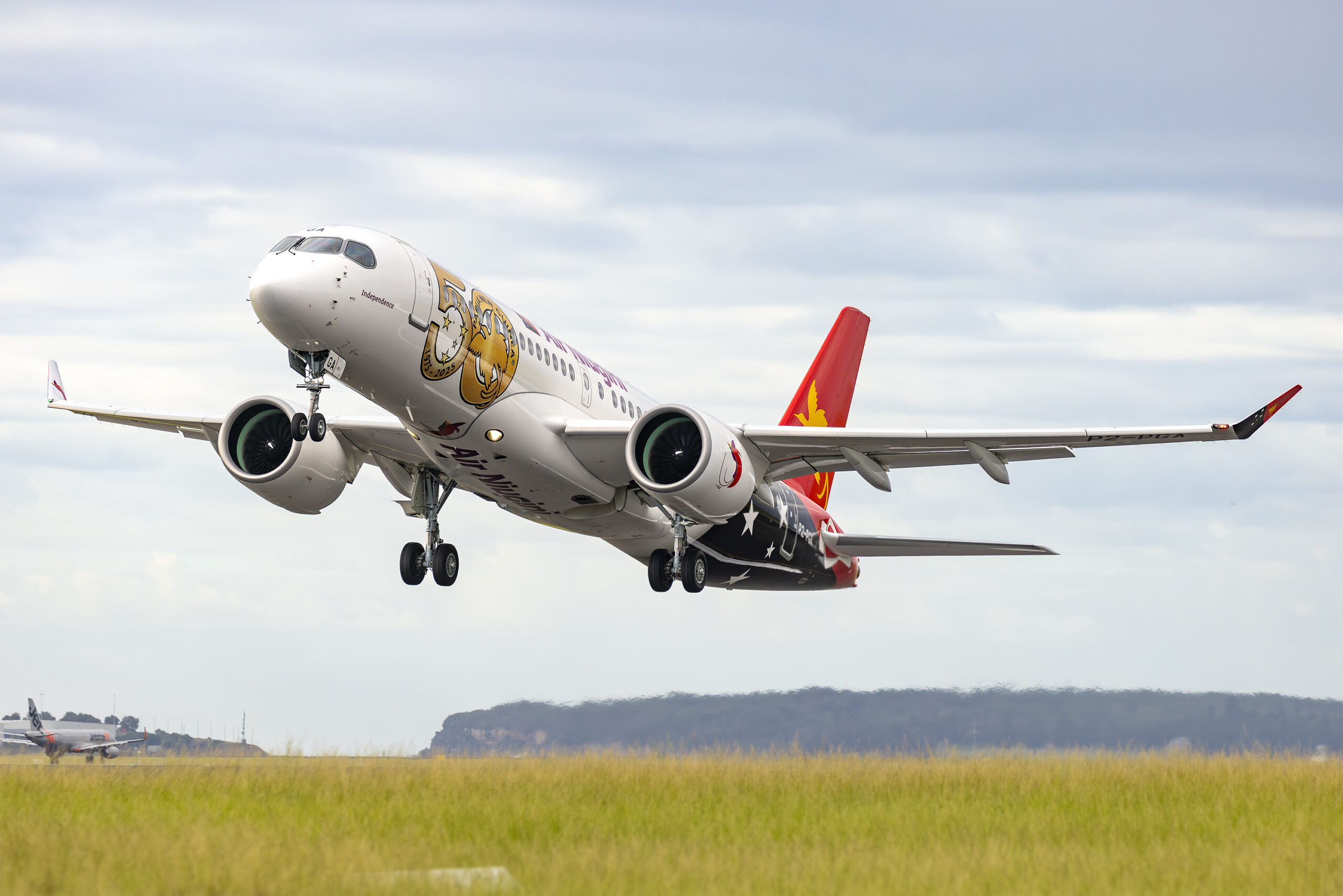
The A220 offers significant advantages in fuel efficiency and range, making it ideal for both domestic and regional routes. However, integrating these new aircraft requires more than just buying planes. It demands a transformation in how the airline operates.
“Strategic priorities are getting the fleet right,” Milne said. “That’s a big project, and that’s the strategy going forward, is making sure that we can get that fleet plan exactly the way we need it to be.”
Reviving a Proven Turnaround Playbook
Milne isn’t starting from scratch. During his previous tenure, he led a successful turnaround program called “Higher Altitudes,” which helped the airline move from a massive loss to a modest operating profit within a year.
“There is a fundamental change happening in Air Niugini. The last time around, we started a program call Higher Altitude. We have restarted that, and we’re rolling out the same things that we did that time around, which meant lower costs, lower operating costs, better revenue, not just through higher ticket prices, but different ways of generating revenue” Milne told Exepreneur.
He emphasizes that this isn’t a one-time fix but an ongoing effort.
“It’s not just a one-off, we do it, fix it, and then turn it off again. It’s a continuous improvement as we continue.”
This time, however, the challenge is greater. The airline is simultaneously managing a major fleet upgrade while trying to control costs, a delicate balancing act.
Navigating Global Headwinds
Like all airlines, Air Niugini is grappling with soaring fuel prices driven by global instability.
“The war in the Gulf at the moment is having a devastating impact on the fuel price, particularly at international ports,” Milne told Exepreneur. “The fuel price has doubled, which is, you know, we can’t push that on to our fare prices because it just makes it too, you know, unreachable.”
While many carriers have passed these costs onto passengers through higher fares, Air Niugini, being state-owned, has chosen to absorb the increase to keep travel accessible.
“The airline industry always rides the waves. COVID is a really good example. The industry was the first to be hit and the last to recover,” he said. “If it’s not COVID or SARS, it’s a terrorist attack or a war or something. So we just need to be resilient enough to be able to ride that.”
Cash flow remains a daily concern.
“An airline is always tough. Cash flow is always a problem for an airline, and we manage that on a daily basis,” he said. “But when you have a shock that big, it does make an impact.”
Beyond Flying: Maintenance and Cargo
Milne’s vision extends beyond passenger flights. He aims to position Air Niugini as a regional maintenance hub, offering heavy engineering services to other Pacific carriers that lack such capabilities.
“For a lot of the Pacific Island nations, we would be the closest engineering facility,” he told Exepreneur. “There are lots of operators out there, Solomon Airlines, Air Vanuatu, etcetera, that don’t have the capability to do big heavy maintenance checks. And we want to set ourselves up as a bit of a maintenance hub here, where we can do customer aircraft.”
This not only generates revenue but also creates skilled jobs for Papua New Guineans.
“It’s a great opportunity for employment, for training, for the young people of PNG to have a career as an aircraft engineer, which is where I started. And it’s a wonderful career to have.”
Cargo is another growth area. With freight demand rising and seat-filled flights not always guaranteed, expanding air cargo services offers a stable revenue stream that doesn’t depend on passenger numbers.
A Legacy in the Making
Milne describes Air Niugini as a “legacy airline,” a term that captures both its historical significance and the inertia that comes with it.
“Look, a legacy airline is a really good term, and that’s exactly what it is,” Milne told Exepreneur. “Now the biggest problem that we have to manage as a result of that is the change program, is that we can’t continue the way we’ve always done. We need to adopt new practices, new processes.”
He stresses that new aircraft alone won’t deliver results unless the entire organization evolves to support them.
“These come along with the new generation aircraft as well. We need to make sure that the organisation is capable of delivering the benefits that these aeroplanes can.”
Safety and reliability remain his top priorities.
“Without safety, compliance and reliability, you really don’t have an airline,” he said. “So that has to be the datum that we operate to, that we meet the requirements of the regulations, that we have a very safe operation, and that we fly the schedule that we’ve sold.”
“Aeroplanes don’t get unsafe, they just cost more to maintain, parts get harder to find, and there’s more disruption to the network as a result. So the introduction of new fleet types, new aircraft, brings reliability with it.”
As CEO, he takes full responsibility.
“So the buck stops with me,” Milne said. “As the Chief Executive Officer, I’m the accountable manager to make sure that the operation is compliant and safe. So it’s my responsibility to our regulator, the Civil Aviation Safety Authority.”
His confidence comes from deep technical expertise.
“I’m a qualified engineer, aircraft engineer, and a qualified pilot. So I know the operation pretty well.”
And the job never truly ends.
“As an airline CEO, your day starts at midnight and finishes at the following midnight,” he said. “It never stops. We have aeroplanes in the air all the time, and whilst ever that’s there, I’m accountable for that.”
Why He Stays
Milne is confident to see that the transformation is well underway before he lives.
“I can’t see myself leaving until we have that plan locked in place and we’re at least fifty percent through the way of delivering that,” he told Exepreneur. “We have good succession plans in place for our team, our management team, that we have good young nationals in the ranks coming along as a CEO ultimately.”
“That’s my role, is to make sure that we have that talent in our ranks and that we breed that talent and train it accordingly.”
He acknowledges the emotional and professional pull of the work.
“I can do the airline standing on my head. That’s easy. That’s 44 years of that experience. I can run an operation. But the people part of it and the business part I really, really enjoy.”
For now, the focus is on steady progress, not quick profits.
“Are we going to be super profitable into the future? Potentially, but, you know, the next 12 months is going to be locking the business down, cutting costs where, you know, absolutely where we can. A leaner, more effective business is what we’re after, and ultimately a reliable outcome for our passengers.”
With most of the new fleet still to arrive and key routes just restarting, the true test of Milne’s plan will come in the airline’s upcoming financial results and whether Port Moresby can truly become the Pacific’s aviation crossroads.