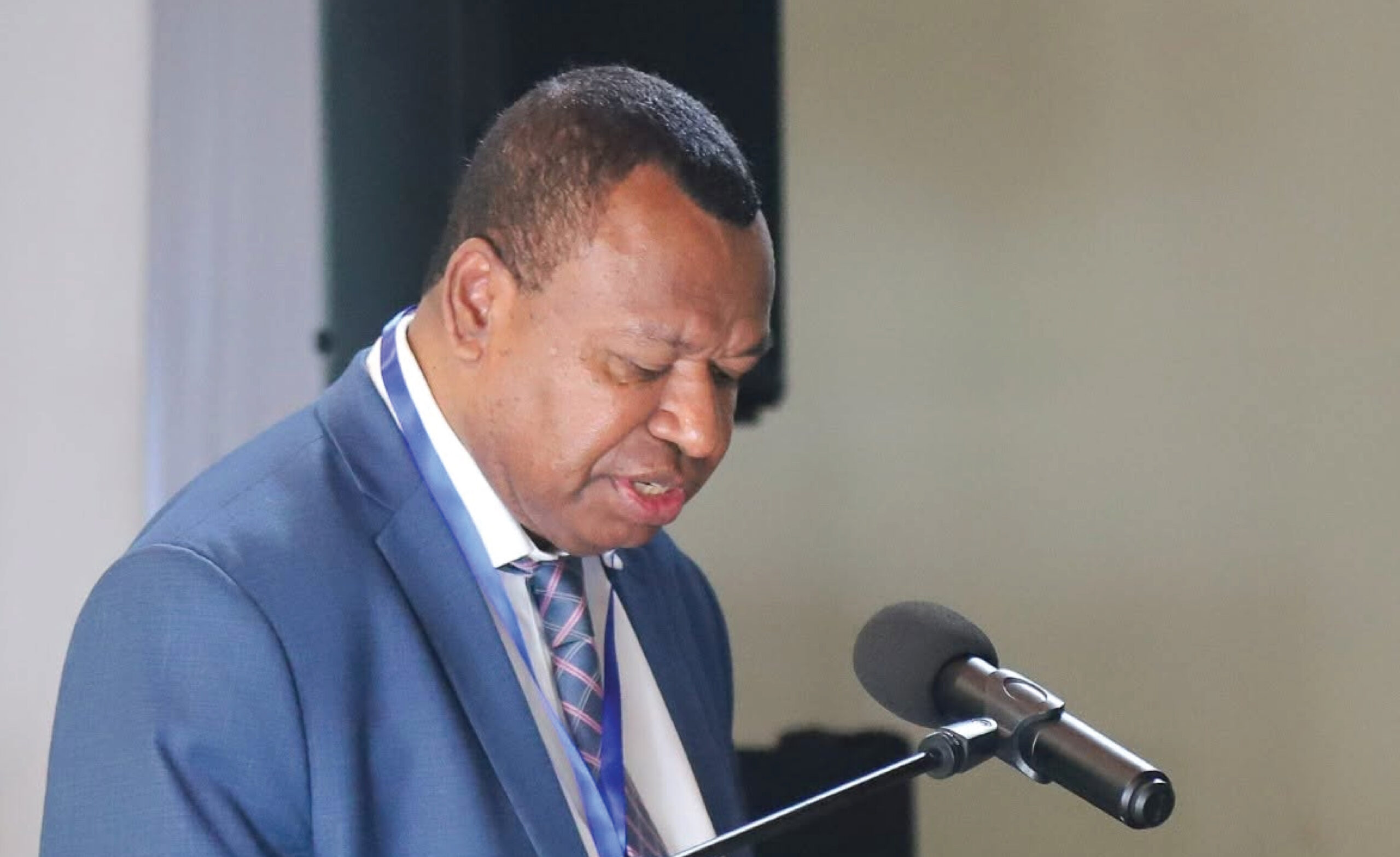
Papua New Guinea’s foreign exchange backlog has collapsed from K1.8 billion to about K200 million, an 89% drop that Bank of Papua New Guinea deputy governor Jeffery Yabom calls one of the most tangible results of the country’s IMF program. The bill for that turnaround is landing somewhere else: on ordinary Papua New Guineans paying more for imported goods, a cost Yabom himself admits businesses barely notice and households can’t avoid.
On one side of this story: BPNG, the International Monetary Fund, and a currency reform that is, by the numbers, working. On the other: every household buying rice, fuel or medicine in kina that buys less than it did three years ago. Both halves are true at once, and Exepreneur went back through the primary documents, not press summaries of them, to check which one PNG’s institutions are actually telling the truth about.
The announcement
Yabom told The National in March 2026 that businesses used to wait months to convert kina into US dollars to pay overseas suppliers, a delay severe enough to bring operations to what he called a near standstill. That is no longer the case. Outstanding orders are now being cleared on a daily and weekly basis, Yabom said, and BPNG’s own internal survey of businesses found they are, in his words, happy. Companies have stopped complaining about foreign exchange, he said, a claim that would have sounded implausible in Port Moresby’s business community two years ago.
The mechanism behind that shift is a triage system BPNG built to allocate scarce US dollars. Essential imports, food, medicine, and infrastructure equipment, get processed first. Everything else, including dividend repatriation by foreign investors and offshore capital placements by superannuation funds, sits in a second queue that only clears when the market generates a surplus. Yabom pointed to a specific data point to prove the second queue is moving too: the week before his comments ran, BPNG cleared more than K200 million in capital investment orders, evidence, he said, that the market is now producing enough liquidity to serve both queues at once.
That is a meaningfully different picture than the one Port Moresby’s business community was describing eighteen months ago, when dividend repatriation could sit unresolved for months behind a wall of essential-import priority. It does not mean the second queue clears on demand. Yabom’s own description makes clear it clears opportunistically, when exporters like Ok Tedi, Porgera and PNG’s LNG operations generate enough dollar inflow to create slack. On a bad week for commodity exports, that queue backs up again.
Checking the number against the IMF’s own book
Yabom’s K1.8 billion to K200 million figure is the freshest, most specific number on record, and it comes from BPNG’s own deputy governor rather than a press release. It is worth stacking against the parallel figures in the IMF’s own June 2026 country report on Papua New Guinea, which covers a different measurement window and uses a narrower definition, BPNG’s “outstanding order book” rather than the full backlog Yabom describes, but tells a consistent directional story.
The IMF’s staff report puts that order book at around K1.1 billion at the end of 2024, falling to around K360 million by December 2025. BPNG’s FX sales interventions, the direct dollar injections the central bank makes to clear orders, fell to zero in July 2025 before ticking back up slightly on seasonal factors.
FX market turnover rose to a monthly average of US$1.2 billion in the second half of 2025, up from US$1.0 billion in the first half. The IMF’s own language is blunt about what that adds up to: the fund’s Deputy Managing Director, Bo Li, said access to foreign exchange has greatly improved thanks to central banking reforms, a narrowing of the kina’s overvaluation, and higher commodity prices.
The overvaluation point is worth sitting with, because it is the mechanical root of everything else in this story. The IMF’s external sector assessment puts PNG’s real effective exchange rate overvaluation at 4.4% in 2025, down from 6.2% in 2024 and a substantial correction from roughly 14% at the time the country’s IMF program was first requested in early 2023. That is the number that explains why the queue shrank. A currency held artificially high forces rationing. A currency allowed to crawl down toward its market-clearing level removes the need to ration in the first place.
What BPNG actually built
BPNG moved to what it calls a crawl-like exchange rate arrangement in January 2024, replacing a hard peg with a managed, gradual depreciation path designed to serve as what the IMF terms the nominal anchor for monetary policy. The reform was never framed as a float. It was framed as a controlled walk toward convertibility, one the IMF explicitly credits with narrowing the kina’s overvaluation while keeping inflation from spiking on the way down.
It has not been a clean process. The IMF’s own staff report notes that key operational details of the crawl, the reference currency, the reference exchange rate, the pace of the crawl, and the width of the intervention band, have not been fully disclosed to the public, a transparency gap the fund’s staff flagged as something BPNG needs to close to build full market credibility.
The report also notes that PNG’s interbank FX market remains fragmented: some foreign banks sit on excess dollar liquidity able to serve non-essential demand, while others still lean on BPNG’s own interventions to clear essential orders. That unevenness is part of why Yabom’s “cleared daily and weekly” framing, while directionally accurate, understates how uneven the experience still is across PNG’s banking sector.
The fiscal and credit picture
The currency reform did not happen in isolation. It sits inside a broader IMF-backed program that has visibly changed PNG’s sovereign numbers. Government gross debt is projected at 49.2% of GDP for 2026, down from 52.6% in 2025, according to the IMF’s own tables, continuing a decline from a 2023 peak above 54%. Real GDP growth hit 5.6% in 2025, the IMF reported, moderating to a projected 3.8% in 2026 as LNG production plateaus and the war in the Middle East weighs on demand for non-resource exports while pushing up import costs.
Credit markets have taken notice. S&P Global Ratings affirmed PNG’s B-/B sovereign rating in June 2025 with a stable outlook, then went further a year later: on June 19, 2026, S&P revised the outlook to positive while again affirming the B-/B rating, citing PNG’s growth prospects. That is a rare trajectory for a country that spent much of the past decade fighting off downgrades, and it is the kind of signal institutional investors read closely even when the headline rating itself hasn’t moved.
The fiscal side backs up the credit story with hard numbers, not sentiment. PNG’s fiscal deficit narrowed to 2.1% of GDP in 2025 from 3.3% in 2024, the IMF reported, driven mainly by a 1.7 percentage point cut in current spending as the government delayed or canceled lower-priority transfers to local governments. Domestic borrowing costs eased sharply alongside it: the one-year Treasury bill rate fell below 6% in early 2026, down from above 8% at the end of 2024, freeing the government from some of the expensive short-term domestic debt that had built up in the pre-program years.
The part BPNG isn’t celebrating
Here is where Yabom’s own words carry more weight than any modeling in this story. Asked directly whether the reform’s benefits are shared evenly, he said no. Businesses have noticed the improvement, he said, but ordinary Papua New Guineans are more likely to feel the reform’s downside, the cost-of-living pressure that comes from a depreciating kina pushing up the price of imported goods. Many people don’t understand the mechanics of the reform, Yabom said. They only feel the inflation.
That is not a side comment. It is the central bank’s own deputy governor naming a distributional problem in the reform he is otherwise defending, and it deserves more attention than it got in a single paragraph of a March news story.
A weaker kina is precisely what closes the gap between the official exchange rate and the market-clearing rate, and it is precisely what makes every imported bag of rice, tin of fish or liter of fuel more expensive in kina terms. Yabom frames this as a necessary correction PNG has to absorb on the way to full convertibility, not a flaw in the design. He is not wrong on the economics.
He is also describing a policy where the winners, businesses that can now source dollars without months of delay, and the people bearing the cost, households with no dollar income to offset a weaker currency, are not the same group.
The compliance clock running in parallel
PNG’s FX story does not exist in a vacuum, and a second deadline is running alongside it that carries its own cost regardless of how well the currency reform performs. The Financial Action Task Force placed PNG on its grey list in February 2026, confirmed in BPNG’s own statement and detailed at length in the IMF’s June country report, after PNG failed to fully close deficiencies identified in a September 2024 mutual evaluation covering anti-money laundering and counter-terrorism financing controls.
The IMF’s own report is specific about what that costs, separate from any FX queue. Grey-listing increases scrutiny of PNG’s correspondent banking relationships, potentially raising the cost of cross-border transactions and, in the IMF’s words, disrupting cross-border financial flows, particularly for smaller domestic banks more exposed to de-risking by international counterparties. It also raises compliance costs directly, through higher due-diligence requirements and account maintenance fees that get passed on to PNG’s own exporters and importers using trade finance.
The IMF cites its own working paper research showing that capital inflows, including foreign direct investment, tend to decline meaningfully when a country lands on the grey list, a dynamic that could offset some of the very FX relief BPNG has just spent two years building.
PNG has been on this list before. It was grey-listed in 2014 and exited in 2016, and the government has set a similar roughly two-year target for exit this time, according to PNG’s own reporting on its FATF action plan. Whether it moves faster than the FX reform did is an open question, not a settled one.
What’s still ahead
The next leg of PNG’s currency story is not policy, it’s construction spending. Multiple large resource projects are moving through PNG’s investment pipeline: Wafi-Golpu’s gold and copper development is progressing through permitting toward construction, Papua LNG’s Final Investment Decision remains pending with the IMF’s own risk assessment naming it as a key upside catalyst for growth “in the coming months,” and earlier-stage gas projects including Pasca A and P’nyang remain further out. The IMF’s own capacity-to-repay analysis explicitly excludes these unconfirmed projects from its baseline forecasts, a conservative choice that leaves room for upside if any of them reach FID on schedule.
The reason this matters for the FX story specifically: multinational developers building these projects have to sell dollars for kina to pay local contractors, workers and suppliers during construction, an inflow that lands well before any production revenue does. That is the next wave of relief for whatever remains of PNG’s backlog, and unlike Yabom’s daily-clearance claim, it is not yet running. It is scheduled.
The result?
Papua New Guinea did something genuinely hard: it took a currency backlog that had strangled ordinary commercial activity and brought it down by roughly 89% inside about two years, according to the country’s own central bank, while a separate IMF dataset independently confirms the same direction of travel through a different metric. That is a real institutional achievement, and S&P’s positive outlook revision last month says the market is starting to believe it.
What PNG has not done is make that achievement free. The kina bought less at the end of this process than it did at the start, on purpose, and the people who feel that most are the ones without a business bank account clearing dollar orders. Yabom said it plainly: businesses are happy, and everyone else is left holding the inflation. A reform that fixes the queue and quietly moves the bill to households is still a bill. Someone in Port Moresby is always going to ask who’s paying it.
Editors Note: Bank of Papua New Guinea Deputy Governor Jeffery Yabom, as reported by The National (March 12, 2026); IMF Country Report No. 26/129 (June 2026); IMF Press Release PR26/192; Reuters (June 8, 2026); S&P Global Ratings (research updates dated June 27, 2025 and June 19, 2026). Figures describing PNG’s “outstanding order book” (IMF) and its broader “forex backlog” (BPNG) reflect different measurement definitions and time windows and should not be read as the same series.





