IRC Has K3.8 Billion Left to Find Before Marape’s Balanced Budget Year
PNG's IRC had K16.5 billion of a raised K20.3 billion 2026 target by 28 October, leaving about K3.8 billion before Marape's 2027 balanced-budget goal.
Key points
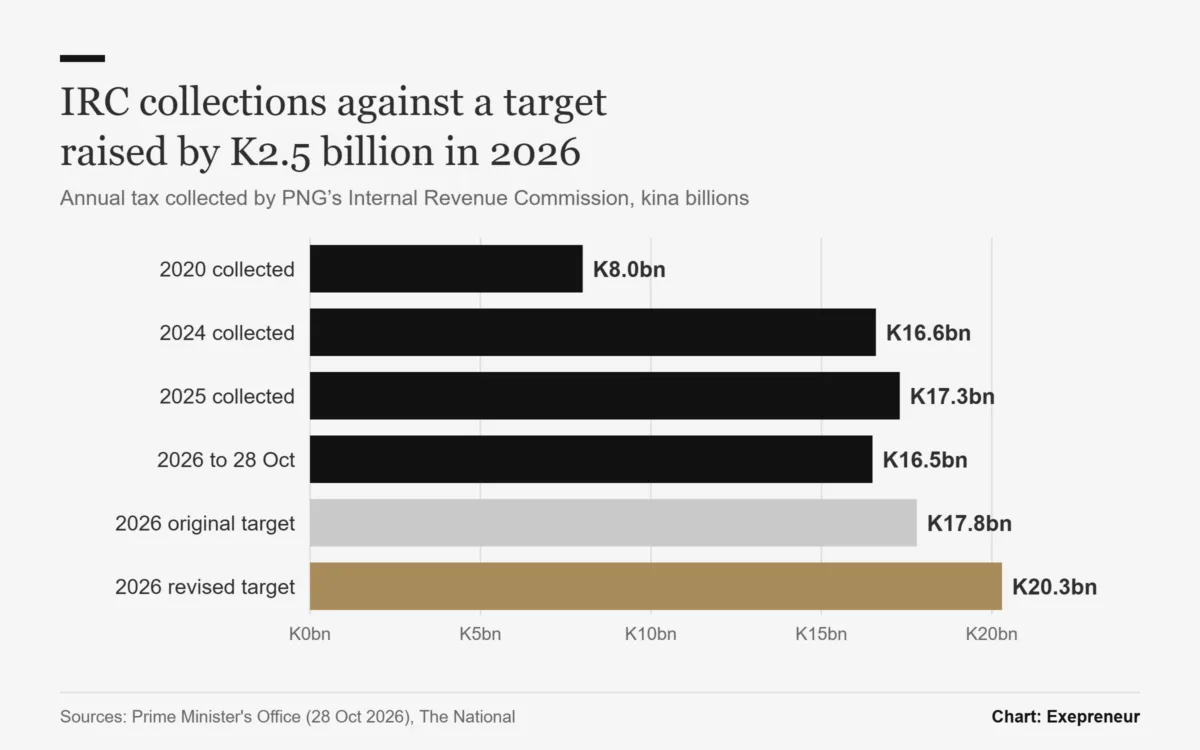
- The IRC had collected K16.5 billion against a revised 2026 target of K20.3 billion, raised from about K17.8 billion in the Supplementary Budget, the Prime Minister’s Office said on 28 October.
- Closing the K3.8 billion gap in November and December would need about K1.9 billion a month, around 15% above the January to October average if the figure covers ten months.
- Then-Treasurer Ian Ling-Stuckey said the 2026 upside came from Minerals and Petroleum Tax, expected over K3 billion above budget, while other taxes were slightly underperforming.
Papua New Guinea’s Internal Revenue Commission had collected K16.5 billion in 2026 against a revised annual target of K20.3 billion, according to a 28 October statement from the Prime Minister’s Office. That leaves about K3.8 billion to bring in before 31 December, with the Marape government aiming for a balanced budget in 2027.
Prime Minister James Marape released the figure on 28 October after chairing the Budget Management Committee in Waigani. The statement credited the result to investment in information technology, better compliance and stronger institutional capacity.
The K20.3 billion target was set in the Supplementary Budget. The original projection was about K17.8 billion, the Prime Minister’s Office said, which means the bar was raised by about K2.5 billion partway through the year.
Ahead of one target, behind the other
Measured against the original K17.8 billion, the IRC had already collected about 92.7% of its full-year number, according to the release. Measured against the revised K20.3 billion, it had collected about 81%.
The release did not state the cut-off date for the K16.5 billion. If the figure covers January to October, the IRC averaged about K1.65 billion a month. Collecting K3.8 billion in November and December would require about K1.9 billion a month, roughly 15% above that average.
Exepreneur could not confirm whether December carries heavier tax receipts than other months in PNG. The 28 October release gave no monthly breakdown of collections. According to the Prime Minister’s Office, the reported collections also exclude certain transfers tied to GST arrangements with provincial governments.
The record so far
Collections have grown quickly since 2020. The Prime Minister’s Office put 2020 collections at about K8 billion. By 2024 they had reached about K16.6 billion, and in 2025 they rose to about K17.3 billion.
That 2025 increase was about K700 million, or 4%, according to the same release. The National reported in January that the IRC transferred K15.8 billion to the Waigani Public Accounts in 2025, which was 97.3% of the projection, or 2.7% short.
Sam Loi, then Acting Commissioner-General, told The National at the time that the government had invested K130 million to modernise tax administration systems. He attributed part of the 2025 shortfall to “additional capital expenditure claims by the extractive sector.”
The 2026 revised target of K20.3 billion is about 17% above the K17.3 billion collected in 2025. The original 2026 projection of K17.8 billion would have required growth of about 3%, close to the 4% the IRC achieved the year before.
Where the extra money was meant to come from
The Supplementary Budget speech gives some context. Then-Treasurer Ian Ling-Stuckey told Parliament on 1 September that the Minerals and Petroleum Tax “is now expected, to exceed its budget estimate, by over K3 billion,” while “other taxes are slightly underperforming,” according to the published speech.
The speech did not give a revised total for tax revenue, and the Prime Minister’s Office release did not break the K20.3 billion target down by tax type. Exepreneur could not confirm how much of the IRC’s revised target is mining and petroleum tax. On Ling-Stuckey’s own description, though, the 2026 upside came from resources rather than from the broad tax base that the GST Monitoring System is designed to reach.
The same speech put additional 2026 revenue at K1,330 million, with matching spending, lifting total 2026 expenditure to a record K32,245 million. The deficit was held at K1,608 million, which Ling-Stuckey said represented “just 1.0% of GDP.”
The speech also set out new costs. Ling-Stuckey said the government’s fuel support would cost at least K1 billion in direct subsidy plus K110 million in lower GST revenue, and that he would introduce amendments “to remove GST from fuel.” El Niño relief added K1,165 million across national, provincial and district allocations.
What the IRC is counting on
Two changes sit inside the IRC’s own operations.
The first is the GST Monitoring System. NBC News reported in June that the commission had started a phased national rollout, beginning with large retailers and targeting what Loi called “the riskiest sectors and the sectors where we have the highest consumption.” The system links to businesses at the point of sale and captures transactions in real time.
The IRC told NBC it expected the system to be fully established by the end of 2026. The rollout had been deferred from 2025, when it was originally meant to launch alongside the removal of GST from 13 basic household items.
The second is the Income Tax Act 2025, which the IRC began implementing on 1 January 2026, The National reported.
What the IRC gave up
Policy decisions also cut into collections. The National reported in January that revenue forgone through the higher tax-free threshold and the removal of GST on 13 household items exceeded K300 million.
That GST relief is scheduled to end. As Exepreneur reported in October, the 10% GST on the 13 staples is due to return in January 2027. In 2025, the IRC also transferred K1.1 billion in GST to provinces and paid about K907 million in GST refunds and offsets to taxpayers, according to The National.
The 2027 problem
Marape tied the IRC result directly to next year’s fiscal plan, though the language has shifted. Ling-Stuckey’s September speech committed to “a budget surplus in 2027.” According to the Prime Minister’s Office, he said the government aims to contain the deficit at about 1% and is “hopefully bringing Government spending to a Balanced Budget next year.”
He listed what stands in the way. The statement said 2027 brings challenges including the National General Election, and that the government is still subsidising fuel. Marape also directed agencies that “no new contracts that are unplanned or unbudgeted must be introduced.”
He called for more non-tax revenue, including dividends and earnings from state-owned enterprises, companies and statutory bodies.
The IRC’s own growth has slowed. Between 2020 and 2024, collections roughly doubled from about K8 billion to about K16.6 billion, an average gain of about K2.2 billion a year. In 2025 the gain was about K700 million.
What it means for business
For companies, the K3.8 billion gap has two practical consequences.
The first is compliance pressure in the last weeks of the year. The GST Monitoring System is already reaching large retailers, and Loi’s stated aim is to know a business’s GST liability before it files. For retailers in high-consumption sectors, that means point-of-sale records feeding the IRC directly, on the commission’s own description of the system.
The second is the 2027 budget. For a balanced budget in an election year, with fuel subsidies still running, the 28 October statement points to two levers: a revenue push through the IRC and state enterprises, and a ban on unplanned or unbudgeted government contracts.
Treasury’s 2026 Final Budget Outcome will show whether the revised target was met. The 2027 National Budget, once tabled, will show how much of the balanced-budget goal rests on IRC collections growing again from whatever base 2026 delivers.
On the Prime Minister’s own figures, the IRC needs about K1.9 billion a month for the rest of 2026 to meet a target the government raised by K2.5 billion in the middle of the year.