
Fiji Airways Adds 125,000 Seats Into a Nadi Airport Needing FJ$2.3 Billion
Fiji Airways is adding more than 125,000 seats through Nadi in 2027. Fiji Airports has named no financier for its FJ$2.3 billion airport plan.
Key points
- Fiji Airways will fly more than 125,000 extra international seats through Nadi in 2027, led by a new Western Sydney route and more Hong Kong flights.
- Fiji Airports puts the Nadi master plan at an estimated FJ$2.3 billion, with a terminal expansion due by 2028.
- Exepreneur found no signed loan, public-private partnership or equity deal for the plan in public records through 4 November 2026.
Fiji Airways will fly more than 125,000 extra international seats through Nadi in 2027 within its existing fleet, the airline said on 2 October. In mid-October, Fiji Airports Acting Chief Executive Officer Amit Singh gave Parliament’s Standing Committee on Social Affairs the price of the Nadi International Airport master plan. It is an estimated FJ$2.3 billion, based on 2024 estimates, the Fiji Sun reported. It will be built progressively as demand and funding allow, he said.
Fiji Airports says Nadi is becoming overcrowded, and a terminal expansion is planned for completion by 2028, FBC News reported on 19 October. The existing terminal is designed for 3.4 million passenger movements a year, and Fiji Airports forecasts 8.8 million by 2048.
A separate parliamentary committee reported in July 2025 that Nadi’s aerobridges, baggage belts and scanning machines were 25 to 30 years old, the Fiji Sun reported. It said the airport needed FJ$2.3 billion over 10 years. Exepreneur found no public record of signed financing for the plan.
Where the new seats land
Fiji Airways’ release breaks the 2027 additions down by route. A new Western Sydney service starts at three flights a week on 19 March 2027, adding about 42,000 seats.
Hong Kong rises from three to five weekly flights from February, adding about 40,500. Christchurch goes from three to five weekly from March and Singapore from two to three, each adding about 20,000. Tokyo moves from two to three weekly in April and again from August, adding about 13,600.
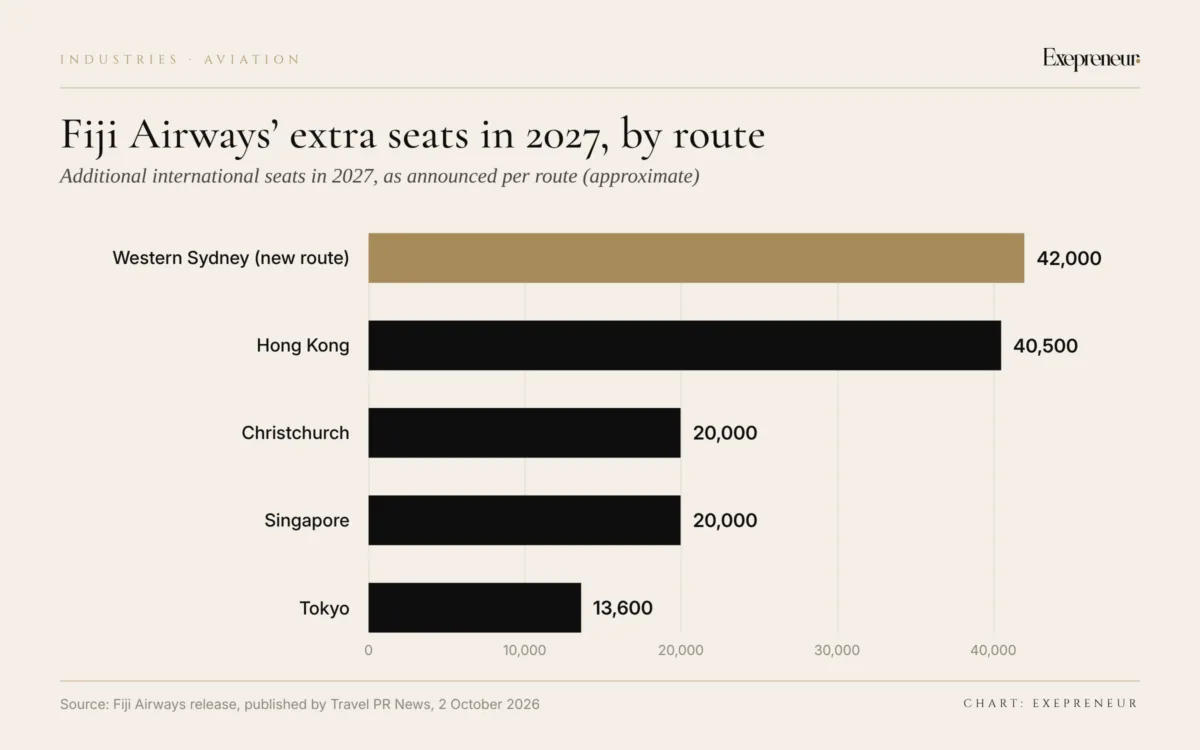
By Exepreneur’s count, those five route figures add up to about 136,100 seats, more than the headline total. The release, as published by Travel PR News, does not explain the difference.
“We’re excited to expand our network in 2027 and give more people around the world greater access to Fiji,” Managing Director and Chief Executive Officer Paul Scurrah said in the release. Scurrah said the expansion would also make it easier for passengers to connect through Nadi to the rest of the network, according to Islands Business.
Finance Minister Esrom Immanuel told Parliament in August that the airline faced significant financial pressure from high aviation fuel costs, according to fijivillage. Parliament unanimously approved a government guarantee of an additional FJ$200 million in Fiji Airways borrowing, covering 1 August 2026 to 30 June 2029. Fijivillage put the rise in the airline’s second-quarter fuel bill at about FJ$113 million against the same quarter of 2025. FBC News reported the increase as about FJ$130 million.
Figures cited in the debate, as reported by FBC News, showed Fiji Airways lost FJ$25 million in 2024 on operating revenue of about FJ$1.85 billion. The loss included an unrealised foreign exchange charge of FJ$83.5 million on US dollar leases. Scurrah told a parliamentary committee on 13 October that the board had approved a five-year plan to restore “sustainable profitability”, ch-aviation reported. He linked recent cost cuts to the 2027 seat additions.
Fiji Airways ended its Nadi to Dallas service in early September, citing fuel costs, the Fiji Sun reported. AeroRoutes listed the last Dallas flight as 5 September; the Fiji Sun reported the route would cease on 7 September.
How busy Nadi already is
Fiji Airports’ 2024 annual report counted 2,895,185 international passenger movements across its network, up 9.3% from 2,649,610 in 2023 and 30.9% above the 2,212,090 recorded in 2019. The same report says Nadi handles 97% of all international arrivals. Domestic passenger movements reached 1,039,632, and total aircraft movements hit 99,239, against 95,868 in 2019.
The report does not break out Nadi’s own terminal throughput. Its network-wide international figure is therefore not a like-for-like measure against the Nadi terminal’s 3.4 million design capacity.
The Fiji Bureau of Statistics recorded 986,367 visitor arrivals in 2025, up 0.3% on 2024 and 10.3% above 2019’s previous record of 894,389. July 2026 brought 105,791 visitors, the first month above 100,000. September arrivals reached 95,970, up 3.9% year on year, the bureau said.
The bureau’s monthly provisional releases put arrivals for January to September 2026 at 762,352, by Exepreneur’s sum. ANZ’s Pacific Insight report, using bureau data, put arrivals for the 12 months to June at 1,003,233, according to The Fiji Times. It was the first time the moving annual total had topped one million.
The Ministry of Finance’s June Pre-Election Economic and Fiscal Update forecast 1,003,283 arrivals for 2026 and 1,023,349 for 2027, growth of about 2%, The Fiji Times reported.
What has been fixed so far
The Standing Committee on Foreign Affairs and Defence put the equipment problem on the record while reviewing Fiji Airports’ 2022 annual report. It said many capital projects had been postponed in 2020 to preserve cash during COVID-19, the Fiji Sun reported.
Fiji Airports awarded RATE Australia a FJ$10.4 million contract for six new aerobridges, and the first went into service at Gate 2 in June 2025, according to Airports Council International Asia-Pacific. The bridge it replaced dated from 1985. The remaining units were scheduled for delivery by the end of 2025. Exepreneur could not confirm from public sources whether all six are now operating.
In September 2025 Fiji Airports announced a FJ$26 million baggage upgrade, including an FJ$8.1 million conveyor contract with Alstef Group, ACI Asia-Pacific reported. The work adds a second check-in conveyor, a new outbound screening line and a larger make-up carousel. Automated bag drops are coming with Collins Aerospace, and every hold-baggage screening machine is due for phased replacement.
The 2024 annual report lists FJ$4.7 million in early works to extend the departure lounge for more seating.
Kelepi Dainaki, Fiji Airports’ General Manager Assets and Infrastructure, said in October that smart gates are already installed for departures. “We are working with the ministry of immigration to install the smart gates,” he said of arrivals, according to FBC News.
Fiji Airports financial analyst Sowani Yaca told the committee that operating and maintenance costs rose 28.4% in 2024 compared with 2023, FBC News reported on 15 October. He named ageing infrastructure as the main cause. Maintenance now absorbs 12% of revenue, Yaca said.
Nadi’s runway lights failed from about 3 p.m. to 8:30 p.m. on 10 January, FBC News reported. Deputy Prime Minister and Minister for Tourism and Civil Aviation Viliame Gavoka called such disruptions unacceptable and directed the airport to operate fully around the clock.
The money behind the plan
Fiji Airports’ 2024 annual report shows net profit after tax of FJ$62.8 million, up 27.1% from FJ$49.4 million in 2023, and capital expenditure of FJ$46.2 million. The company paid FJ$22 million in dividends during 2024 and carried about FJ$94.0 million in interest-bearing borrowings at year end.
Spread evenly over the committee’s 10-year horizon, FJ$2.3 billion is FJ$230 million a year, about five times what Fiji Airports spent on capital works in 2024. The 2024 annual report does not put a cost on the master plan.
The most recent signed external financing Exepreneur found predates the plan. In 2021 the Australian Infrastructure Financing Facility for the Pacific (AIFFP) and ANZ Fiji put together an A$68.4 million package. AIFFP’s investment list shows a A$6.5 million direct loan and a A$61.9 million AIFFP guarantee of ANZ’s lending. It paid for apron, air traffic management and runway works. AIFFP lists the project as completed, with ANZ refinancing the AIFFP loan in May 2024.
The only master-plan funding Exepreneur found on record pays for advisers. In May 2025 the International Finance Corporation committed FJ$907,141 for project management, legal and green-building certification support, with Fiji Airports adding FJ$228,109, The Fiji Times reported. “It marks the beginning of what we hope will be a long-term and strategic partnership,” Fiji Airports Chairman Hasmukh Patel said at the signing. “The long-term vision laid out by Fiji Airports is one we fully support,” said Stephen Ndegwa, the World Bank’s director for Papua New Guinea and the Pacific Islands.
A Fijian Government call for private partners in August 2024 put the first stage of the plan, due by 2028, at an estimated US$250 million, InfraPPPWorld reported. Exepreneur checked Fiji Airports’ 2024 annual report, AIFFP’s investment list, IFC and World Bank statements, and Fiji Sun, Fiji Times and FBC News coverage through 4 November 2026. None disclosed a signed loan, public-private partnership or equity deal for that first stage or for the wider FJ$2.3 billion plan.
“The expansion will allow more passenger seating and retail offering,” Singh said, according to FBC News. He said food and beverage revenue would help fund the infrastructure upgrades.
Hong Kong moves to five weekly flights in February. Western Sydney’s first flight leaves Nadi on 19 March 2027. Fiji Airports’ expanded terminal is due in 2028, and the company has not publicly named who will finance it.