Medilek’s First Quarter Decides K92’s 2026 Guidance After 43% Gold Grade Fall
K92 Mining needs 47,388 ounces in David Medilek's first quarter as chief executive to meet 2026 guidance, after gold head grade fell 43% to 6.1 g/t.
Key points
- K92 Mining milled a record 250,042 tonnes in the third quarter, but gold head grade fell to 6.1 g/t from 10.7 g/t a year earlier.
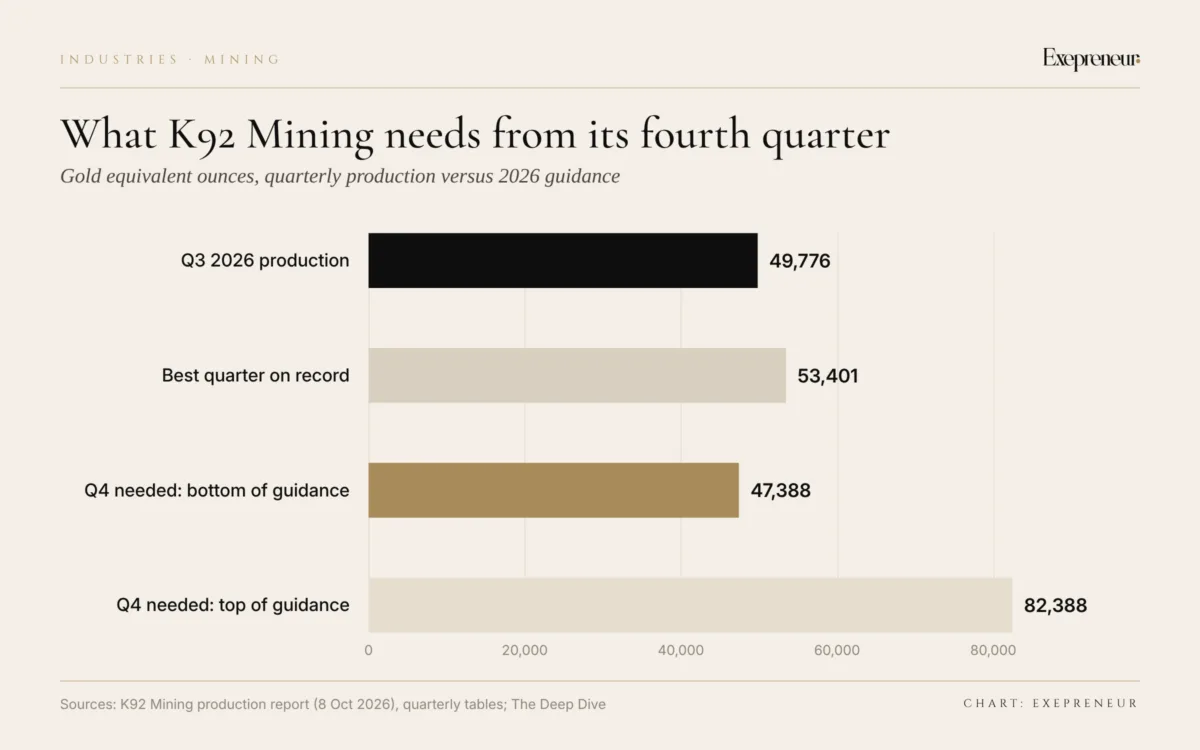
- Meeting the bottom of 2026 guidance needs 47,388 gold equivalent ounces in the fourth quarter, David Medilek’s first as chief executive.
- About PGK 116 million in landowner royalty is held in trust pending a court appeal, K92 told The National.
K92 Mining put a record 250,042 tonnes of ore through its Kainantu plant in the third quarter of 2026, 82% more than a year earlier, and got back 9% more gold. The company’s production report of 8 October shows why. The gold grade of the ore fed to the mill fell to 6.1 grams per tonne, from 10.7 g/t a year before.
K92’s October investor presentation calls it “the high-grade, low-cost Kainantu Gold Mine.” After a 43% fall in head grade, the Eastern Highlands mine has to move far more rock for each ounce it pours. The quarter still produced 49,776 gold equivalent ounces, the second-highest total in K92’s history, the company said. That was 46,063 ounces of gold, 1.95 million pounds of copper and 55,746 ounces of silver.
K92 has produced 142,612 gold equivalent ounces so far this year, according to its quarterly tables, against 2026 guidance of 190,000 to 225,000 ounces. Reaching the bottom of that range needs 47,388 ounces between October and December. The top end needs 82,388. K92’s best quarter on record produced 53,401, The Deep Dive reported.
K92 Mining reiterated its guidance on 8 October and said the fourth quarter would be its strongest of the year.
A new chief executive inherits the arithmetic
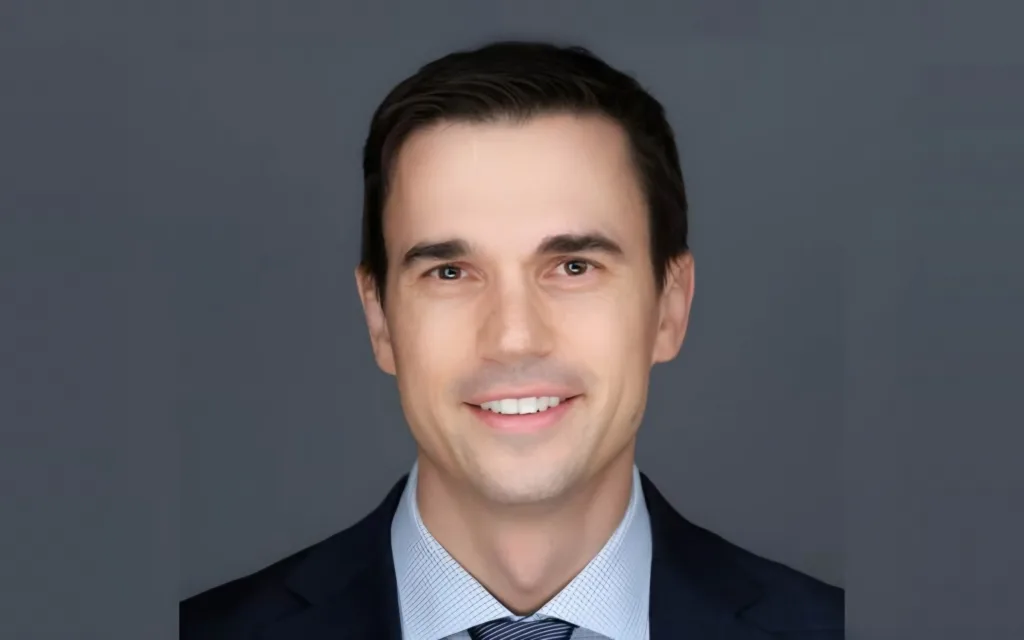
David Medilek took over as chief executive on 1 October, the company announced in August. John Lewins, chief executive since August 2017, became non-executive chair. Medilek joined K92 in 2019, according to the succession release, after working as a precious metals analyst at Macquarie, a mining banker at Cormark Securities and an engineer at Barrick Gold. The quarter that settles the 2026 guidance is his first in the job.
Medilek put his name to the target in the production release.
K92 Mining said a second mining front began stoping in April and a third, at Twin Incline, delivered its first stope ore in September. A primary ventilation upgrade that lifts airflow from about 350 to 600 cubic metres per second was scheduled to finish commissioning in the second half of October. Exepreneur’s review of K92’s news releases up to 4 November found no announcement confirming that commissioning was complete.
Eight new 60-tonne surface trucks are coming into service to haul ore straight from underground to the plant, five of them from late in the third quarter, according to the company. New bridges at Baupa and Kokomo and the Kasese river crossing have tripled the payload on the haul road from 20 tonnes to 60.
Volume up, grade down
The extra tonnes come from the Stage 3 plant, a 1.2 million tonnes per year mill that K92 completed in December 2025. Its design capacity is 3,290 tonnes a day. Over the 92 days of the third quarter, 250,042 tonnes works out to about 2,718 tonnes a day, or 83% of design, by Exepreneur’s calculation from K92’s figures. September did better: a record 92,937 tonnes, about 94% of design over 30 days, with a single-day peak of 3,725 tonnes on 19 September.
On grade, K92’s own quarterly table shows gold head grade at 10.2 g/t in the first quarter of 2026, then 6.2 g/t in the second and 6.1 g/t in the third. In its second-quarter results, the company reported “a moderate positive gold grade reconciliation” against its resource model. The lower-grade stopes came in slightly richer than the model predicted.
The fourth-quarter promise rests on a planned return to higher-grade stopes, which K92 has not quantified in public. The plant recovered 94.1% of gold in the third quarter, above the 92.6% assumed in the mine’s updated feasibility study, for the tenth quarter running, K92 reported.
What it means for costs
K92 guided to all-in sustaining costs of US$1,250 to US$1,350 per ounce of gold for 2026, net of copper and silver credits, in its January outlook.
K92 reported all-in sustaining costs of US$1,421 an ounce in the first quarter and US$1,376 in the second. Its half-year management discussion put the six-month figure at US$1,399, US$49 above the top of guidance. The same filing cited a “lower gold head grade of 7.7 g/t” for the half, against 10.9 g/t a year earlier.
K92’s average payable gold price was US$4,566 an ounce in the first half of 2026, against US$2,904 a year earlier, according to its MD&A. Even so, net income fell from US$116.6 million in the first quarter to US$84.6 million in the second, the company’s results show. Revenue dropped from US$236.3 million to US$205.2 million. Net cash reached a record US$310.0 million at 30 June.
Some third-quarter inputs are already public. K92 sold 41,587 ounces of gold in the quarter, 11% fewer than the 46,682 it sold in the second. The gold price it used to calculate gold-equivalent output fell from US$4,561 in the second quarter to US$4,308 in the third. K92 said on 9 October it will publish third-quarter costs and earnings after North American markets close on 16 November.
What Papua New Guinea gets from the volume
K92 Mining has paid PGK 230,920,184 to the Internal Revenue Commission as its third and final corporate tax instalment for 2026, the company announced. It said its tax and royalty payments for the year had reached PGK 991 million. “This third corporate tax instalment of PGK 231 million reflects Kainantu’s growing contribution to Papua New Guinea, with our total tax and royalty contributions for 2026 expected to exceed PGK 1 billion by year-end,” Medilek said.
The company says it has spent more than PGK 2.6 billion locally since commercial production began in 2018. In 2025 it paid PGK 136.6 million to joint ventures with local communities for transport, security, catering and maintenance. That was part of PGK 667.0 million spent with PNG suppliers, 52% of its procurement. About 60% of a workforce of more than 3,000 employees and contractors comes from landowner communities and Eastern Highlands, K92 told The National in July.
K92’s half-year management discussion records income tax expense of US$93.6 million for the first six months of 2026, nearly nine times the US$10.6 million it booked in net smelter royalties.
K92 told The National in July that about PGK 116 million in landowner royalty is held in trust pending a court appeal over who the declared landowners are. All of the provincial royalty has been paid, the company said. A revised agreement would split the 2% royalty 70% to landowners and 30% to the province, the company said. It would also give landowners and Eastern Highlands a 5% equity stake, but the government has not formally approved it and the equity provision is held up in court.
Kainantu MP William Hagahuno has pressed the issue for more than a year. At the opening of the Stage 3 plant in October 2025, he said royalties had been kept in trust for nine years, The National reported.
In June, Hagahuno asked Prime Minister James Marape in Parliament why the mine had not moved from a mining lease to a special mining lease. “It must migrate to a special mining lease regime,” Marape replied, The National reported. He directed Mining Minister Solen Loifa and the Mineral Resources Authority to settle compensation, licensing and agreement issues with landowners by the end of August. Exepreneur found no public report that those talks had concluded.
Stage 4 runs through the same agreement
The expansion that is meant to make volume pay sits on top of that unresolved deal. K92’s website says its Stage 4 Expansion will lift the plant to 1.8 million tonnes a year, with commissioning scheduled for the second half of 2027. The company says annual production will then pass 400,000 gold equivalent ounces, about double current levels. It has budgeted US$75 million to US$80 million of Stage 4 and accelerated growth capital this year.
Landowners told then Mining Minister Rainbo Paita in August 2025 that the benefits agreement must be signed before the mine moves to the special mining lease stage, according to The National. Marape has said a Pangu government policy passing 40% of secured benefits back to host provinces and people applies to the mine. “So that policy envelopes Kainantu mine as much as other mines,” he told Parliament in June.
Medilek’s fourth quarter needs 47,388 ounces to keep K92’s word to the market. Of the last five quarters in K92’s production tables, only the one just reported cleared that mark. The PGK 116 million in landowner royalty that K92 says sits in trust is waiting on a court appeal, not on a stope.