
AI Agents Head for 40% of Apps. The Pacific Has Only Principles
Agentic AI will sit in 40% of enterprise apps this year, Gartner says. The Pacific's first AI governance framework reaches leaders in 2027.
Key points
- Gartner expects task-specific agentic AI in 40% of enterprise applications by the end of 2026, up from under 5% in 2025. Pacific leaders endorsed their first collective AI principles only in September.
- PNG has a draft sovereign digital and AI strategy, a planned National AI Register, four new bills and deepfake amendments headed for the November sitting of Parliament.
- Gartner also predicts more than 40% of agentic AI projects will be cancelled by the end of 2027, the same year the Pacific’s AI governance framework reaches Forum leaders.
Task-specific AI agents will sit inside 40% of enterprise applications by the end of 2026, according to Gartner’s August 2025 forecast. The 2025 base was under 5%. The Pacific endorsed its first collective position on AI in September 2026, and it is not binding.
That is the gap this analysis measures. Boardrooms and conferences across Papua New Guinea and the region are still debating general AI: chatbots, content tools and whether staff may use them. The market the region buys its software from has moved to agentic AI, systems that plan and execute multi-step tasks on their own, and the numbers behind that shift now have dates attached.
What the world is building
Gartner’s August 2025 release, reported by UC Today, puts the move from embedded assistants to task-specific agents inside a single year. By 2028, the firm expects at least 15% of day-to-day work decisions to be made autonomously by agentic AI, up from 0% in 2024. It expects agentic capability inside 33% of enterprise software by the same year. By 2035, it projects agentic AI will account for about $450 billion in enterprise software revenue, near 30% of the market.
The same firm is the loudest sceptic. In a release dated 25 June 2025, Gartner predicted more than 40% of agentic AI projects will be cancelled by the end of 2027. The reasons it gave: escalating costs, unclear business value and inadequate risk controls. It estimates only about 130 of the thousands of vendors selling “agentic AI” offer the real thing, and calls the rest “agent washing”: chatbots and automation rebadged for the moment.
Gartner senior director analyst Anushree Verma made that assessment in the June release, adding that most agentic propositions “lack significant value or return on investment,” and that many use cases sold as agentic do not need agents at all.
| Year | Gartner forecast for agentic AI |
|---|---|
| 2025 | Under 5% of enterprise applications carry task-specific agents |
| 2026 | 40% of enterprise applications carry task-specific agents |
| 2027 | More than 40% of agentic AI projects cancelled by year end |
| 2028 | 15% of day-to-day work decisions made autonomously; agentic AI in 33% of enterprise software |
| 2035 | About $450 billion in enterprise software revenue, near 30% of the market |
| Source: Gartner releases of 25 June and 26 August 2025, as reported by UC Today and Outlook Business. | |
What the Pacific is debating
The region’s formal answer arrived in Koror. At the 55th Pacific Islands Forum, held in Palau from 31 August to 3 September 2026, leaders endorsed the Pacific Digital and Artificial Intelligence Technology Principles, which the communiqué calls the Pacific’s first collective regional position on AI and responsible digital technologies.
The principles commit members to AI that stays human-centred, inclusive and aligned with Pacific values, according to the communiqué. They call for transparency, accountability, safety and human oversight, and for protection of Pacific languages, cultures and traditional knowledge. A Pacific AI Governance Framework is to be developed from them and put to leaders in 2027. Forum Secretary General Baron Waqa urged ICT ministers in Port Moresby in July to “shape digital transformation on our own terms.”
The sequencing is the story. The framework reaches leaders in 2027, the year by which Gartner expects the first wave of agentic projects to have been built, judged and, in four cases out of ten, cancelled. A Devpolicy Blog analysis of the Koror communiqué described it as heavy on procedure and light on action.
Writing in The National in July 2025, technology policy researcher David Hua and AI Asia Pacific Institute board chair Peter Brimble noted that no Pacific island country had yet published a national AI strategy. They warned the region risks becoming a passive consumer of AI, bearing more of its risks than its benefits. Their prescription: law reform on data privacy and consumer protection, investment in AI literacy and a regional technical assistance facility.
What PNG has on the table
PNG is further along than the regional timetable suggests. The Department of Information and Communications Technology released a Draft National Sovereign Digital Transformation and Artificial Intelligence Strategy for public consultation in March 2026. Acting ICT Minister Peter Tsiamalili Jr described it as “a national reform blueprint to build a more modern, interoperable, secure, and investment-ready digital state.”
The draft proposes a single enterprise architecture for government services, a Digital Transformation and AI Board and an independent National Digital Economy Authority. It creates a state-owned Kumul Digital Infrastructure Holding Company and directs 1.5 percentage points of the 5.6% Connect PNG funding envelope to digital infrastructure through it. It names four bills: Critical Digital Infrastructure Investment, National Artificial Intelligence, Digital Identity and Trust Framework, and Data Governance and Protection.
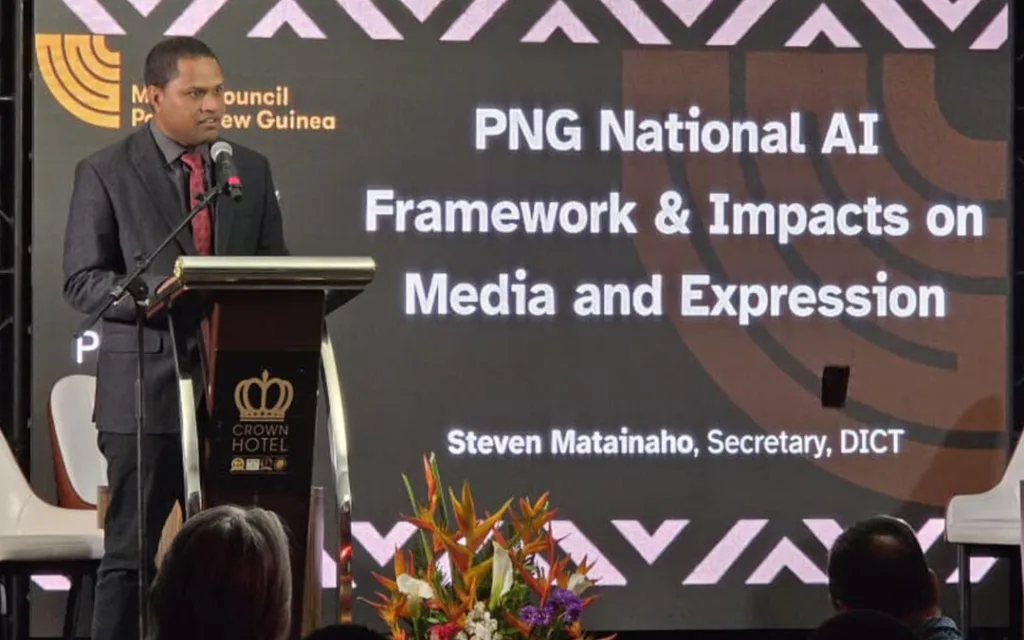
DICT Secretary Steven Matainaho set out the thinking at Media Summit 2026 in May. The department’s framework would deploy AI on trusted national platforms such as SevisPass, according to its account of the panel. A National AI Register would track every model used in the country, with oversight of offshore data processing. The longer aim is a move from foreign-trained models toward locally developed ones. Matainaho warned that without a sovereign framework, global AI models could misrepresent Pacific cultures, many of which remain oral and community-based.
The first legislation is already moving. Tsiamalili announced in July that amendments to the Cybercrime Code Act covering AI deepfakes, voice cloning and digital impersonation would be introduced in the November sitting of Parliament. The amendments put duties on platforms and AI providers to report and remove unlawful content. “No Papua New Guinean should have their face, voice or identity stolen and weaponised for profit,” he said in the ministry’s statement, while stressing the reforms are “not about criminalising legitimate AI use.”
The gap between the two clocks
Set the two timetables side by side and the mismatch is visible. The software PNG companies buy will carry agents this year, on Gartner’s numbers. The national AI bill has no published date. The regional framework arrives in 2027. The deepfake amendments hold the one confirmed parliamentary slot. They respond to general AI harms, not to agents acting autonomously inside business systems.
The adoption base is thin as well. DataReportal’s Digital 2026 report counts 2.6 million internet users in PNG as of October 2025, a penetration rate of 24.1%, leaving 8.21 million people offline. The Koror communiqué recorded that all Forum members are now connected to undersea cables for the first time. Exepreneur has reported on PNG’s digital ID rollout, where more than 3.6 million eligible citizens had yet to register for a national identity card as of mid-2026.
Agentic systems act on data. A country where three quarters of the population is offline hands those systems a narrow picture of its people. The data protection bill that would govern that picture is still a draft. Matainaho’s warning about misrepresented cultures is a version of the same point.
What business leaders can do now
The sceptic’s numbers are the practical guide. Verma’s advice in Gartner’s June release is to pursue agentic AI where it delivers measured value or return on investment. For a PNG bank, retailer or government supplier, that reads as a short list. Pick processes with clear rules and measurable outcomes. Demand evidence a product is genuinely agentic rather than a rebadged chatbot. Price in the risk controls before deployment, not after.
Procurement is the immediate exposure. With only about 130 genuine agentic vendors among thousands, on Gartner’s estimate, the first agentic decision most Pacific firms make will be a purchasing decision. The vendor due diligence question is no longer “does it use AI” but “what does it do without a human in the loop, and what records does it keep.”
What government leaders can do now
The pieces PNG has drafted map onto the agentic problem, if they pass. A National AI Register would capture agents, not just chatbots, if its definitions are written that way. A Data Governance and Protection Act decides what an autonomous system may touch. The November cybercrime amendments establish the principle Tsiamalili stated in July: “Accountability must extend beyond the person who creates harmful content.” Extending that principle to autonomous systems is a drafting choice, not a new policy fight.
The regional calendar gives PNG a window. The Pacific AI Governance Framework goes to leaders in 2027, and PNG hosted the ICT ministers whose July meeting fed it. A PNG National Artificial Intelligence Act passed ahead of that date would make Port Moresby the reference point for the regional text rather than a taker of it.
The dates to watch are fixed. Parliament’s November sitting takes the deepfake amendments. The ITU decides on a Pacific area office at its plenipotentiary conference in November. Forum leaders take up the governance framework in 2027. Gartner’s cancellation deadline for the first agentic wave falls at the end of the same year.
How will this affect your organisation over the next 12 months?