Pacific Resilience Facility Has US$10m in the Bank Against US$190m Pledged
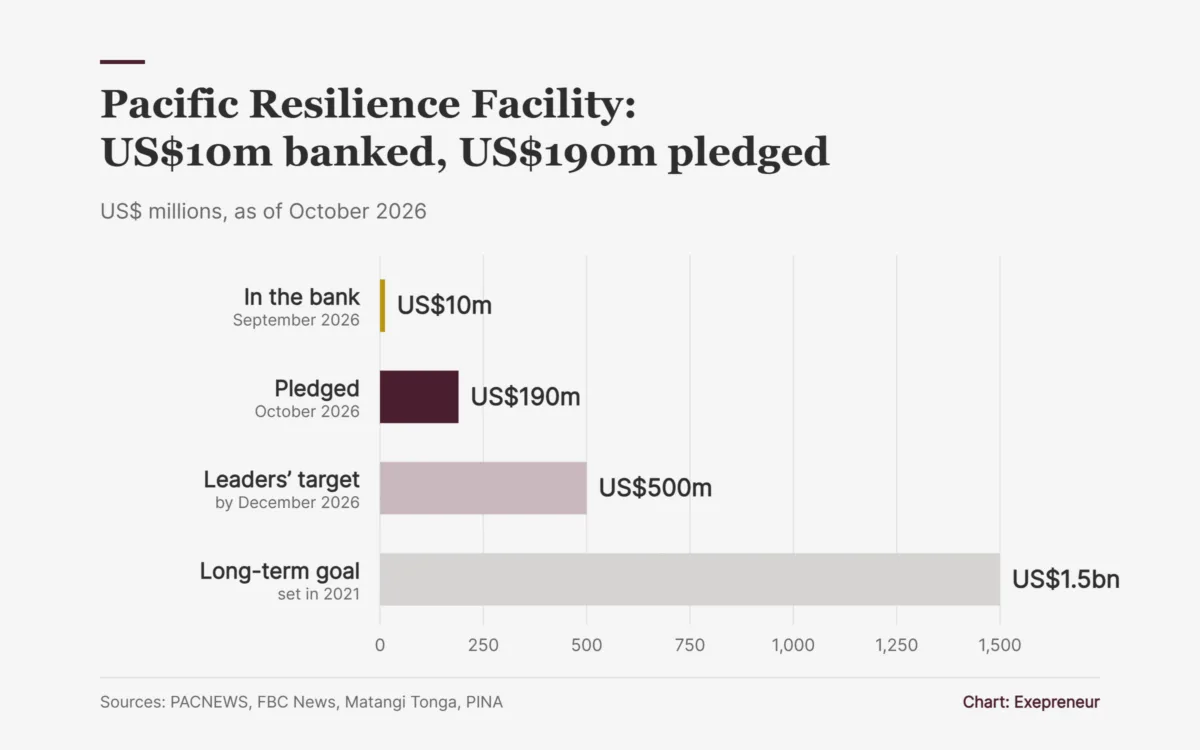
The Pacific Resilience Facility had US$10m in deposits in September against pledges now at US$190m. Leaders want US$500m by year-end.
Key points
- The Pacific Resilience Facility has US$10m in the bank against US$190m pledged. Leaders want US$500m by December or COP31.
- 14 of 15 signatories have ratified the treaty. PNG pledged US$4.5m but appears on no published ratification list.
- Pledges cover 13% of the US$1.5bn long-term goal. Deposits are 2% of the initial target, and the first funding call has slipped to January.
The Pacific Resilience Facility held US$10 million in deposits in early September against US$173 million in pledges, its general manager, Finau Soqo, told PACNEWS at the Forum leaders’ meeting in Palau. Pledges have since reached US$190 million, FBC News reported after the pre-COP meeting in Nadi this month. That is short of the US$500 million leaders want raised this year.
Forum leaders set December 2026 as the date for that target, Matangi Tonga reported. Climate Home News reported the aim as US$500 million by COP31, which opens in Antalya, Türkiye, on 9 November.
Soqo named Japan, Canada, Ireland and Nauru as having paid. Australia, New Zealand, France, the Marshall Islands and Solomon Islands were processing or preparing payment. The facility was still pursuing Saudi Arabia’s pledge, PACNEWS reported.
The first two pledges
Saudi Arabia’s US$50 million came first. Then-Forum chair Mark Brown announced it in November 2023 at the leaders’ meeting in the Cook Islands, PINA reported, saying it set the tone for the engagement the Pacific wanted.
Australia followed weeks later at COP28. Foreign Minister Penny Wong’s office described a “foundational” A$100 million contribution in a release dated 8 December 2023.
Almost three years on, Soqo’s September list placed Australia among the members still processing payment, PACNEWS reported. The United States has appropriated US$20 million, but its contribution is still under discussion, according to the same report.
Totals that do not reconcile
PACNEWS reported US$162 million in pledges up to the 2025 Forum leaders’ meeting. Matangi Tonga put the figure at US$172 million when the treaty took effect in May. PACNEWS and Islands Business both reported US$173 million at the end of August.
In Palau, PACNEWS reported new pledges of US$14 million from the United Kingdom, US$4.5 million from Papua New Guinea, US$1.05 million from Norway and US$1 million from the Marshall Islands. By Exepreneur’s count, that is about US$20.55 million. Islands Business reported the UK commitment as an additional £10 million over three years.
In Nadi, Fiji pledged US$10 million, Denmark US$2.3 million and the Netherlands US$1 million, FBC News reported. Climate Home News put the pre-COP pledges from European and Pacific governments at about US$15 million.
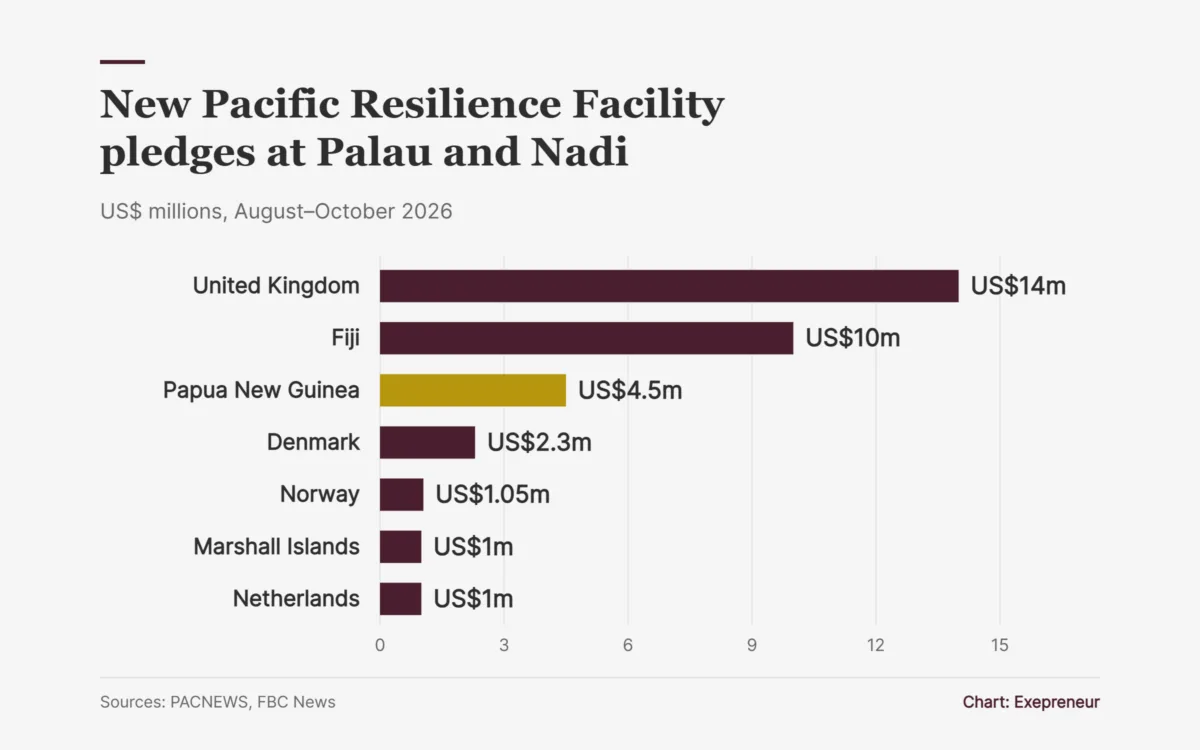
Added to US$173 million, the Palau and Nadi pledges would take the total above US$200 million. The facility’s published figure is US$190 million. Exepreneur could not establish which pledges each reported total includes.
Fourteen of fifteen
Forum leaders endorsed the Pacific Resilience Facility in 2023, named Tonga as host in 2024 and had 15 leaders sign its treaty in Solomon Islands in 2025, Matangi Tonga reported.
The treaty entered into force on 6 May 2026, when Australia and Fiji lodged their ratifications in Suva. According to statements from both governments, that made ten ratifying states, with Tonga, Nauru, the Marshall Islands, Solomon Islands, Tuvalu, the Cook Islands, New Zealand and Niue.
Kiribati joined at the first Council meeting on 25 June. The Federated States of Micronesia, Vanuatu and Palau deposited instruments in August, PACNEWS reported, and Soqo said 14 of the 15 signatories had ratified. He did not name the fifteenth.
PNG’s position
Papua New Guinea pledged US$4.5 million in Palau and, with Tonga and the Forum Troika, leads the effort to raise the remaining capital, PACNEWS reported. Projects in PNG are among those still in development, according to a separate PACNEWS report.
PNG does not appear on any published list of ratifying states Exepreneur reviewed. Neither does Samoa. Exepreneur could not confirm which signatory has yet to ratify, or whether PNG signed the treaty in 2025.
The Pacific Resilience Facility’s US$1.5 billion goal
The Pacific Resilience Facility started with a US$1.5 billion goal, PINA reported in 2021. COVID-19 delayed fundraising, and development partners have since cut aid budgets, Islands Business reported.
Prasad said a fully operational facility could hold US$1.5 billion and provide up to US$200 million a year, PACNEWS reported.
COP31 President Murat Kurum endorsed the US$1.5 billion figure as the Nadi meeting closed on 8 October, Climate Home News reported. Fiji’s climate minister, Lynda Tabuya, said the Pacific would hold the conference to it.
Pledges of US$190 million equal 38% of the initial target and about 13% of the long-term goal, by Exepreneur’s calculation. Deposits of US$10 million equal 2% of the initial target.
What the money buys
The Pacific Resilience Facility has awarded community grants of up to US$20,000 per member, funding 14 projects in nine countries, Islands Business and PACNEWS reported.
In Fiji, the money pays for about 22 rainwater tanks for a drought-hit community. Two Marshall Islands atolls get water tanks, Funafuti gets a women-led water project and Tonga is replanting native coastal trees, including two endangered mangrove species. In South Tarawa, two schools get water projects; one teaches students with disabilities.
The facility projects an annual operating budget of about US$5 million, partly covered by a fee members pay for access, PACNEWS reported. It plans to fund grants from investment income and charge its management fee against that income rather than its capital. Exepreneur has tracked where capital is actually going across the region.
The Pacific Resilience Facility timetable
Cook Islands Prime Minister Mark Brown said large global funds are slow, complex and built for big projects, Islands Business reported. Soko Tuima, the facility’s sub-regional coordinator for Melanesia, said its grants should reach communities fast.
In May, the Australian and Fijian governments said the first call for proposals would open at the Palau leaders’ meeting in late August. In September, Islands Business reported that the call would open in January, worth at least US$2.25 million.
A US$1.8 million community disaster resilience pilot was due at the October pre-COP, Islands Business reported. PINA’s report on the pre-COP pledges did not mention it, and Exepreneur could not confirm it was announced.
The Green Climate Fund is supporting the facility’s set-up through its readiness programme, PACNEWS reported. Executive director Mafalda Duarte described the facility as complementary to the fund’s work, and regional director Hemant Mandal said it would not replace the GCF in the Pacific. Soqo said the facility has no short- or medium-term plan to seek GCF accreditation, according to PACNEWS.
COP31 runs in Antalya from 9 to 20 November, and Australia and Fiji said in May that a special session there would take pledges for the facility. Its permanent board is due by January 2027, Islands Business reported, the month its first call for pilot projects opens. Exepreneur found no deposit figure published since Soqo’s US$10 million in September.