
KEY POINTS
1. Under draft SevisPass SIM registration rules, every active phone line in Papua New Guinea would face a government identity check at least once every 12 months. Lines that fail would be restricted, then cut off.
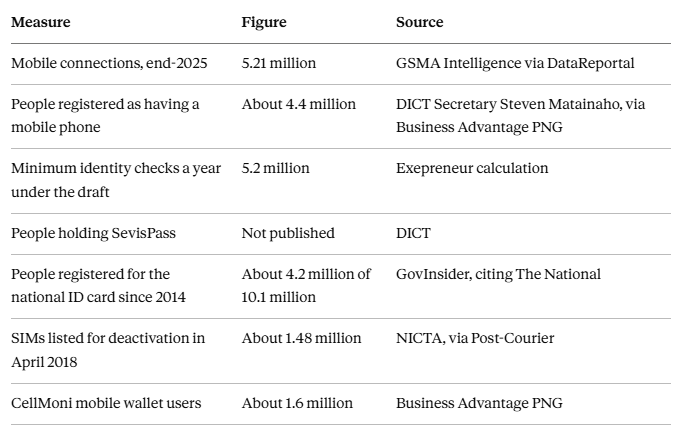
2. PNG had 5.21 million mobile connections at the end of 2025, according to GSMA Intelligence data published by DataReportal. That means at least 5.2 million checks a year.
3. The government has not published how many people hold a SevisPass. In the last SIM registration drive, about 1.48 million SIMs were listed for deactivation in April 2018.
Every active phone line in Papua New Guinea would have to pass a government identity check at least once a year, or be cut off. And the man who will ensure this happens is the recently appointed Minister for Information and Communicatons Technology, Robert Naguri. Every active SIM will undergo at least one digital ID re-verification every 12 months according to statement released by the ministry.
PNG had 5.21 million mobile connections at the end of 2025, according to GSMA Intelligence figures published by DataReportal. On those numbers, the rule means at least 5.2 million identity checks every year, each one tied to SevisPass, the government’s digital ID.
SevisPass SIM registration at a glance
What the SevisPass SIM rules require
The draft rebuilds SIM registration around SevisPass. Adults could not activate a new SIM without first proving who they are through SevisPass, the ministry’s statement said.
Existing customers would have to get a SevisPass and link each active SIM to it using the SevisWallet phone app. Teenagers aged 13 to 17 could hold a SIM in their own name through a SevisPass-Minor connected to a parent or guardian. Children aged 12 and under could not hold a SIM in their own name at all; any SIM they use would be registered under a parent’s or guardian’s ID.
Getting a SevisPass and linking a SIM would be free for citizens, the ministry said. Phone companies would pay instead, through a fee for each identity check and each annual recheck. The fee schedule would be agreed with the ICT department, the National ICT Authority (NICTA) and the Bank of Papua New Guinea.
Phone companies would also stop holding customers’ biometric data. “Telcos will no longer store raw biometrics; they will rely on SevisPass tokens instead,” the ministry said.
The ministry’s statement lists reducing fraud, scams and crime among the rule’s goals. Peter Tsiamalili Jr, then Acting ICT Minister, said the change ensures every phone number in PNG is tied to a verified, sovereign digital ID, The National reported in December 2025.
The yearly check
Under the draft, every line goes back through the check each year. A SIM that fails the yearly recheck “will first be placed on limited access and then deactivated,” the ministry’s statement said. The draft does not say how long a customer would have between losing full service and losing the line altogether.
The rules also set a deadline for the first round. A grace period was proposed to run from 1 January to 30 June 2026, after which SIMs not linked to a valid SevisPass “will be deactivated,” the statement said.
That date has passed with the rules still unapproved. Biometric Update reported on 2 October that ICT Secretary Steven Matainaho said PNG was finalising the rules, and that subscribers would have 12 months to link their SIMs to SevisPass once the regulation is endorsed.
How many people could lose their phone line
The government has not published how many people hold a SevisPass. The other public figures do not agree with each other. GSMA Intelligence counted 5.21 million mobile connections at the end of 2025, equal to 48.2% of the population, DataReportal reported.
DataReportal noted that connections are not the same as people, because some users hold more than one SIM. Matainaho said around 4.4 million Papua New Guineans were registered as having a mobile phone, Business Advantage PNG reported in July 2025. The ICT ministry’s own April 2026 statement put mobile penetration above 70%. Exepreneur found no published reconciliation of these figures.
Only about 4.2 million of an estimated 10.1 million people had registered for PNG’s older national ID card since 2014, according to an article on GovInsider co-written by DICT’s digital public infrastructure programme lead, which cited The National. Only 5% of those registered had received the physical card.
SevisPass can be obtained through the app or at enrolment centres, using personal details and fingerprints or a face scan, the Digital Government Network reported in April. The GovInsider article said offline and printable credentials are available for people without smartphones or reliable coverage.
Lessons from PNG’s last SIM cut-off
PNG has switched off phones before. In April 2018, NICTA listed about 1,477,000 unregistered SIMs for deactivation, Post-Courier reported. Digicel alone had 2.6 million active subscribers, of whom 1.4 million were unregistered. Operators faced a penalty of K50,000 for every unregistered SIM they failed to switch off.
Amanda Watson, a researcher at the Australian National University, documented what followed on the Devpolicy Blog in December 2019. The Supreme Court granted Madang MP Bryan Kramer an urgent injunction against deactivation on 30 April 2018. Deactivation started in urban areas on 1 August 2018. It was then on hold for most of 2019 while the Ombudsman Commission’s constitutional challenge was before the court. Readers of her post later recorded further deadline extensions in 2020, partly because of COVID-19.
Watson warned that deactivation could have a very real impact on rural and remote communities, where mobile phones are often the only form of communication. She noted that registering the last remaining users meant sending teams to remote areas, which was costly and slow.
What’s at stake for mobile money
Digicel’s CellMoni wallet has about 1.6 million users, roughly 53% of Digicel’s PNG customers, Business Advantage PNG reported in July 2025.
Since April 2026, people can open a MiBank account through the SevisWallet app, send money to other verified users and buy airtime, according to a statement from the ICT ministry. The same statement estimated that 60% to 70% of the population is unbanked, particularly in rural and remote areas.
Ronald Prasad, Vodafone’s chief strategy officer, told the Innovation PNG 2025 conference that mobile wallets could bring up to 50% of the unbanked into the formal financial system, Business Advantage PNG reported.
The draft does not say what happens to a mobile wallet when the SIM behind it is restricted or deactivated. Exepreneur found no published figure for the number of MiBank customers using SevisWallet.
Where the SevisPass SIM rules stand
NICTA consulted on the draft SIM Card Registration (Amendment and Consolidation) Regulation 2026 from 17 December 2025 to 28 February 2026, after a one-month extension, the ICT department said on 10 March.
“I anticipate that NICTA will implement the regulation through a phased enforcement approach,” Tsiamalili said at the time. The department said further announcements would follow once the regulation moved through formal approval and gazettal. It gave no date.
The government also plans to connect SevisWallet to the electoral roll, Biometric Update reported. Polling for PNG’s next national election is tentatively set for 26 June to 9 July 2027, The National reported in February.
Three numbers will show how much risk the rules carry: the date the regulation is gazetted, the start of the 12-month linking window that follows, and the first published count of SevisPass holders from the ICT department.





