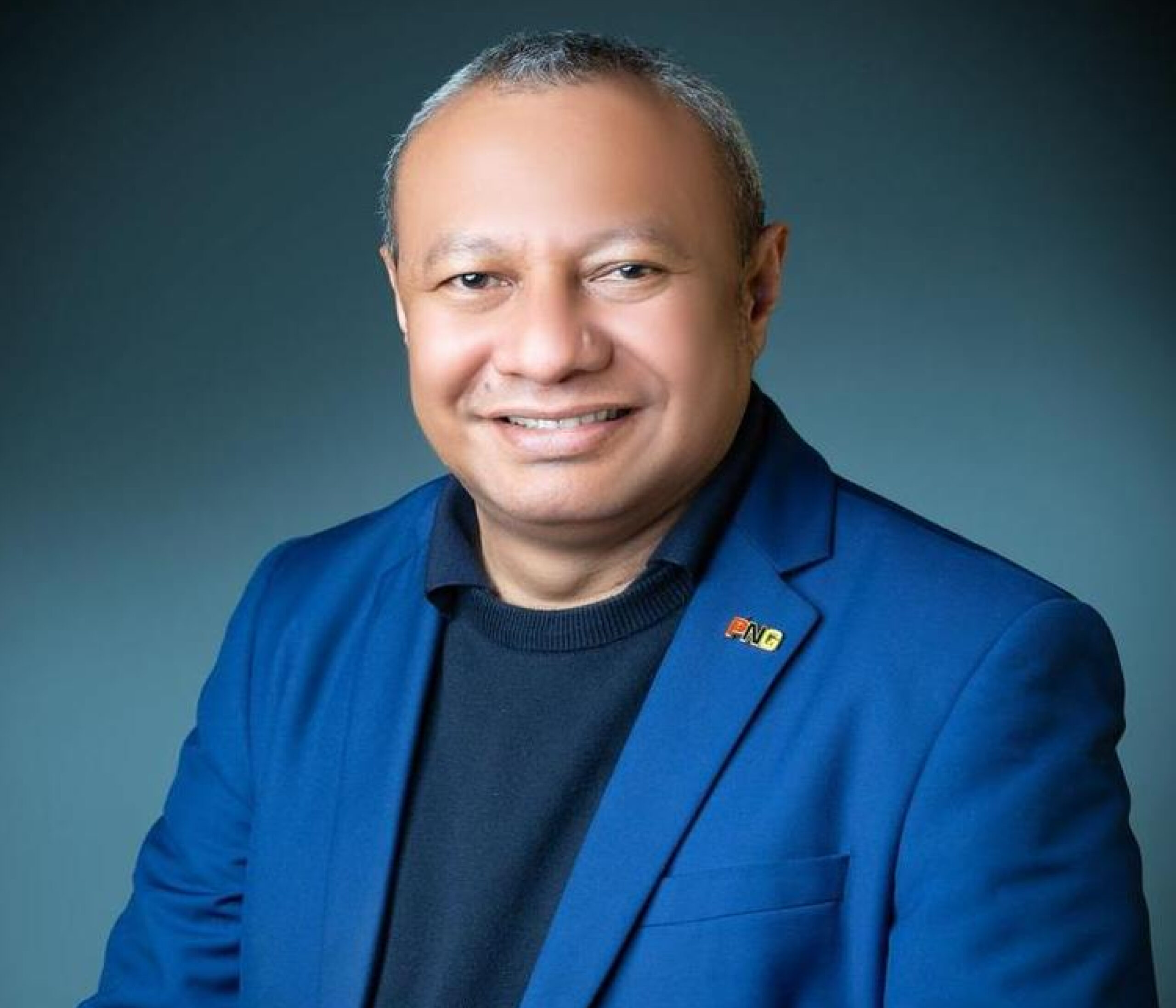
Sam Loi has been confirmed as Commissioner General of Papua New Guinea’s Internal Revenue Commission, ten months after he stepped in as acting head. Unless the 2027 Budget extends it, the GST exemption on 13 household staples ends on 31 December, and his office goes back to collecting 10% on rice, tinned fish and baby diapers the next day.
Loi, who joined the IRC as an auditor in 1999, replaces Sam Koim. By his own figures, Koim more than doubled annual tax collections in six years. He resigned in December 2025 to contest the Dei Open seat, NBC News reported.
Koim’s numbers
The IRC collected K8.2 billion in 2020, Koim’s first full year, despite losing about K2.16 billion during the first Covid-19 lockdown, he told The National. By 2023 collections were just under K16 billion, he told NBC News in May 2024. In December 2024 the IRC said it had met its K17.3 billion target for that year, and Koim put total collections since 2020 at K65 billion.
The 2020 base was low. Mining and petroleum tax fell 75% that year, Koim said at the time, which flatters any comparison that starts there.
Koim arrived from outside the tax system in August 2019, after chairing Investigation Task Force Sweep, the disbanded anti-corruption unit, Loop PNG reported. In his first statement he put company tax compliance at 9% the previous year, said K18 billion in sales had gone unreported in 2016 and said K5 billion in tax debt was still uncollected. He promised criminal prosecutions of companies that cheated the State.
Cabinet made the job permanent in early 2020. Prime Minister James Marape told IRC staff their new leader “makes people work,” The National reported.
Koim switched off unverified GST credit offsets against salary and wage taxes, which added about K30 million a month in personal income tax, The National reported. In 2022, with budget projections built on US$60 oil, the IRC set provisional tax assessments at US$110 a barrel, against the US$80 to US$90 that oil and gas companies had proposed, according to Koim. That April, K1.18 billion went into the public accounts in a single day.
Collections for the first half of 2022 reached K5.945 billion, K1.28 billion above projections, Koim said. He credited higher oil prices and 32 internal reform projects.
The IRC’s budget rose to K100 million in 2025 from K62 million in 2024, EMTV reported. The government reappointed Koim for five years from January 2025, according to the National Gazette. He left 11 months into that term, during discussions over amendments to the IRC Act, NBC News reported.
The 2025 shortfall
The IRC collected K17.3 billion in 2025, up 4% on 2024, PwC PNG reported in January, citing the IRC. The target had been K19.4 billion. Collections came in about K2.1 billion, or 11%, below it.
Those figures do not square with the IRC’s earlier claim. A 4% rise to K17.3 billion puts 2024 near K16.6 billion, not the K17.3 billion the commission said it had reached in December 2024. Exepreneur could not reconcile the two.
Total tax collections grew 7.9% in 2025, according to Treasurer Ian Ling-Stuckey’s Final Budget Outcome, as summarised by PwC. He also warned that over two years, tax had lagged nominal GDP by a cumulative K1.6 billion. GST was held back by the staples exemption and by delays to the IRC’s GST monitoring system, PwC said.
Loi’s first nine months
Loi took charge as acting Commissioner General on 17 December 2025. He has spent his whole career inside the commission.
Loi started as a source collection auditor in 1999, became a senior resource company auditor in 2008 and an assistant commissioner in 2014, and ran the Large Taxpayers Office from 2018, according to The National. He later served as Commissioner of Tax.
The National lists his specialties as transfer pricing and the taxation of mining, petroleum and gas, and says he ran the IRC’s Covid-19 continuity plan.
Marape said Loi brought 30 years of IRC experience, according to The National. His own record starts in 1999, which makes it about 27.
Koim pushed for that promotion. Naming Loi acting Commissioner of Tax, Koim said the commission’s top tier had been filled by lawyers and he wanted “an accountant here to crunch the numbers,” The National reported.
Revenue rose 37% in the first quarter of 2026, helped by one-off early mining and petroleum payments and high commodity prices, PwC reported in May, citing the IRC. First-half revenue was up 46% on the same period in 2025, PwC said in August. Newmont’s Lihir operation paid about K1.5 billion in advance tax in those six months.
The IRC’s Hela office opened this year, completing its Highlands network. PwC described it as a project that moved from vision under Koim to delivery under Loi. Hela was the one province without an IRC branch in May 2024, Koim told NBC News.
In January the IRC formalised an information-sharing arrangement with the Independent Commission Against Corruption, PwC reported. By March it had announced an Additional Profits Tax audit of mining companies and was working with the Australian Taxation Office on tax crime cases.
The 2026 Budget amended the IRC’s founding law to create an oversight body, PwC reported. Ling-Stuckey has since pointed to a planned IRC governance board as a way to lift collections and reach the informal economy.
The GST break
Rice, flour, tinned fish, tinned meat, chicken, biscuits, noodles, tea, coffee, cooking oil, soap, women’s hygiene products and baby diapers have carried no GST since June 2025. Marape set the exemption to expire on 30 June 2026, and the 2026 Budget pushed that to 31 December. Exepreneur found no government statement on what follows.
Ling-Stuckey told The National the exemption would cost about K210 million in the second half of 2025. This year’s budget set aside K1.01 billion for household relief, with a full year of the GST break as its biggest item, up from K685 million in 2025, he told Parliament.
The Bank of Papua New Guinea’s monetary policy committee said at its final 2025 meeting that the exemptions were holding down core inflation, PNG Business News reported. Annual inflation fell to 2.2% in the March quarter of 2026 from 4.7% in the September quarter of 2025, official figures show.
Westpac reached the same view in April, crediting the GST break and steadier non-fuel prices.
Some shops did not pass the cut on. An IRC inspection of zero-rated goods across the country found significant non-compliance among retailers in the Islands Region, PwC reported in May, and the commission sent warning letters.
The International Monetary Fund expects inflation of 4.8% in 2026 and says the GST break is partly offsetting dearer imports, AAP reported in June. The kina is about 20% weaker than at the start of 2023, the central bank said in August, according to The National. Oxfam PNG estimates up to 3 million people could be hit by El Niño drought and frost, 1.9 million of them in the Highlands, PreventionWeb reported.
The budget squeeze
KPMG puts the 2026 Budget deficit at about K1.6 billion, with a surplus targeted for 2027. “We need more revenue (but) we do not want to increase taxes,” Ling-Stuckey said when he tabled it, according to The National.
On 30 September Marape told public servants to cut travel and conference spending and said some unstarted projects could slip to 2027. In the same statement he released K150 million for the Electoral Commission and about K50 million for police and defence election planning. He defended the fuel subsidy without saying what it costs.
University of Papua New Guinea economist Andrew Anton-Mako, who argued for the tax break before it began, has pointed to Fiji as a country that found other ways to ease costs for low-income families, RNZ reported.
The till system
When the exemption was announced, the government gave the IRC K100 million for a GST monitoring system. Ling-Stuckey said then that the tax break depended on it, because it lets shops charge GST on some items and not others.
It missed its 2025 launch. Rollout began this year with large retailers, NBC News reported in June. PwC said in May that the system and ITAS, which replaces the IRC’s SIGTAS administration platform, were running behind a mid-2026 timetable.
“Once we have this established at the point of sale, it will tell the IRC what GST has been collected at, for instance, a waterfront shop,” Loi told NBC News. He expects it to be fully running by the end of 2026.
Once the system worked, Koim told NBC News in December 2024, the IRC would recommend cutting wage and salary taxes and recovering the money through GST.
Loi expects the system to be fully running just as the staples exemption lapses. If the 2027 Budget does not renew it, rice goes back on the GST list on 1 January.





